







Key Takeaways
- An income statement, also called a P&L, shows your shop’s sales, costs, gross profit, operating expenses, and net profit over a set period.
- Gross profit is sales minus cost of sales; net profit is what remains after all expenses.
- Wages for technicians doing repair work belong in cost of sales.
- A free Excel and Google Sheets template is included.
An auto repair shop income statement, also called a profit and loss (P&L) statement, shows how much money your shop brought in and how much it spent over a set period. It breaks down sales, the cost of parts and labor, gross profit, operating expenses, and net profit, helping you see whether your shop is making money.
This guide walks you through a sample statement, explains each line and its formulas, and includes a free Excel and Google Sheets template. Shop management software can also make tracking these numbers easier.

Free eBook
Schedule a free demo today!

Boost your shop sales
Simplify shop management
Empower your technicians
What is an income statement?
An income statement, also known as a profit and loss statement (P&L), shows how much money your business earned and spent over a set period, usually a month, quarter, or year. It helps you see whether your business made a profit or a loss.
Additionally, income statements help uncover the company’s break-even analysis. This is based on an average company’s running costs within the industry, including payroll and fixed costs for items like rent, utilities, etc.
This particular document provides you, your accountant and potential investors with key information on how your business is performing.
The statement provides a detailed analysis of how your expenses are linked to profits or losses. Profit on the income statement isn’t cash in the bank. Unpaid invoices or spent profit can leave a profitable shop short of cash.
Why do you need an income statement?
There are some key benefits to managing a P&L statement. Advantages include:
1) Organized finances
By using an organized chart of accounts, you can improve your shop’s operations. This documentation enables you to have a bird’s-eye view of your financial trends.
Income statements provide a quick snapshot of your company’s day-to-day revenue and losses the shop may incur.
2) Increased business efficiency
With income statements, you no longer need to mull over hours of scattered paperwork. Sales, invoices, payments, and tax data can flow directly from your shop management software into QuickBooks Integration. This reduces manual data entry, simplifies accounting and keeps your financial records organized.
Streamlined documentation will help ensure efficient business operations, freeing up more time to focus on improving the shop’s performance.
3) Smarter business decisions
With every financial detail covered in an organized fashion, you can make faster decisions. Using this information, you can also better allocate your budget to accommodate various aspects of your shop.
Perhaps the information reveals you can afford to increase your shop’s labor rate. Or maybe you’re spending too much on parts and need to cut spending in that area.
Perhaps the information reveals you can afford to increase your shop’s labor rate. Or maybe you’re spending too much on parts and need to cut spending in that area.
What information is needed in an income statement?
Put simply, income statements show all the money that comes in and goes out of your business.
An income statement includes the following categories
- Sales: labor, parts, tires, sublet, shop fees
- Cost of sales: parts, tires, sublet, productive technician wages
- Gross profit
- Operating expenses: advisor and office wages, rent, utilities, insurance, software, marketing
- Net profit
Technician wages tied to repair work belong in cost of sales. Recording them as operating expenses can overstate gross profit, so keep the classification consistent each month. Similarly, sales tax in the US and GST/HST in Canada generally aren’t revenue and should be recorded separately from sales.
Sample income statement
An income statement shows how much your shop earned, what it spent, and what remained after expenses. The example below uses fictional figures for one month to show how a general repair shop can track sales and profitability.
Illustrative monthly income statement
Fictional shop | One month | USD
Income and expenses | Amount | % of sales |
1. Revenue | ||
Labor sales | $40,000.00 | 53.2% |
Parts sales | $35,118.33 | 46.8% |
Total sales | $75,118.33 | 100.0% |
2. Cost of sales | ||
Technician wages | $18,000.00 | 24.0% |
Parts costs | $21,000.00 | 28.0% |
3. Gross profit | ||
Labor gross profit | $22,000.00 | 29.3% |
Parts gross profit | $14,118.33 | 18.8% |
Parts gross margin % | 40.2% | |
Total gross profit | $36,118.33 | 48.1% |
4. Operating expenses | ||
Administrative wages | $9,000.00 | 12.0% |
Rent | $5,000.00 | 6.7% |
Insurance | $1,200.00 | 1.6% |
Utilities | $1,000.00 | 1.3% |
Marketing | $600.00 | 0.8% |
Software and other expenses | $2,200.00 | 2.9% |
Total operating expenses | $19,000.00 | 25.3% |
5. Net operating income | $17,118.33 | |
Net operating margin | 22.8% |
Note: All figures are illustrative. Percentages are calculated against total sales and may not sum exactly due to rounding.
Here is a sample income statement your auto repair shop can use to get started.
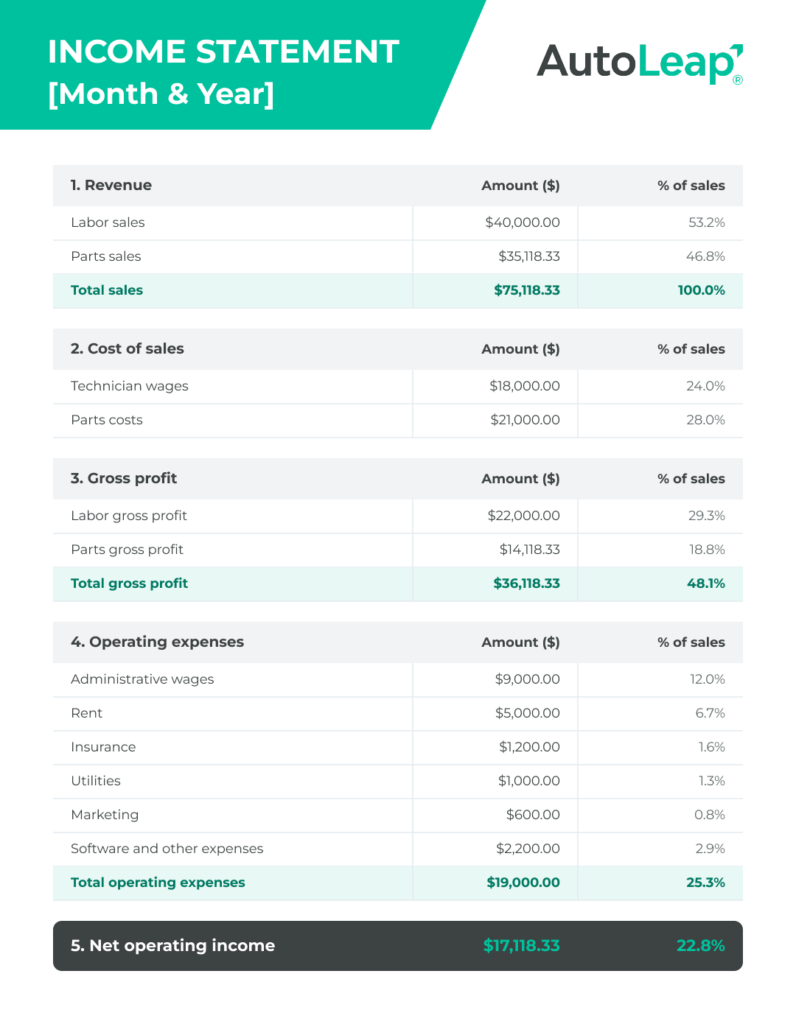
In this example, the shop generates $36,118.33 in gross profit and $17,118.33 in net operating income for the month, before interest, taxes, and any other excluded items.
Annualized sales would be approximately $901,420, close to the annual sales benchmark cited for a general repair shop by Vertical IQ. Verify the current figure and employee count against the source before publishing; the example is not intended to represent typical profit margins.
Calculate your shop’s profit margins
Use these formulas to see how much your shop earns after covering costs and expenses.
Formula | How to calculate | Result using the sample |
Gross profit | Total sales − cost of sales | $36,118.33 |
Gross margin % | Gross profit ÷ total sales × 100 | 48.1% |
Net operating income | Gross profit − operating expenses | $17,118.33 |
Net profit margin % | Net profit ÷ total sales × 100 |
Formulas source: AutoLeap’s Profit & Valuation eBook
How does your parts margin compare? In PartsTech’s 2025 survey of 752 US repair shops, the most common parts gross profit range was 51–60%. The Institute for Automotive Business Excellence recommends a 58% benchmark, and more than 63% of surveyed shops fell short. Reviewing your parts markup matrix can help you identify where pricing adjustments may improve margins.
Get the income statement template: Download the free Excel template or open the Google Sheets version to start tracking your shop’s monthly performance.
FAQs
Is an income statement the same as a profit and loss statement?
Yes, both terms refer to the same report, which summarizes income, expenses, and profit or loss over a specific period.
Do technician wages go in cost of goods sold?
Yes, wages for technicians performing repair work generally belong in cost of sales because they’re directly tied to service delivery. Advisor and office staff wages typically fall under operating expenses.
How often should an auto repair shop review its income statement?
Review it monthly and compare results with the same month last year to spot trends and changes in profitability.
Do I need an income statement for taxes?
It helps organize your figures for tax filing. US sole proprietors report business income on Schedule C, while Canadian sole proprietors use Form T2125. Corporations generally file Form 1120 or 1120-S in the US, or a T2 return in Canada.
Wrapping up
Understanding your income statement helps you track profitability, spot unnecessary costs, and make better financial decisions for your auto repair shop. Download the template above to organize your numbers and review your shop’s performance each month.