Enter your effective labor rate, your highest paid tech’s hourly pay, and your tech productivity to see the labor rate your shop needs to charge and the technician wages you can afford.
How This Labor Rate Calculator Works
Built with the Institute for Automotive Business Excellence, the math runs on one rule: your technicians should cost no more than 40% of your labor revenue.
Start with technician wages, then add a 30% load for FICA, FUTA, workers’ compensation, and paid time off, because that is what an hour of your tech really costs. Multiply the loaded cost by 2.5 and you have the effective labor rate your shop needs to charge. Why 2.5? Because the other 60% of every labor hour has to cover shop overhead and profit margin, not just payroll.
It works in reverse too. Take the effective labor rate you charge today and multiply by 40%: that is the loaded technician cost you can afford. Divide it by 1.3 and you have the unloaded wage. If your best tech wants more than that number, the rate is the problem, not the tech.
The productivity result goes one step further: loaded cost divided by (100% minus your tech productivity rate). It shows what the hour has to earn once non-productive time is priced in.
Posted Labor Rate Vs. Effective Labor Rate
Your posted labor rate is the number on the wall. Your effective labor rate is the number in your bank account: total labor revenue divided by total hours clocked, with comebacks, warranty work, and idle time between jobs included.
The two are never equal, and that’s normal. Most independent shops run an effective rate 15–20% below posted. What’s not normal is letting it slide below your break-even rate. At that point you’re losing money on labor, no matter what the invoice says.
Wondering how your posted rate compares nationally?
Divide last month’s labor dollars brought in by last month’s labor hours sold. The result blends every rate you actually charge, including discounted, warranty, and menu-priced work, into the one number that tells you what an hour of labor really earns. That is the figure this calculator asks for first.
How do I calculate billable hours for my shop?
Billable hours are the hours you invoice customers — not the hours your technicians are on the clock. Once you account for diagnostics that don’t convert, cleanup, and gaps between jobs, most shops bill 70–80% of a tech’s 40-hour week, so 28 to 32 billable hours per technician is a realistic starting point. For a multi-tech shop, add each technician’s billable hours together and enter the total.
What’s the difference between posted labor rate and effective labor rate?
Your posted rate is what customers are quoted per labor hour. Your effective labor rate is what the shop actually earns per hour of technician time once discounts, comebacks, warranty work, and idle time are factored in. The gap between the two is one of the clearest measures of how efficiently your shop turns technician hours into labor revenue.
My effective rate is lower than my posted rate. What does that mean?
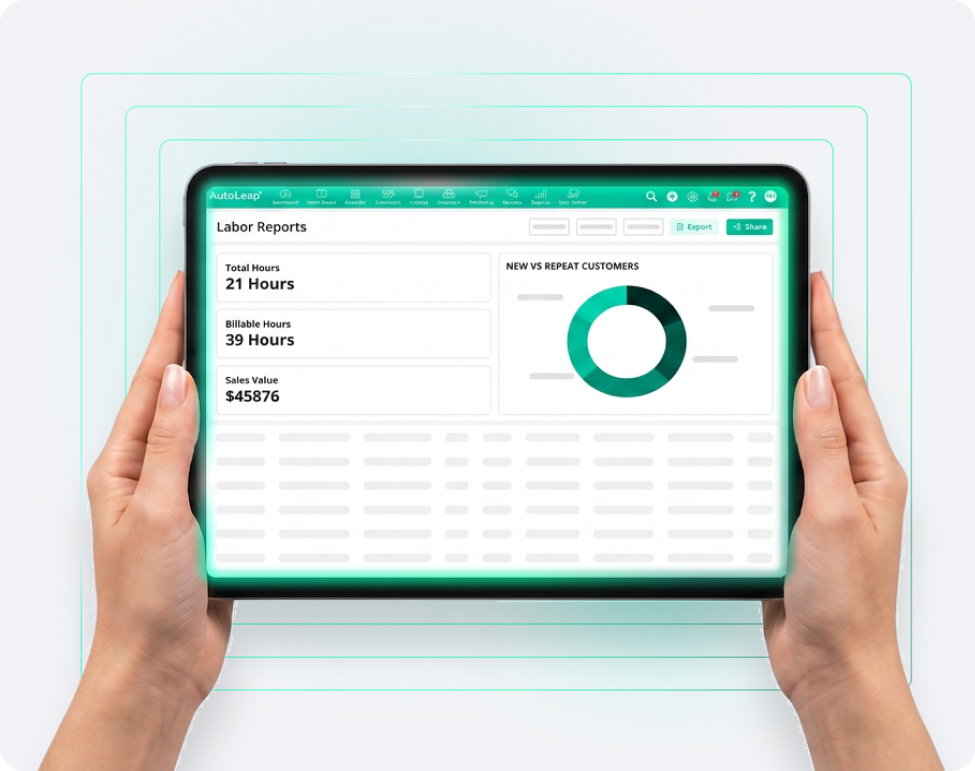
It means part of your technicians’ time isn’t producing revenue at your full rate — usually a mix of comebacks, warranty jobs, discounted tickets, and idle time between repair orders. A gap of 15–20% is typical for independent shops; a wider gap points to a scheduling, efficiency, or pricing problem worth digging into. AutoLeap’s reporting tracks your effective labor rate automatically, so you can see the gap — and what’s driving it — without pulling the numbers by hand.
Don’t Leave Just Yet!
Sign up and join hundreds of shop owners who are turbocharging their shop growth with AutoLeap.