


When a driver hears a strange noise from their brakes or watches their check engine light flicker on, their first move is almost always the same, they grab their phone and search. That search is the moment your shop either wins a customer or loses one to a competitor down the street.
Over 235,000 auto repair shops across the U.S. are competing for that exact visibility. And where you rank on Google is directly equivalent to how many phones ring in your shop each week. Unlike social media posts or billboard ads, a driver searching for “brake repair near me” is ready to book right now.
This guide covers every layer of SEO for auto repair shops in the order you should tackle it: from foundational keyword research to technical setup, content, Google Business Profile, and measurement. Whether you’re starting from zero or auditing what’s already in place, this is your full implementation roadmap.
1. What is SEO and why it matters for auto repair shops
Search engine optimization (SEO) for auto repair shops helps your shop stay visible when nearby drivers search for the services you offer. But what separates auto repair SEO from most other industries is the nature of the person doing the searching.
How search intent makes auto repair SEO different from other industries
A driver searching for “transmission repair near me” isn’t window shopping. They have a broken car, a real deadline, and immediate booking intent. No other marketing channel replicates that moment. A Facebook ad, a mailer, or a sponsored Instagram post can’t compete. Those channels interrupt people who weren’t looking for you. Search captures people who are actively trying to find you.
Understanding this difference affects how you think about SEO. For auto repair, it’s a lead generation channel with measurable, near-real-time returns. When you improve your ranking for “oil change in [your city],” more people call your shop. The relationship is that direct.
Local pack vs organic results, why shops need visibility in both
When someone searches for a repair term on Google, two distinct ranking surfaces appear.
The first is the local pack, the map, and three business listings that appear above the regular search results for location-based queries. This is prime real estate. It captures emergency and “near me” searches from drivers who are ready to call immediately.
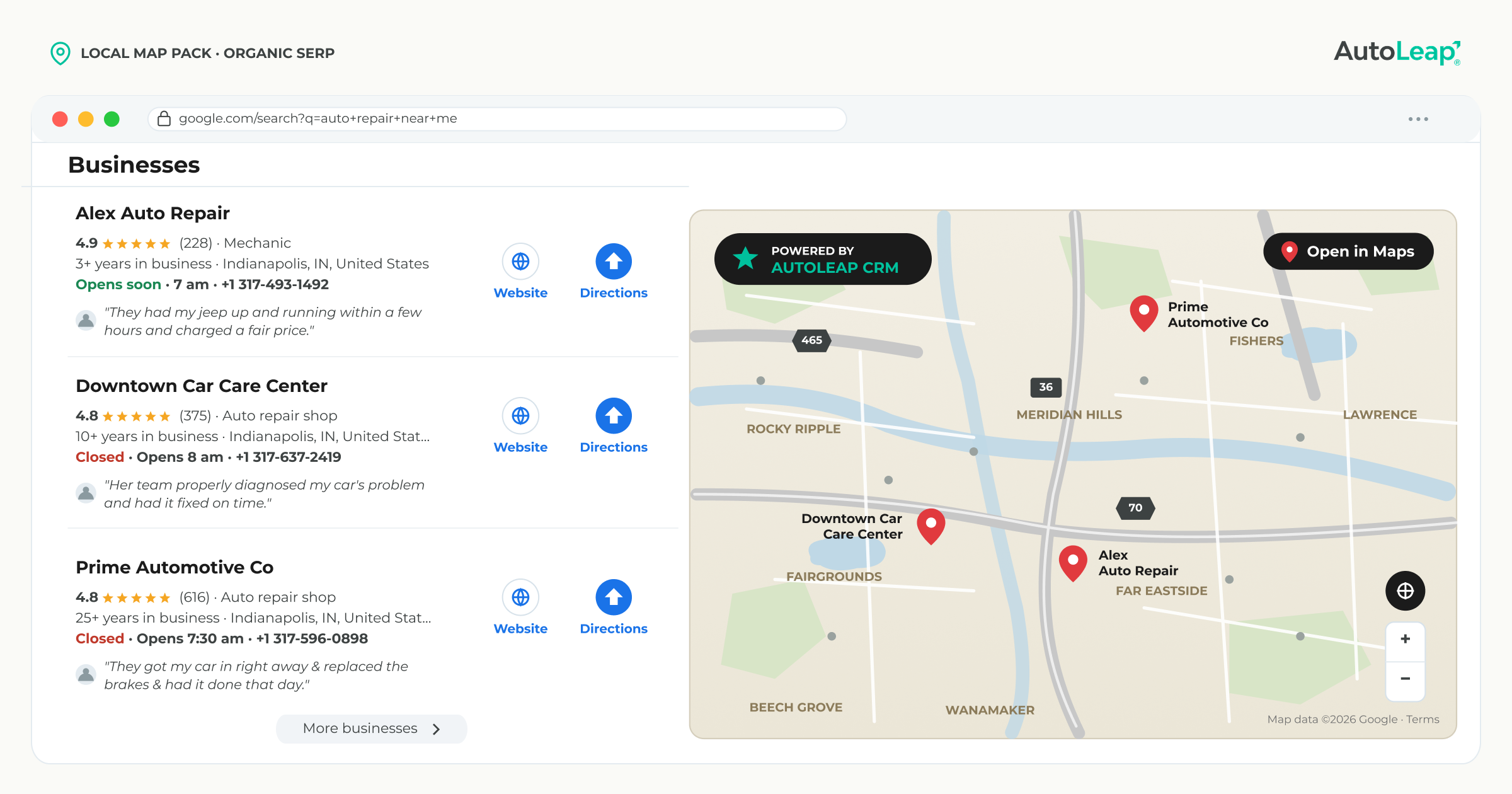
The second surface is the organic results, the traditional blue links below the map. These capture research-phase searches: drivers who searched “how much does a brake job cost” or “best transmission shop in [city]” before they’re ready to book.
A shop that only optimizes for one misses half the traffic.
- Your Google Business Profile (GBP) largely controls local pack placement.
- Your website’s service pages control organic rankings.
Both need attention, and both reinforce each other.
For example, a driver whose check engine light comes on searches “check engine light diagnostic near me.” Google serves the local pack. The driver sees three shops, reads the star ratings, and calls the top-ranked one with strong reviews. They never scroll further. That’s how local pack position translates directly into phone volume and why ranking improvements show up as booked appointments, not just impressions.
76% of people who conduct a local search on their smartphone visit a related business within 24 hours. That’s the conversion speed no other marketing channel delivers at scale.
2. Keyword research: find what local customers actually search
Build a local keyword list using service plus location modifiers.
Keyword research is where you identify the exact phrases drivers type when searching for repair services. Use those phrases to
- Shape what pages your site has
- What those pages say
- Which searches you can realistically rank for.
It’s the foundational step that everything else builds on. Get it wrong, and you’ll publish pages optimized for the wrong terms. Or rank for searches that don’t convert, and miss the queries that actually drive car count.
Every auto repair shop needs to build a keyword list across three categories:
- Location-based terms: These combine a service with your city or neighborhood: “brake repair in Columbus,” “oil change near Buckhead,” “auto repair shop in Mesa, AZ.” These are your highest converting targets because the searcher has already identified both their need and their location.
- Service-specific terms: These capture drivers in research mode who haven’t yet filtered by city: “transmission repair,” “AC recharge,” “timing belt replacement.” These are more competitive and often more national in scope, but service pages optimized with local modifiers can still rank for them within your market.
- Vehicle make terms: These serve shops that specialize in or see high volumes of specific brands: “BMW mechanic near me,” “Toyota repair shop,” “diesel truck repair [city].” These capture high-intent searches from owners who want a specialist, not a generalist.
For example, using Google Keyword Planner for a mid-sized U.S. city, “brake repair [city]” might show 320–480 monthly searches, “oil change [city]” can reach 600–900, and “transmission repair [city]” might range from 150 to 300. These are local, achievable, high-intent terms, exactly the kind that drive calls rather than clicks that bounce.
Map keywords to specific pages rather than the homepage
The most important decision in keyword research isn’t which terms you target, it’s where you assign them. The most common mistake shop owners make is trying to rank their homepage for every service. Google cannot determine which specific search the homepage is meant to satisfy when it mentions oil changes, brake jobs, transmission work, AC repair, and tire rotations all at once. So it ranks the homepage for none of them well.
The fix is keyword to page mapping. Each high-value service, plus a location keyword, gets assigned to a dedicated page.
- “Brake repair in [city]” maps to a brake repair service page.
- “Transmission shop in [city]” maps to a transmission page.
That mapping decision then determines the page’s URL, H1 heading, meta title, and body content, ensuring every signal on the page points Google toward one specific search intent.
Short, high-volume keywords like “auto repair” are worth understanding but not worth chasing. National directories like Yelp, RepairPal, and Angi dominate those terms. Your energy is better spent owning the specific service plus location terms in your market. These are terms you can actually rank for and that convert at a higher rate because the searcher’s intent is already clear.
3. On-Page SEO: optimize your website to rank for repair searches
Build a dedicated service page for each core repair
A service-specific landing page is a dedicated page on your website targeting one service and one location (e.g., “Brake Repair in Dallas, TX”). It exists because Google needs a focused, unambiguous signal to rank a page for a specific search, and a homepage listing ten services provides that signal for none of them.
Every high-revenue service your shop offers should have its own page. That means separate pages for brake repair, oil changes, transmission service, AC repair, engine diagnostics, tire services, and any other core revenue driver. If your shop serves multiple cities or neighborhoods, each service city combination is a candidate for its own page.
At a minimum, a service page that both ranks and converts needs:
- The service name and city in the H1 heading, “Brake Repair in [City, State],” are directly not buried in a paragraph
- A unique meta title that includes the service name and city, ideally under 60 characters
- At least 300 words of service, specific content, what the service involves, common symptoms that indicate the need, what the repair process looks like at your shop, and pricing context if you share it
- A tap to call button and booking link above the fold, a driver reading on mobile shouldn’t have to scroll to contact you
- At least one trust signal, an ASE certification badge, a review excerpt, a “we’ve completed 500+ brake jobs” statement, or a warranty note
On-page signals, including service-specific content and keyword relevance, remain among the top factors Google uses to determine which local pages rank for which searches. Getting this structure right on your core service pages is the highest leverage on-page investment you can make.
Title tags, meta descriptions, and headers that signal relevance
Your meta title is what appears as the clickable headline in Google search results. It’s one of the strongest on-page signals you can control. It’s also where the most common mistake happens where you have duplicate titles across multiple pages.
When your brake repair page and your transmission page both have the meta title “Auto Repair Services | [Shop Name],” Google treats them as interchangeable, and suppresses both from ranking for their individual target terms. Every service page needs a unique meta title, a unique meta description, and a unique H1.
A strong meta title format for service pages: [Service] in [City, State] | [Shop Name], “Brake Repair in Austin, TX | Rivera Auto.” This puts the target keyword at the start, includes local context, and identifies the business.
Your H1 should match or closely mirror the meta title. Use H2s and H3s to organize the page content. Symptoms sections, process explanations, and FAQ content all benefit from structured headers that tell Google what each section covers.
Internal linking to build topical authority across the site
Internal links are links from one page on your site to another. They perform two functions:
- Pass authority between pages (helping your highest-traffic pages boost your lower-traffic ones)
- Signal to Google which pages are the most important destinations on your site.
For example, you publish a blog post titled “5 Signs Your Brakes Need Replacing.” Within that post, you naturally link to your brake repair service page using anchor text like “Professional brake repair in [city].” That link tells Google two things:
- Brake repair service page is the authoritative destination for brake-related queries
- The blog post and service page share topical relevance.
Over time, as your blog builds traffic, that authority flows toward the service page and strengthens its ranking.
Every piece of content you publish should include at least one internal link to the most relevant service page it supports.
- Blog posts link to service pages.
- Service pages link to related services.
- Your homepage links to all core service pages.
Build the web intentionally, not randomly.
4. Technical SEO: the foundations most shop websites get wrong
Schema markup that helps Google and AI understand your shop
Technical SEO covers the configurations that determine whether Google can find, read and correctly categorize your pages. It’s invisible to visitors, but fundamental to everything else. Strong content and a complete Google Business Profile produce no ranking results if Google can’t crawl and index your site correctly.
Schema markup is structured data code added to your website’s HTML that explicitly tells Google (and AI systems) what your business is, where it’s located, what hours you keep, and what services you offer. Instead of inferring this information from your page text, Google reads it directly.
Every auto repair website should implement three types of schema:
- The Local Business schema on the homepage. This includes your shop’s name, address, phone number, hours, and service area. This is the foundational data layer that confirms your business identity to Google.
- AutoRepair schema on service pages. A more specific type that tells Google these pages describe automotive repair services, not just general business information. This increases relevance signals for repair-specific searches.
- FAQ schema on question and answer content. Structures your FAQ sections as machine-readable question-answer pairs. Google uses this to populate AI overviews and featured snippet boxes, increasing your visibility beyond standard organic rankings.
That last point matters more every year. As AI-generated answers appear more frequently at the top of search results, the FAQ schema gives your content a better chance of being the source those answers pull from.
Site speed and mobile performance as direct ranking factors
Google uses page speed as a direct ranking factor, and for good reason, a slow-loading page on mobile loses the customer before they even read your content. According to Google’s own research, as page load time increases from one second to three seconds, the probability of a mobile visitor bouncing increases by 32%.
For auto repair shops, where the majority of searches happen on mobile devices by drivers who need help now, a slow site is a direct revenue leak.
The most common fixable speed issues on shop websites are
- Uncompressed images (the single biggest culprit, compress every image before uploading)
- Unused CSS and JavaScript loaded by page builders or plugins
- Lack of browser caching that forces full page reloads on every visit.
Use Google’s PageSpeed Insights (free) to generate a specific list of what’s slowing your site down. Aim for a mobile score above 70. Below 50 is a meaningful competitive disadvantage.
But the mistake is to treat technical SEO as a one-time task. A few things that can go wrong:
- Site speed degrades as plugins accumulate.
- Schema can break after website updates.
- Mobile requirements shift as Google updates its criteria.
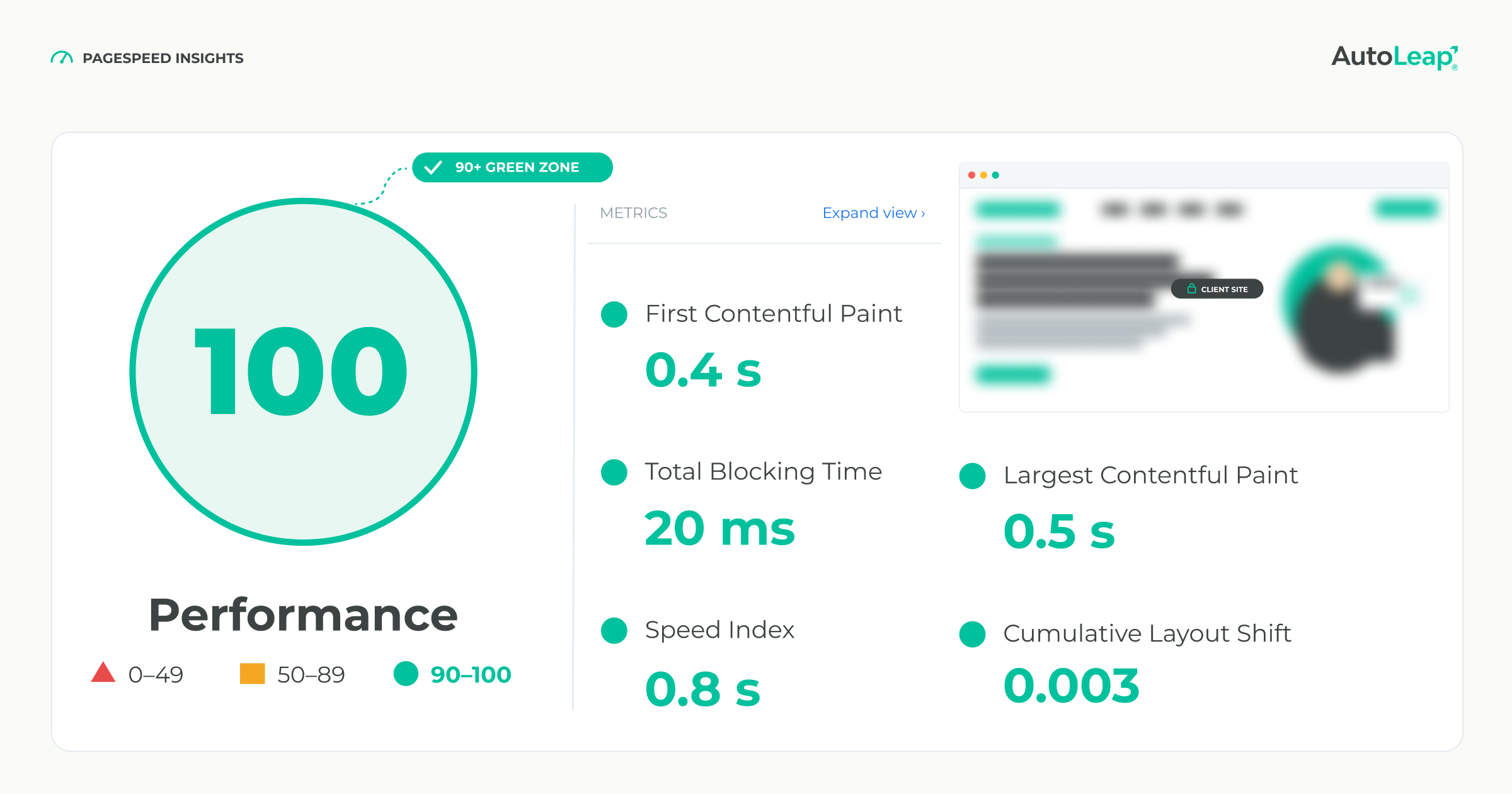
A quarterly technical check, running PageSpeed Insights, validating schema in Google’s Rich Results Test, and confirming your pages are indexed in Search Console, is the minimum cadence to protect your rankings.
5. Off-Page SEO: builds the authority and trust signals Google relies on
Local citations and NAP consistency across directories
A citation is any online mention of your shop’s Name, Address, and Phone Number (NAP). Google cross-references your NAP data across directories to verify that your business is legitimate and physically located where it claims to be. Inconsistencies, a different phone number on Yelp than on your website, or a slightly different address format on Apple Maps, reduce Google’s confidence in your business data and suppress your local rankings.
The audit comes before the build. Many shops add new directory listings while existing ones contain errors, which compounds conflicting signals rather than resolving them. Before submitting to any new directories, verify and correct your current listings on the priority platforms: Google Business Profile, Yelp, Facebook, Apple Maps, Bing Places, Yellow Pages, RepairPal, and your local Chamber of Commerce. These carry the most weight and are the most frequently referenced by Google’s local algorithm.
Once your core listings are consistent, expand to secondary directories, CarFax Service, Angi, the Better Business Bureau, and any local or regional business directories in your area.
Builds local backlinks that carry geographic authority
A backlink is a link from another website to yours. For local SEO, links from websites in your geographic area carry significantly more ranking weight than links from generic national directories. It’s because they signal to Google that your shop is a recognized, trusted presence in its specific community.
A link from your local Chamber of Commerce, a community news site covering your sponsorship, or a neighboring complementary business (a body shop, a tire retailer, or a car wash) tells Google something a link from a general business directory cannot, i.e., your shop is genuinely embedded in its local area.
Four link sources any shop owner can pursue without an agency:
- Youth sports sponsorship: sponsor a local team, and most leagues list sponsors on their website with a link.
- Chamber of Commerce membership: most Chambers maintain a member directory with links to member websites.
- Complementary local business partnerships: offer to list each other on your respective websites as “trusted partners.”
- Community event participation: local event pages often list sponsors and participants with links.
Link signals account for a meaningful portion of local organic ranking factors, with locally relevant links weighted more heavily than general inbound links. Start with the sources you can reach through existing community relationships.
Reviews as a ranking signal and conversion driver
Reviews serve two functions simultaneously:
- They influence where you rank in the local pack
- They influence whether a prospective customer calls you after finding you.
Google factors review quantity, recency, and response rate into local pack rankings. A shop with 200 reviews and steady new ones consistently outranks a comparable shop with 40 reviews that stopped growing a year ago.
The most effective review acquisition process is simple: at invoice close, send an SMS within the same hour with a direct link to your Google Business Profile review page. Research consistently shows that same-day requests produce significantly higher response rates than requests sent 48–72 hours after the visit. It’s when the experience is still fresh, and the goodwill is highest.
Responding to reviews, both positive and negative, is itself a ranking signal. A shop that replies to reviews within 24–48 hours signals to Google that the business is actively managed. Negative reviews handled professionally often convert skeptical readers into customers more effectively than a perfect rating with no context.
6. Content strategy: blogs, FAQs, and service pages that rank long-term
Choose blog topics that match real customer search behavior
Blog content and service pages serve different purposes. Service pages target high-intent searches from drivers who already know what they need. Blog posts target the research phase, the questions drivers ask before they know they have a problem or before they’ve decided who to trust with the repair.
A blog post that ranks for “How do I know if my brakes need replacing?” captures a driver who isn’t yet searching “brake repair near me,” but will be. When that post leads them to your brake repair service page, your shop has built a relationship before the customer even made the call.
There’s a simple content planning method. Write down the 10 questions customers ask most often at check-in. “What causes a check engine light to come on?” “How long do brake pads actually last?” “Is it safe to drive with a slow oil leak?” Each of those is a blog post, and each should be titled using the exact phrasing a driver would type into Google. It’s not industry language, but customer language.
Service area pages capture the surrounding neighborhood traffic
A service area page is a dedicated page targeting a city or neighborhood that your shop serves but isn’t physically located in. If your shop is in the center of a metro area, drivers from surrounding suburbs may be willing to travel 5–10 miles for a trusted shop, but they’re searching for “[service] in [their neighborhood],” not your city.
A service area page captures those searches. Each service area page needs
- The target city name and a core service in the H1
- A paragraph acknowledging that you serve customers from that area
- Your shop’s address
- The approximate distance
- Local context that makes the page feel written for that community (not copy-pasted)
- A clear booking CTA.
These pages are also relevant if your shop specializes in certain services. So, if tire services are a major revenue driver, the same SEO principles apply to your service area expansion strategy as well.
FAQ content that appears in AI search answers and featured snippets
Google’s AI Overviews and featured snippets increasingly pull answers directly from structured FAQ content. The format that performs: an H3 heading phrased as a question, followed immediately by a direct, concise answer in the first sentence, with supporting detail in the following sentences.
For example, write in an H3 heading:
How long do brake pads last?
Answer in normal text: Brake pads typically last 30,000 to 70,000 miles, depending on driving habits, vehicle type, and pad quality. City driving with frequent stops wears pads faster than highway miles. Your mechanic can measure pad thickness during any service visit and let you know how much life remains.
That format, direct answer first, context second, is what Google’s systems extract for AI-generated answers and featured snippet boxes. Structure your FAQ pages and blog posts this way throughout, and you increase your chances of appearing in those premium positions at the top of results pages.
But, publishing blog posts and FAQ pages without internal links back to the relevant service pages kills content ROI. A post about brake warning signs that never links to your brake repair page drives traffic that reads and leaves. Every blog post should end with a clear link and CTA pointing to the service page most relevant to its content.
7. Google Business Profile: optimize the asset that controls local pack rankings
Complete your profile at a service-specific level
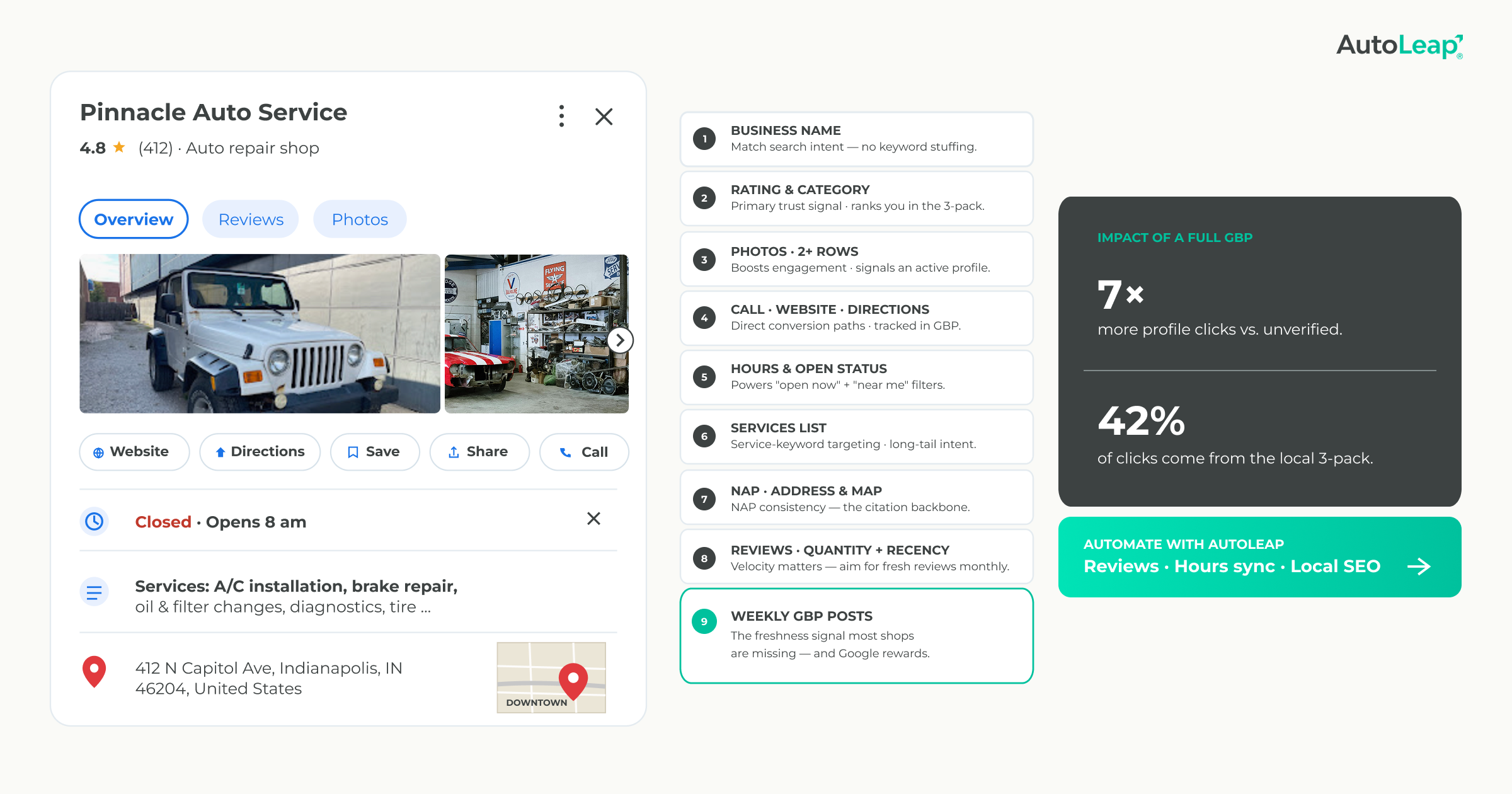
Your Google Business Profile is the most direct lever you have for local pack placement, the map, and three listings that appear above organic results for location-based searches. Most high-intent repair searches, “brake shop near me” or “check engine light diagnostic open now,” result in a call from the local pack, not from a scroll through organic results.
Profile completion needs to go beyond basic accuracy. Every field is a ranking input.
Service level completion means selecting Auto Repair Shop as your primary category (not just “Automotive”).
- Add relevant secondary categories based on your actual service mix (brake shop, oil change service, transmission shop).
- Add individual service listings with names and descriptions, not just a generic “auto repair” entry.
- Upload a minimum of five current photos, exterior, interior, staff at work, and completed jobs, and ensure your name, address, and phone number match your website character for character.
If your website says “123 Main Street” and your GBP says “123 Main St.,” that’s a discrepancy Google registers. Exact match, across every platform, is the standard.
According to Google’s own research, businesses with complete GBP profiles receive significantly more direction requests and website clicks (7x more) than those with incomplete profiles.
Maintain weekly activity to hold the local pack position
Google treats GBP activity as a proxy for business health. A profile that was set up once and left static signals to Google that the business may be less active, less engaged, or less current than competitors who update theirs regularly. Weekly maintenance is what separates shops that hold local pack positions from those that slowly slide out of the top three.
The minimum weekly activity cadence:
- Respond to new reviews within 48 hours, both positive and negative
- Answer any new Q&A questions, and proactively add your own questions and answers for the most common ones you receive by phone
- Upload new photos at least monthly, fresh visuals signal ongoing business activity
- Publish at least one post per week, announcements, seasonal services, or educational tips
A profile left dormant for 60–90 days reliably loses local pack position to competitors who maintain consistent activity. This is about signaling to Google exactly what a wellrun, customer-engaged business looks like.
Use posts and Q&A to capture high-intent searches
GBP Posts are short updates that appear directly on your profile in search results. Most shops either ignore them or publish them reactively. The shops that use them strategically publish posts 4–6 weeks before a seasonal demand peak, and those posts consistently outperform those published after demand has already begun.
An April post about AC recharge availability, published before summer heat hits, captures searches from drivers thinking about cooling before they experience a problem. A November post about winter tire or battery services reaches drivers before their first cold morning. Timing matters.
The Q&A section of your profile is an underused opportunity. Anyone can ask, and answer, questions on your GBP. Proactively add the 10 most common questions you receive by phone, with clear, direct answers. This content appears in your profile for every searcher, serves as an FAQ schema for AI search, and reduces the friction between a first impression and a booked appointment.
8. Measure SEO: confirm your efforts are producing booked appointments
The KPIs that connect SEO activity to revenue
SEO measurement for an auto repair shop confirms that ranking improvements are producing calls, direction requests, and filled bays. Shops that skip measurement continue funding tactics that aren’t producing car count while underinvesting in the ones that are.
According to Google’s research, 28% of local searches result in a purchase. That conversion rate is why GBP call clicks are the most direct available proxy for SEO to revenue attribution. Each click represents a driver who found your shop in search and chose to call.
Track these KPIs, organized by source:
From GBP Insights:
- Monthly call clicks (drivers who tapped “Call” from your profile)
- Monthly direction requests (drivers navigating to your shop)
- Profile views and search impressions (leading indicators of visibility growth)
From Google Search Console (free, verify your site if you haven’t):
- Which queries are generating impressions for each service page
- Click-through rate by query, low CTR on high-impression queries means your title tags or meta descriptions need work
- Average ranking position by page
From Google Analytics:
- Organic traffic by landing page, whose service pages are generating sessions
- Conversion events, phone link clicks, booking form submissions, and direction clicks by page
A monthly review cadence that keeps rankings moving
We recommend a monthly SEO review. It doesn’t have to be an all-day project. Just thirty minutes, once a month, covering three things:
- GBP call and direction trends: Are call clicks growing month over month? If not, check post frequency, photo recency, and review response time, these are the most common activity signals that drop when profile maintenance lapses.
- Search Console position changes: Which service page queries are gaining or losing ranking position? Queries gaining impressions but not clicks need title tag and meta description improvements. Queries gaining clicks but not producing conversions need landing pages or booking flow work.
- Organic traffic by page: Which pages are growing in organic sessions? Pages that are gaining traffic but show no conversion events (phone clicks or form submissions) need a stronger CTA or a cleaner booking path.
The simple decision rule: ranking position alone is not the success metric. A shop ranking fourth for “brake repair [city]” with 40 monthly GBP call clicks is generating measurable revenue. A shop ranking second with five call clicks has a conversion problem, not a ranking problem. Measure business outcomes, then work backward to the SEO inputs that drive them.
Implementing all eight of these SEO layers consistently, while running daily shop operations, managing staff, and serving customers, requires sustained time and real expertise. If you’d rather have a proven system running in the background than add another operational responsibility, AutoLeap’s digital marketing services are built specifically for independent auto repair shops. It’s a logical next step for owners who want compound SEO results without taking on the execution themselves.