







Picking the wrong repair manual isn’t a minor inconvenience. It produces comebacks, misdiagnoses, and, in EV or ADAS work, real liability. This guide reviews the six most-used manual sources on the market today, then breaks down how to choose the right one (or combination) for your specific shop type.
At a Glance: Best Auto Repair Manuals Compared
| Manual / Platform | Best For | OEM Accuracy | EV/ADAS Support | Updates | Price Range |
|---|---|---|---|---|---|
| Factory Service Manuals (FSM) | Precision on safety-critical jobs | Highest | Full | Real-time | ~$25–$50/day or annual, per make |
| Chilton Repair Manuals | Budget multi-make domestic coverage | Moderate | Limited to post-2020 vehicles | Static editions | $100–$180/month subscription |
| Haynes Repair Manuals | DIY-style visual step-throughs | Moderate | Limited to post-2020 vehicles | Static editions | $100–$180/month subscription |
| ALLDATAdiy | Solo techs, single-vehicle depth | High (unedited OEM) | Limited | Regular | ~$30–$45/year per vehicle |
| MOTOR Manuals | Spec, labor, and emissions reference | High | Partial (spec-focused) | Regular | Varies by title, print or electronic |
| Mitchell 1 ProDemand | Full-service independent shops | High (aggregated OEM) | Full | Real-time | Premium tier, quote-based |
1. The Best Auto Repair Manuals Reviewed
Factory Service Manuals (FSM)
A Factory Service Manual is produced directly by the vehicle manufacturer and contains everything that manufacturer certified the vehicle against, the closest thing to a ground truth reference that exists for a given make.
Pros:
- Exact OEM torque specifications and multi-stage torque sequences
- Complete circuit-level wiring diagrams
- TSB references tied to specific model years
- Repair sequences tested against real manufacturer failure data
Cons:
- Single-make coverage only. A multi-make shop needs several subscriptions or day-passes to stay covered
- Written for professionals, with little procedural hand-holding for less experienced technicians
- Cost per vehicle adds up quickly across a mixed bay
Chilton Repair Manuals
Chilton covers a broad range of domestic and import makes and model years under a single subscription, aimed squarely at shops that can’t justify per-make OEM portal costs.
Pros:
- Wide multi-make, multi-year coverage under one subscription
- Strong for routine, high-volume jobs, brakes, suspension, and fluid services
- Lower cost than stacking multiple OEM portals
Cons:
- Torque specs and procedures are approximated, not manufacturer-issued
- Static editions, no mid-cycle updates for TSBs or design revisions
- Thin EV/ADAS coverage on recent model years
Haynes Repair Manuals
Haynes covers similar ground to Chilton but leans harder into visual, step-by-step disassembly guidance, which makes it a common pairing with an OEM source on complex jobs.
Pros:
- Heavier use of photos and illustrations than Chilton for disassembly steps
- Simplified procedural language that’s easier for newer technicians to follow
- Broad multi-make coverage at a comparable price point
Cons:
- Same accuracy trade-off as Chilton, specs are approximated, not factory-issued
- Static publication cycle, so recent TSBs and revisions are missed
- Limited depth on EV/ADAS procedures
ALLDATAdiy
ALLDATAdiy licenses unedited, factory-sourced repair data on a per-vehicle basis rather than a shop-wide subscription. It’s built for the serious DIYer or solo enthusiast working on a small, known set of vehicles, not a shop servicing a rotating mix of customer cars.
Pros:
- Unedited data pulled directly from OEM sources, not rewritten or condensed
- Covers wiring diagrams, TSBs, recalls, and DTCs for the specific vehicle purchased
- Genuinely low cost per vehicle (roughly $30–$45/year) compared to a full OEM portal subscription
Cons:
- Per-vehicle licensing doesn’t scale, a shop seeing a different car every day would need a new subscription for nearly every job
- No integrated labor guide or estimating tools, so it doesn’t replace a shop’s quoting workflow
- Built for single-vehicle depth, not the fast multi-make search a busy bay needs
MOTOR Manuals
MOTOR is less a single platform than a library of specialized reference titles, specification guides, labor guides, wiring diagram sets, and emissions manuals, sold individually in print or electronic form. Its specification and brake guides in particular are treated as an industry standard reference.
Pros:
- MOTOR’s Specification Guide and Brake Specifications Guide are widely regarded as the go-to quick-reference standard nationwide
- Multi-year, multi-make coverage across domestic and import vehicles in each title
- Available in both print and electronic formats, depending on shop’s preference
Cons:
- Modular structure, a shop typically needs to purchase several separate titles (specs, labor, wiring) rather than getting a unified search
- Less real-time than a cloud-based platform; updates follow each title’s own publication cycle
- Not built around EV/ADAS diagnostic workflows the way newer platforms are
Mitchell 1 ProDemand
ProDemand aggregates OEM-sourced repair data across nearly every domestic and import make, layered with SureTrack, a database of technician-confirmed “Real Fix” solutions, plus integrated labor times and parts pricing in a single lookup. It competes at the professional tier alongside platforms like ALLDATApro.
Pros:
- OEM repair and service information spanning 1960–2025+ across nearly all makes and models
- SureTrack Real Fixes add crowd-verified diagnostic solutions on top of factory data
- Labor times, OEM parts pricing, and parts diagrams shown on a single page for faster estimating
- Interactive, color-coded wiring diagrams with a dedicated ADAS quick-link for calibration data
Cons:
- Priced at a premium monthly subscription, higher than Chilton or Haynes, quote-based rather than published
- Cloud-based only, so it depends on a stable internet connection at the bay
- Card-based 1Search Plus interface has a learning curve for technicians new to the platform
Best Manual for Your Shop Type
2. How to Choose the Right Manual for Your Shop Type
“Best” means nothing without context. The best manual source for a two-bay independent shop doing mostly domestic oil changes and brakes is genuinely different from the best source for a six-bay European specialist handling BMWs and Porsches.
What makes a manual source the right choice comes down to five criteria:
- Coverage breadth across the makes you actually service
- OEM data accuracy on the jobs where precision matters
- Update frequency for TSBs and mid-cycle technical changes
- EV and ADAS support
- Total cost against what you’ll recover in reduced comebacks and diagnostic time
Best manual sources for general independent repair shops
A general independent shop servicing primarily domestic vehicles, Ford, GM, Chevrolet, Dodge, should prioritize a premium digital platform that aggregates factory-level data across those makes, combined with OEM portal access for the two or three highest-volume makes in the bay. The platform gives you breadth; the OEM portals give you precision where a torque error costs you.
Priority criteria for this shop type:
- Domestic coverage depth across the model years you actually service
- Integrated labor time accuracy so service writers can quote with confidence
- Search speed on the floor, a technician shouldn’t have to stop a job to locate specs
If your shop runs more than eight domestic makes through the bays weekly and OEM portal costs per make exceed your per-vehicle margin on diagnostics, a premium aggregated platform covers the gap and pays back within 60 to 90 days on diagnostic time savings alone. For this profile, Mitchell 1 ProDemand is the platform to prioritize.
Best options for shops specializing in European, Asian, or diesel vehicles
Import specialists need OEM-level data for specific makes that many general platforms cover incompletely. European makes in particular, BMW, Mercedes-Benz, and Audi, have proprietary diagnostic protocols, manufacturer-specific TSB distribution, and torque specifications that aftermarket editions frequently approximate rather than replicate.
A shop running primarily European imports should prioritize the following:
- Direct OEM portal access for the top three makes by volume, or
- A premium platform that publicly documents the source and update frequency of its import data, not just lists the make as “covered”
Asian makers and diesel-heavy shops face the same dynamic. The shop’s most-serviced makes should have verifiable factory-data coverage in whatever platform is selected, not general coverage that quietly excludes the model years most frequently in the bay.
If your top three makes by volume lack verifiable factory-data coverage in a platform’s live database, not its marketing page, the subscription is not covering your actual work. Prioritize direct OEM portal access for your top makes before evaluating any aggregated platform.
Best platforms for shops adding EV and hybrid service capability
This is where platform selection becomes a safety decision. Any shop adding EV or plug-in hybrid service capability needs a manual source that carries confirmed high-voltage safety procedures specific to the makes the shop will service. “Confirmed” means the platform publicly documents that its EV procedures come from manufacturer sources and specifies the update frequency for those procedures.
Before committing to any platform for EV service, run this two-step verification:
- Pull your shop’s top 20 vehicle makes from the CRM and test each against the platform’s live coverage database, not the marketing page
- Confirm that EV and ADAS procedures are explicitly documented for the makes you’re adding, with a stated update cadence
We have often seen shop owners select a manual based on pricing alone without checking the specific makes and models the shop is actually servicing. A subscription that doesn’t cover your vehicle mix produces no return regardless of how comprehensive it looks in the brochure.
If a platform cannot confirm in writing that its high-voltage procedures for your specific makes are sourced from OEM documentation and updated on a stated cadence, it is not an adequate reference for EV service. The direct OEM portal for each make you service remains the only dependable source here, no aggregated platform fully replaces it yet.
3. OEM vs. Aftermarket Manuals: What’s Actually Different
What factory service manuals contain that aftermarket editions do not
A Factory Service Manual (FSM) is produced by the vehicle manufacturer and contains everything the manufacturer certified the vehicle against. It has:
- Exact OEM torque specifications and multi-stage torque sequences
- Complete wiring diagrams, including circuit-level detail
- Technical Service Bulletin (TSB) references tied to specific model years
- Diagnostic trouble code definitions with manufacturer-documented resolution paths
- Model-specific repair sequences tested against real failure data
When an FSM specifies a four-stage torque sequence on a head bolt installation, that sequence exists because the manufacturer ran failure rate tests across hundreds of engines. Deviating from it is a liability. For shops servicing newer vehicles where precision directly affects safety system performance, the FSM is the authoritative source. There is no functional equivalent.
When aftermarket manuals are the practical and cost-effective choice
Aftermarket manuals, Chilton, Haynes, and similar publications cover a broader range of makes and model years under a single subscription or purchase. That breadth is their primary advantage. A shop running 15 different domestic makes through its bays every week cannot practically subscribe to 15 separate OEM portals.
Where aftermarket manuals earn their place:
- Routine, high-volume jobs, brake replacements, suspension work, and fluid services on pre-2018 vehicles
- Multi-make general shops, where OEM portal costs per vehicle make the math impractical
- Less experienced technicians who benefit from simplified procedural language and stronger visual disassembly coverage
The common mistake is rigidity in either direction: dismissing aftermarket manuals as insufficiently precise, or assuming one OEM portal covers your complete vehicle mix. Neither is true.
The practical evaluation: pull your shop’s top 10 vehicle makes from your CRM, check whether each has full OEM portal coverage at a reasonable per-vehicle cost, and use aftermarket resources to fill the gaps.
The cost of ignoring this is measurable. Industry data consistently puts the average comeback rate at independent shops between 5% and 8% of all repair orders. Following documented OEM repair procedures is central to eliminating that figure. It is a direct gain to the shop’s bottom line, since comeback labor is unpaid labor. Shops that have formalized OEM specification use as a documented step in their workflow see the most consistent improvement.
PRO TIP
How to Combine OEM + Aftermarket on a Complex Job

Pull the OEM portal for exact torque sequences and specifications.

Use the aftermarket manual’s disassembly walkthrough to verify your procedure sequence before starting.

OEM supplies the numbers; aftermarket supplies the procedural clarity. Use both on the same job.
4. Digital vs. Print: What Works Better on the Shop Floor
How searchability and update frequency affect diagnostic speed
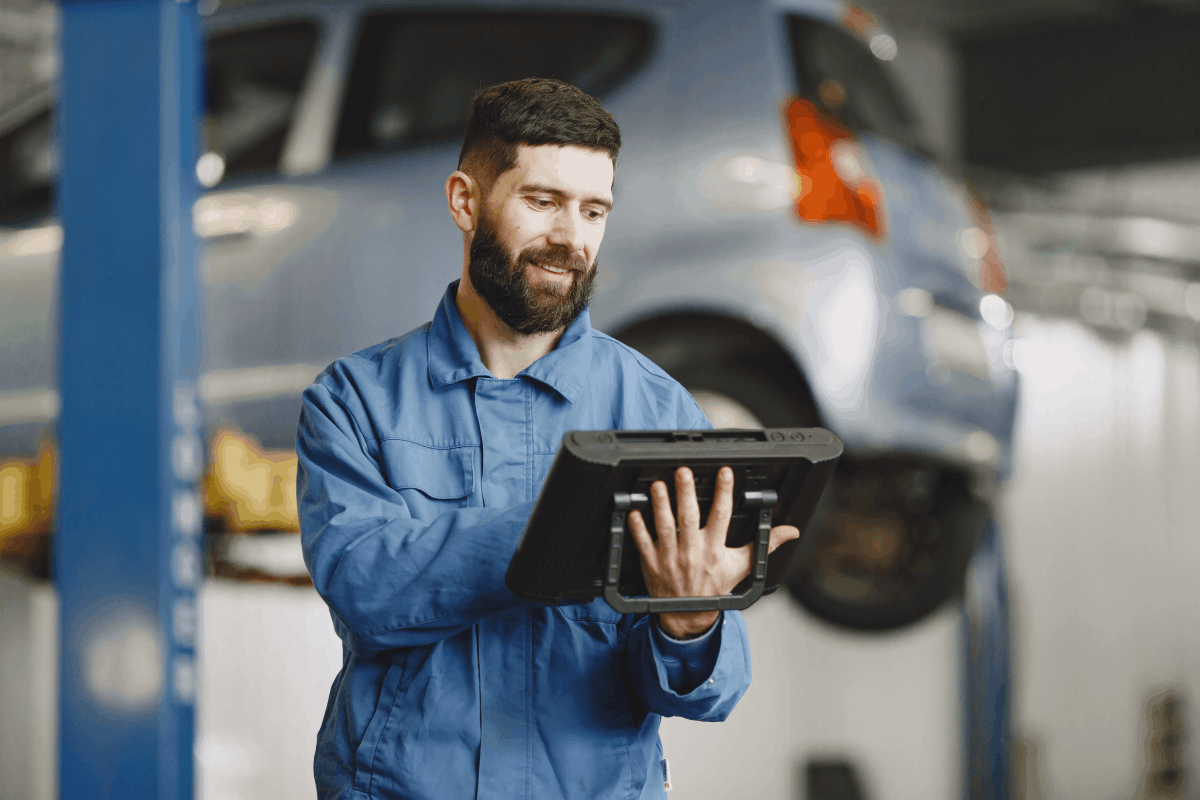
A cloud-based repair database does something a printed manual structurally cannot. It updates. When a manufacturer issues a TSB revising the diagnostic sequence for a sensor fault that’s been producing misdiagnoses for six months, a digital platform incorporates that update. A print edition published two years ago doesn’t.
The shift toward digital is already the industry norm. More than 68% of independent garages and auto service providers have implemented some form of digital repair management software. And 71% of U.S. shops use digital invoicing and service management tools as part of their documentation workflow. The remaining shops running on print-primary workflows are operating with a structural disadvantage on anything built after 2018.
| Digital Platforms | Print Manuals |
|---|---|
| Updated in real-time | Static at publication date |
| Searchable by keyword or DTC | Index-based navigation only |
| Includes EV/ADAS procedures | Limited post-2018 coverage |
| Requires internet connection | Offline by default |
| $150–$300/month | $100–$180/month or free via library |
For electrical faults, sensor-driven codes, and software-controlled systems, a static print edition isn’t a complete reference. These represent an increasing proportion of diagnostic work on post-2015 vehicles. The static print edition is a starting point that may lead a technician to a repair the manufacturer has already documented as incorrect.
Searchability compounds this. Compare the same diagnostic task side by side:
- Digital platform: Search by circuit name, component, or DTC → relevant wiring diagram in under a minute
- Printed manual: Trace page references through an index → locate the wiring section → manually scan for the relevant circuit across multiple pages
On a single job, that’s a minor inconvenience. Across a shop doing 40 electrical-adjacent repairs per month, that navigation difference adds up to approximately 8 to 12 minutes per job, roughly five to eight additional labor hours per month spent locating information rather than completing repairs. At standard labor rates, that gap erases a meaningful portion of any annual platform subscription cost.
Use interactive wiring diagrams and color-coded visual aids effectively
Interactive wiring diagrams are the single most practical advantage digital platforms provide over print for electrical and sensor diagnostics. Search by component, type in the ABS wheel speed sensor for the left rear, and the diagram highlights:
- That specific circuit
- Its ground reference
- Its connector location
- Every component that shares a path with it
A technician on a tablet at the vehicle can trace a ground circuit, identify the splice point, and locate the connector without walking back to a workstation or flipping through a binder. The color coding eliminates the ambiguity of black-and-white print circuits, where distinguishing a chassis ground from a signal return requires context that the diagram doesn’t always provide clearly.
One practical tip: search by the symptom or the component, not the system. “Left rear ABS” gets you to the relevant circuit faster than navigating through the ABS section looking for the right page. Most platforms also let technicians bookmark frequently used diagrams. On high-volume job types, this eliminates redundant navigation on every repeat visit.
When print manuals remain the practical choice for specific shop situations
Print still earns its place in specific scenarios:
- Poor connectivity: Rural locations or older facilities where an offline reference is required
- Pre-1990 vehicles: Digital platform coverage is sparse or absent for older inventory
- Quick-reference lookups: Routine jobs your shop runs daily where specs are already familiar to the team
Don’t keep a printed manual as the primary reference for any vehicle manufactured after 2018. Mid-cycle software updates, sensor calibration revisions, and revised diagnostic sequences make a static print edition unreliable for anything beyond basic mechanical work at that point.
The transition to a digital-primary workflow is straightforward for most shops: identify which staff roles need platform access, complete onboarding with the full team, and run both formats simultaneously for the first month while technicians build database fluency. Print stays as the offline backup; digital becomes the working reference.
5. EV, ADAS, and Emerging Vehicle Technologies

Before Starting Any EV Bay Work
Standard ICE pre-service steps do not isolate the high-voltage system on a battery electric vehicle.
This section covers the documentation your shop needs before any EV service begins.
Finding accurate high-voltage safety procedures for EV service
High-voltage safety documentation is not optional for EV service. A battery electric vehicle at rest can carry 400 to 800 volts through components that a technician may handle during a routine inspection. The conventional ICE pre-service checklist doesn’t address this:
- It doesn’t isolate the high-voltage system
- It doesn’t confirm that the service disconnect has been engaged
- It doesn’t verify that the inverter capacitors have discharged
OEM-High-Voltage Shutdown Sequence

Locate and engage the service disconnect plug (position and access method vary by make)

Wait for the manufacturer-specified discharge time for inverter capacitors

Test with a high-voltage meter to confirm isolation

Proceed only after verification is documented
Every step prevents a specific hazard. Skipping any one of them introduces a risk that the remaining steps don’t compensate for.
Shops that apply conventional ICE pre-service steps to a BEV are working around stored electrical energy with no documentation that it’s been safely isolated. That’s not a procedural shortcut; it’s an unmanaged liability.
The volume direction is not a distant forecast. According to the Auto Care Association and MEMA Aftermarket Suppliers’ Joint EV Trends report, BEV sales are projected to account for 35% of all U.S. light vehicle sales by 2030. And EVs will make up approximately 10% of total vehicles in operation by that same year, growing to nearly half of all vehicles on the road by 2045. A separate 2025 PartsTech industry survey found that 25% of independent shops currently do not service EVs at all, and 70% report EVs make up 10% or less of their annual car count. That gap between fleet growth and shop readiness is where liability concentrates. Shops that establish documented high-voltage procedures now are not preparing for a distant scenario, they are closing a gap that already exists in their bay.
Access ADAS calibration specifications and sensor replacement procedures
ADAS calibration documentation specifies the exact positioning tolerances, target distances, and post-repair verification sequences required to confirm that a replaced or displaced sensor is operating within the manufacturer’s certified parameters.
| Service event | ADAS recalibration required? |
|---|---|
| Camera or radar sensor replacement | Yes |
| Windshield replacement (forward-facing camera vehicles) | Yes |
| Suspension work altering ride height | Yes |
| Front-end collision repair | Yes |
| Routine fluid service or oil change | No |
| Brake replacement (no suspension involvement) | No |
The stakes here are precise. A forward-facing camera positioned two millimeters outside the target envelope may pass a test drive and fail to detect a pedestrian at the reaction distance the system was certified to cover. The shop that performed the replacement owns that result.
SEMA’s advocacy filings on the federal REPAIR Act note explicitly that access to ADAS recalibration information is one of the critical gaps independent shops face. This means the liability isn’t just technical, it’s structural. Without confirmed OEM-sourced calibration documentation, a shop performing ADAS-adjacent work cannot demonstrate it followed a verified procedure if a post-repair incident occurs. That documentation gap is the liability.
Don’t assume a general aftermarket manual covering a vehicle’s make and year includes current ADAS procedures; most don’t. Aftermarket editions are written at the publication date and don’t receive mid-cycle updates for system changes.
For any ADAS calibration work, the only adequate reference is either direct OEM portal access or a digital platform that publicly documents its update cadence for safety-critical procedures on that specific make. If the platform’s documentation doesn’t specify how frequently ADAS procedures are updated, that’s your answer.
6. Putting Manual Data to Work in Your Shop
Standardize bay procedures from repair manual specifications
An auto repair shop operations manual converts external repair data from manufacturer portals, aftermarket manuals, and digital platforms into shop-specific standardized procedures calibrated to your workflow, your technician levels, and your equipment. The external source gives you the specifications; the operations manual converts those specifications into the exact steps your team follows on your bays with your tools. The result: repair quality becomes a function of documented procedure, not the individual technician’s memory or availability on a given day.
Here’s what that looks like in practice for a front brake replacement on your most commonly serviced vehicle:
- Extract caliper bracket bolt torque, caliper slide pin torque, and lug nut sequence from the factory service manual
- Build those values directly into a shop checklist that attaches to the work order every time that job type is dispatched
- Add mandatory checkpoints, rotor thickness measurement, brake fluid condition, parking brake verification, as documented steps, not verbal reminders
- Service advisors now have accurate language to explain the job to customers directly from the work order
The operational impact of documented procedures is measurable at the shop level. Shops that track first-time fix rate, the percentage of repairs completed correctly without a return visit, consistently report that this metric improves when repair data is attached to the work order at dispatch rather than retrieved by the technician during the job. An industry benchmark from shop management data puts top-performing shops at around 85% first-time fix rates. At a shop doing 150 repair orders per month, that difference is around 22 additional comebacks per month, each one absorbing unpaid labor and a bay slot that could have been revenue.
Link repair data directly to digital work orders and job tickets
When repair procedure references are attached directly to digital work orders, two things change immediately:
- For technicians: Job-specific data arrives at the moment the job is dispatched, not after navigating the manual database and confirming the model year match. That navigation takes time on every single job.
- For service advisors: They gain access to the documented steps the technician is following, which gives them accurate language to explain the repair to a customer without interrupting anyone at a bay.
The problem this replaces is what shops sometimes call tribal knowledge, repair procedures that live in the memory of the senior technician who’s been doing the job for 12 years and passes it on verbally to whoever is nearby. Verbal instruction isn’t consistent, isn’t documented, and disappears when that technician is on a different bay, on vacation, or has left the shop. Converting that knowledge into a documented procedure and attaching it to the job management system makes it available at the point of work without depending on another person’s time.
For shops looking to connect repair data to job management operationally, auto repair shop management software is the tool that makes work order integration function as a real-time system rather than a documentation exercise.
Build quick-reference guides for entry-level and lube technicians
A shop-specific mechanic handbook is not a copy of the repair manual; it’s a curated extraction of the sections most relevant to a technician’s role level.
For a lube tech, that typically means:
- Fluid specifications for every vehicle type the shop services
- Tire torque values and filter cross-references
- Documentation standards for recording service on the work order
For an entry-level technician doing their first brake jobs, it means:
- Pre-filled torque tables for the most common vehicles in the bay
- The shop’s inspection checklist for brake components
- A step-by-step guide to navigating the digital repair database for unfamiliar vehicles
The handbook’s purpose is to reduce the time a new hire spends searching for information they need on every job, before they’ve built the database fluency that experienced technicians take for granted.
A quick-reference guide is the shorter version: typically covering the 10–15 most common job types the shop performs with pre-filled specifications and checklist steps, designed to stay at the bay for immediate access. The full handbook covers the complete range of procedures and serves as the authoritative internal reference for less routine jobs.
Both should be version-controlled so that TSB revisions and equipment changes propagate across all copies rather than existing only in the memory of whoever made the update.
Create a continuous learning structure around digital manual access
The most common new-hire mistake isn’t technical; it’s navigational. Most digital repair databases have non-intuitive search interfaces for first-time users. A technician who can’t locate the correct information quickly doesn’t keep searching; they ask a senior colleague or guess. Either outcome defeats the purpose of the platform subscription and recreates the verbal-instruction dependency the handbook was designed to eliminate.
Onboarding a New Tech to Your Repair Platform

Step 1
Sit with them at the platform before the job starts, not during.

Step 2
Locate the correct procedure section for their first job together.

Step 3
Confirm the model year match and check for a relevant TSB.

Step 4
Locate and attach torque specs to the work order before the job begins.

Step 5
Technician performs the job with all information already located and confirmed.
Done consistently across the first 30 days for each new job type encountered, this produces a technician who navigates the database independently, rather than requiring hand-holding on every unfamiliar vehicle. A three-session onboarding sequence covering platform navigation basics, common search patterns for the shop’s top job types, and TSB cross-referencing makes database fluency a trained and tested skill rather than something that develops on its own.
The business case for structured onboarding is concrete. According to the Auto Care Association, the automotive industry is facing a sustained technician shortage, with demand for qualified technicians outpacing available labor every year since 2009. Shops that reduce the time it takes a new hire to work independently directly reduce their exposure to that shortage. Informal verbal onboarding, where a new tech shadows a senior colleague until they “figure it out,” typically extends the supervised period to 60 days or more on unfamiliar vehicle types. A structured three-session program covering platform navigation, common search patterns, and TSB cross-referencing compresses that to 30 days or fewer, freeing senior technicians to stay on billable work rather than hand-holding. That time recovery is the ROI on the handbook investment.
For shops building this operational structure from the ground up, head here for the full sequence.
Wrapping up
Applying repair manual data consistently, across every technician, every job type, every work order, and every training session, is straightforward in principle and genuinely challenging as a shop grows. The procedures exist in the manuals. The challenge is connecting them to the daily workflow, so they’re available at the right moment without adding friction. Shops that are ready to operationalize these strategies by connecting repair data directly to job management can explore auto repair shop management software as the next step. That’s where the documentation work in this guide becomes a live system rather than a reference document on a shelf.