



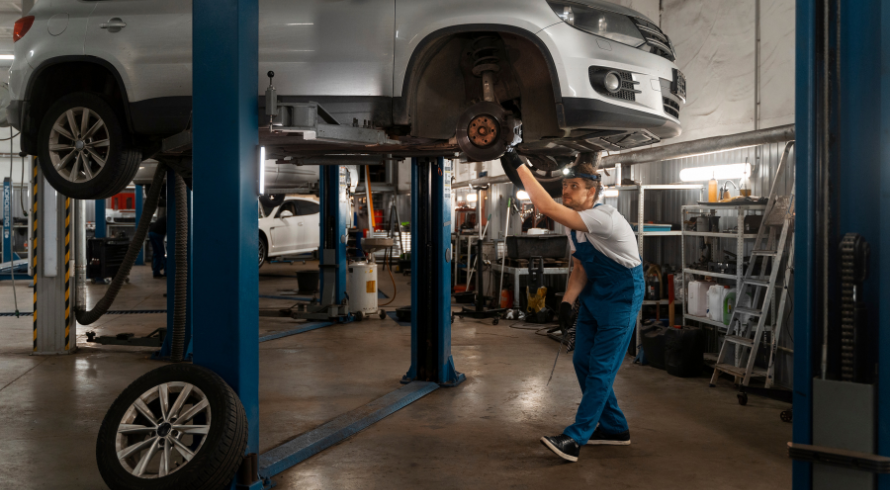
Are you planning to open your own auto repair shop? Or perhaps you need to grow your existing business. Whichever option you choose, you may not want to rely on your current equity only to actualize the ambitious plans.
The domestic auto repair financing sector is more than 21.8 billion and is projected to increase by 6-7 percent per year in the coming years. The rising needs of the repair businesses and consumer demands are leading to the search for adaptable financing arrangements.
Loans are normally used in practical applications since the shops either invest in new technology or expand and could use a loan to buy new and advanced diagnostic scanners and alignment machines. Also, expand the business to cover lean months of cash flow plus payroll and parts inventory, or use a business line of credit to finance the addition of two new service bays.
You can obtain additional funding for your business in a number of ways. We will talk about some of the auto repair loan options, types of loans, how to qualify, and how to be strategic with the financing.
Why do shop owners need auto repair financing?
The habit of financing a business with credit as ancient as it is has a rationale. The additional funds can enable you to invest in the latest machinery, skilled labor, or the most recent auto repair software and take a step further with your business. The solution can be to finance it if you want to expand your vehicle repair shop. Now, how auto repair financing may assist a shop:
- Starting a new shop: To establish a new car-repairing shop, capital is needed, and maybe the whole setup will be hard to finance solely with equity.
- Major equipment upgrades: Small auto repair shops have difficulty in maintaining expensive basic equipment like engine hoists, vehicle lifts, and air compressors. It may not only be cumbersome to use old and outdated equipment, but it might also be unsafe when it is not well kept. Acquisition of the newest equipment will not only ease your operations, but it will also make you current with the changing technology, like Digital Vehicle Inspection (DVI) software and Advanced Driver Assistance Systems (ADAS).
- Growing an existing business: It is such a wonderful milestone to have a successful auto repair shop of your own. Then why not go another step higher? The advantages of expanding your business to yet another place (the second outlet) are not limited to the possibilities of generating revenue but can also become a very efficient marketing tool for your auto repair business.
- Invest in marketing: Although a profitable business, there is a high level of competition in the business, and one must clearly differentiate oneself from their competitors. The level of digital presence is becoming more important than before, and that is why one tends to resort to auto repair loans to build their online presence and get additional customers. The investment in a high-quality professional site and building a powerful social media page can build a recognizable and unique brand identity, which in the long run can result in increased business for the auto shop.
Types of Loans for Auto Repair Shops
Starting to consider the various options of loan offers to your business may look like a good idea at this point in time. However, what are the other options as a shop owner who wants to expand their auto shop or start their own business?
Now, we are going to consider the available options:
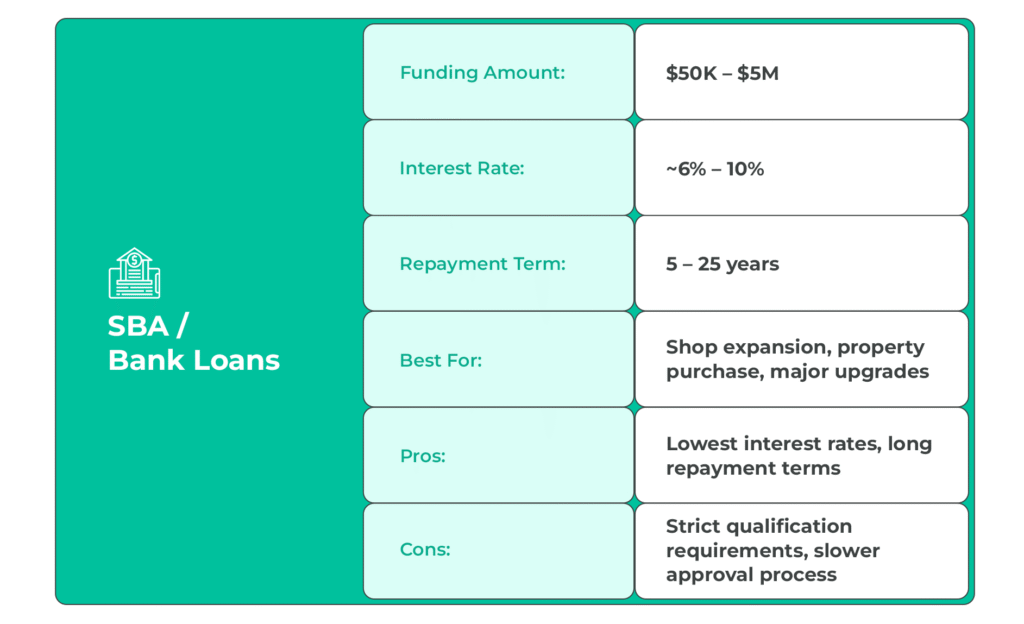
1. Government-Backed Loans (SBA Loans)
Not all people are able to meet the stringent rules and regulations that are often set by some banks when lending a loan or LOC. In this case, the SBA loan guarantee program will enable the borrowers who perhaps failed to meet the requirements to qualify for a small business loan.
They are also at reduced interest rates and terms of repayment. Specifically, auto repair shops use SBA loans for property purchase or shop expansion. Even though the SBA is not a lender, loans are provided by member banks and credit unions, along with some specially licensed non-bank lenders.
2. Traditional Business Term Loans
The traditional bank loan is known to everyone, and particularly to business owners. As a rule, a loan will be made up of three elements:
- Principal amount: This is the real loan amount that you borrow from the bank, which is to be repaid over a certain period of time. This loan is normally provided under stringent conditions, such that it cannot be utilized in other areas other than a business.
- Loan rate: All loans you borrow come with a specific interest rate, which you must pay after some time. This may change with time, depending on several factors such as past credit score background, business forecasts, and many other things. You need to ensure that you get the correct information and your loan is secured at a fair interest rate. You do not want to find yourself in too much debt!
- Repayment terms: There are some repayment terms of loans that will need to be followed, and some of these terms include 12 weeks or 24 weeks. You should ensure that you discuss with your bank and pick out the terms that best suit you in case you need to know and verify what good terms can be offered to your business of repairing cars.
A way of financing any form of business that is quite popular is through a bank loan, and the rates that you get are very reasonable, provided that you have some prior experience in business.
3. Equipment Financing
Sometimes, shop owners would wish to retain the cash to operate. But they, too, would be interested in high-quality auto equipment. It is in this case that they choose to finance equipment.
Equipment financing entails the provision of tools, lifts, diagnostic equipment, or special shop equipment. You have a choice of a type of financing based on the shop’s requirements:
- Equipment loan: This is a loan provided at a fixed monthly payment with ownership at expiry. This loan can be used to purchase lifts or diagnostic equipment.
- Equipment leasing: It is a flexible funding option that can be utilized to upgrade equipment. It is being provided at reduced monthly payments.
- Section 179 Financing: This is a deduction under IRS Section 179. In the first year of its service, the owners can avail a complete-year cost deduction.
4. Business Line of Credit
Taking a line of credit with your bank allows you to have access to a fixed amount of money, which you may access at any time you want. They are often referred to as revolving funds and have several advantages to individuals, and some of them are
- Flexible funds: A line of credit is made up of flexible funds, unlike a traditional loan, where a borrower receives a lump sum of money that s/he can use at any time based on need. Such malleability will ensure that you do not end up drawing out more than you require, but a proverbial safety net will always be there for you to fall on in case you require additional funds.
- Replenishing amount: The replenishing amount will be refunded in the LOC and will replenish the total money you have at your disposal. As long as you have an open line of credit, you will never worry about the money being exhausted.
- Ease of access: Opening a business line of credit will be relatively simpler, as a rule, than most other types of financing, particularly when you have a good credit history.
Using an LOC will enable you to have a rather stable stream of cash and not have your bank accounts run into the red, provided that you manage your money in a reasonable fashion.
5. Alternative Financing Options
In case you are not willing to use any of the financing provided above, you have an option to use alternative financing:
- Trade credit: Auto parts or inventory is ordered from suppliers. You can obtain trade credit where the suppliers allow you to pay in 30, 60, or 90 days.
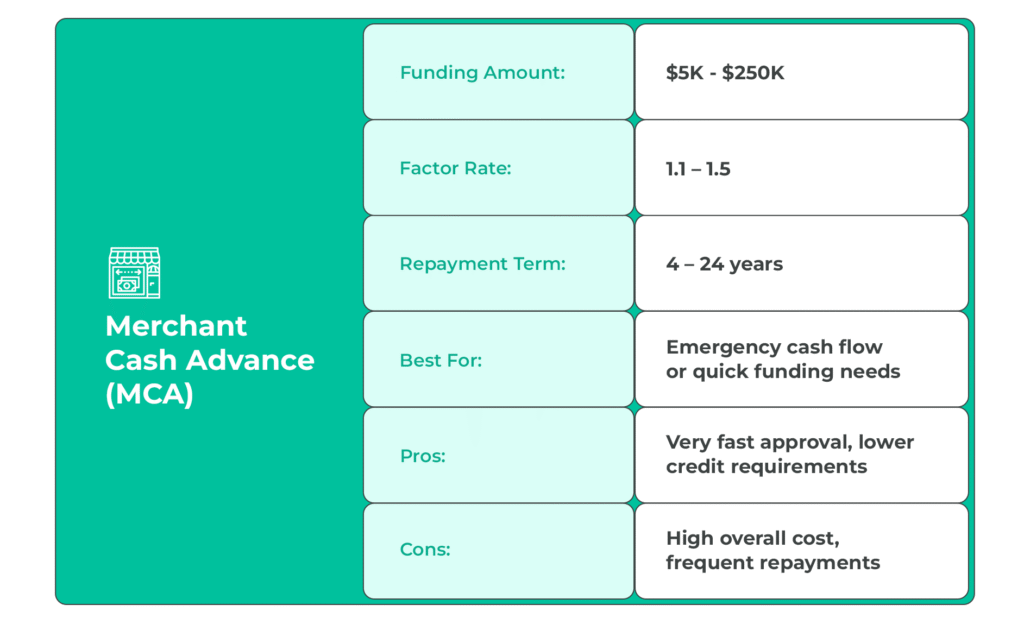
- Merchant cash advance: They are those lending companies that advance you a certain amount. Then you repay it in installments from your everyday dealings. The lenders will approve the loan depending on previous revenues, loans, and sales of your shop.
Strategic Uses for Auto Repair Shop Financing
Any auto shop would incur operational, equipment, marketing, or expansion expenses to operate. The goal is to make the business operations smooth, tools up-to-date, and online presence increasing. Therefore, an auto shop must be financed with the following:
1. Operational costs
The cost is mainly utilized for rent. A shop close to a high-traffic area will have higher rent and will also appeal to customers. The other expense is the payment of mechanical salaries. The more skilled the workforce, the higher the salaries.
Auto services then require several auto tools, which is where inventory costs lie. An inventory of auto parts is critical in order to provide repair services in a timely manner. The right inventory has to be maintained in order to prevent the extra expenses of overstocking. Other minor sundry expenses include utilities, insurance, permits, and miscellaneous expenses.
2. Equipment upgrades
Auto equipment and tools are the first few things needed to get started. Investment in equipment is based on services being offered, bay areas, and business scope. The shop owners have an option of new or used equipment, depending on budget. Simple equipment, such as wrenches and sockets, is cheap, whereas diagnostic equipment and lifts are costly. Acquiring or updating the right equipment at the most favorable price contributes to shop efficiency and minimizes downtime expenses.
3. Shop expansion
Now that your auto shop is busy and popular, it is time to expand so you can accommodate the increasing number of customers. Investment in shop expansion is to add service bays, shop renovations, equipment maintenance and upgrades, or add capacity to repair.
4. Marketing and advertising
With an online presence and word-of-mouth referrals, it is beneficial to allocate a section of your budget towards specific advertising. Online advertisements, print applications, social media campaigns, and community events are all ways through which you can advertise your business successfully in a highly competitive industry.
5. Training and Certifications
The high quality of auto repair requires a skilled labor force. The team of skilled technicians and mechanics needs to invest in mechanic certifications, repair skills, and advanced diagnostic training.
How to qualify for auto repair financing?
Lenders look at various qualifying factors to grant auto repair loans. The factors are based on the type of loan you need.
Qualification Factor | SBA Loans | Equipment Financing | Working Capital | Merchant Cash Advance |
Minimum Credit Score | 650+ | 600+ | 550+ | 500+ |
Time in Business | 2+ years | 1+ year | 6+ months | 3+ months |
Annual Revenue | $100,000+ | $75,000+ | $50,000+ | $5,000+ monthly |
Documentation Required | Business & personal tax returns, financial statements, business plans, profit & loss reports, bank statements, financial projections | Equipment quote or invoice, bank statements, credit application, basic financial statements | Bank statements, profit & loss statements, tax returns, basic business information | Recent bank statements, credit card processing statements, and basic business information |
Choosing the Right Loan for Your Shop
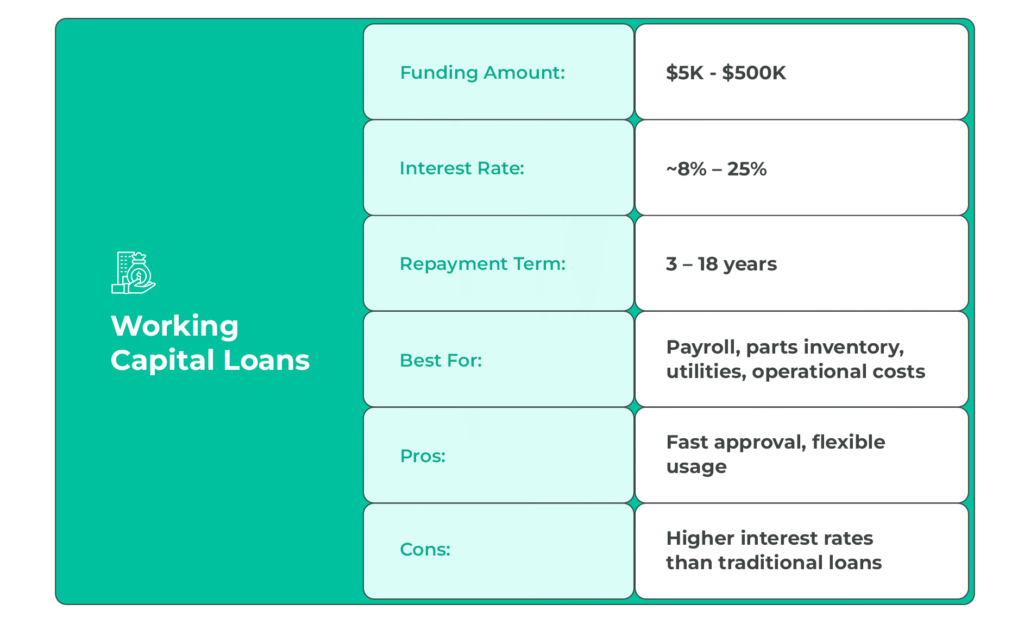
Auto shop owners choose loans depending on the quantity, interest rates, and repayment terms. It is also based on the requirements of the operations; in case they require cash immediately and approval fast, then working capital loans or merchant cash loans are the best alternatives. Bank loans or equipment financing, on the other hand, can be used in long-term planning of expansions and growth. Budget controls of the shop should also be looked at. In case the shop cannot pay interest and repayments, then opt for easy repayment and a reduced interest rate.
Tips for a Strong Loan Application
- Clearly explain the purpose of the loan: Shop owners make a comprehensive business plan, which will clarify the necessity of a loan. The money will be invested in working capital to enhance the cash flows.
- Mention expected returns: Financial positions should be mentioned after the loan is utilized. Guarantee the lender that the loan will contribute to the growth of revenue and, consequently, repay them. Indicators such as the estimated profits, cash flow expectations, and debt-to-service ratios are used to assure the lender that the business can repay the loan.
- Attach financial documents: Highlight the increase in revenues, positive cash flow, and rising customer demand. This is evidence to lenders, and it gets their trust to loan out money.
- Avoid Overleveraging: Payments should be made monthly in accordance with the forecasted cash flow.
- Use Data to Track ROI: With shop management software such as AutoLeap, use data to monitor improvements in revenue and operations over financed investments.
Closing thoughts
Getting the right cash flow in your business may seem to be a daunting task. There are various alternative sources for how you can successfully secure the financing of your auto repair business. Whether you need money up front or over a period of time, it is essential to find the appropriate program to match your business plan to be successful.
Schedule a demo of AutoLeap to see how shop management software can help track revenue, manage operations, and maximize the ROI of financing investments.