




Being an owner of an auto repair shop, it is always your goal to offer the best services to your customers. That could be a good idea because you can provide your technicians with proper training, but you should make sure that they possess enough technical knowledge. Enrolling your techs in a training program can be an excellent way to do just that.
Training programs can keep your technicians abreast of the current changes in technology within the automobile industry. Living in a world where the latest trends, such as electrification, are gaining more and more popularity, it is in your best interests to ensure that you are able to follow through.
Why Your Shop Needs a Training Program for Technicians
Proper training of technicians will allow your team to keep up with the industry. It will make your shop in the long term competitive, efficient, and customer-oriented.
Boosting Business Efficiency and Car Counts
With your technicians well-trained, your whole operation will be quicker and more accurate. For example, a shop upskills an entry-level lube technician into a diagnostics specialist. At first, that technician can do only the oil change and basic maintenance.
With a well-organised training which also includes electrical systems training, use of scan tools and real-time troubleshooting and supervision, such technicians slowly acquire the skill to diagnose complicated problems on their own.
This change will greatly decrease the bottlenecks in your workflow since high-tech diagnostics are no longer dependent on a few senior technicians. This will eventually result in a short turnaround time, more cars per day, and a better customer experience as services are provided faster.
The true importance of a training program implementation for technicians is what counts as one of the most neglected factors when implementing a training program, because many people think that the cost of such a program is only the initial cost.
Although training takes time, resources, and in some cases money, the efficiency of the long term is well worth the initial costs. A highly trained technician is quicker, more precise in diagnosis and less prone to repeat repairs, which directly affects profitability. As an example, a single, well-trained diagnostics technician is able to save one or two hours per job by finding the problems within a short time span, and by eliminating the trial-and-error methodology that is prone to waste time and resources.
This time saving multiplies with each vehicle per day, so your shop can buy more cars with no more staff.
Retaining Top Talent Through Education
One of the most important issues in the auto repair industry is employee retention. Technicians will be much more likely to remain with a shop that invests in their development, offers them a clear career path and assists them in certifications.
Despite these advantages, most of the shop owners still commit the error of treating training as an expense as opposed to an investment. The reality is that not training your technicians can cost you more by causing more inefficiencies, misdiagnoses, and the loss of business opportunities.
Successful shop owners make training part of the business model by providing specific learning time and establishing development opportunities. Eventually, develop a customer-focused culture in which technicians can provide high-quality and consistent service.
Provide greater value to customers
Nobody desires to visit another repair shop for another or more complicated repair. Provided that you can demonstrate to your customers that you are up to the task.
Having a certificate showing your skills and knowledge can instil confidence in your customers. It shows them that you know what you’re doing and boosts the credibility of your technicians.
Having technicians with different certifications can be a great way to grow your auto repair business and cater to more customers.
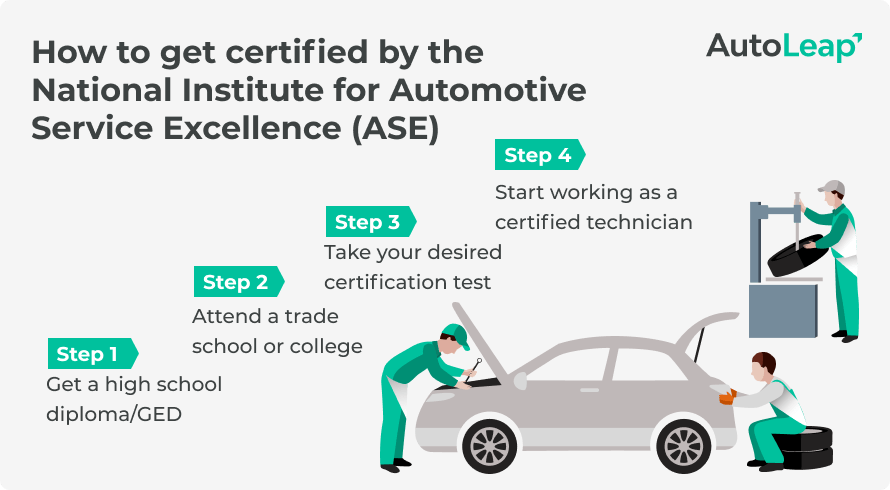
Exploring the Best Ways to Learn Auto Repair
To know how to learn auto repair in the modern world is to know that no one particular way is good on its own, and that learning best is accomplished by a combination of various formats that support both theory and practice.
Leveraging Online Automotive Courses
The online automotive classes have revolutionised the knowledge acquisition process of technicians. It provides convenient and flexible learning methods that can be integrated with work schedules.
These courses enable technicians to learn such important concepts as electrical systems, diagnostics, and newer vehicle technologies at their convenience. So, it becomes less strenuous to keep up with the latest without leaving the job. Nevertheless, online education cannot produce the same realities of working on real vehicles, as a strong theoretical foundation is being created.
Enrolling in Hands-On Vocational Schools
Practical training is also necessary in automotive training as it enables the technicians to put into practice what they have learnt in practice.
Vocational schools and training facilities allow students to handle real tools, vehicles and diagnostic equipment, work with and use under the supervision of professional teachers and instructors, and can assist them in acquiring practical skills and confidence.
Studies have always emphasised that practical exposure is essential in equipping technicians to face the challenges of the real shop, as it helps in closing the gap between theory and practice. ASE credentials are well accepted as evidence of ability and professionalism, enhancing employment and consumer confidence.
Combining Learning Formats
The best strategy is one that integrates both web-based education and practical experience to provide a balanced learning model that can help in developing skills more rapidly.
An example of this would be a technician enrolling in an online course on electrical diagnostics during the week and then translating these concepts into practical use. He can start with testing circuits, using multimeters, and diagnosing actual vehicle problems under their supervision. This integrated learning model strengthens learning, confidence, and ensures that technicians are well-trained to cope with sophisticated assignments.
The most prevalent error made in the growth of technicians is often over-dependence on textbook information without practical use, which may result in the fact that technicians being unprepared to face the real world. Nowadays, the flexibility of the new form of learning enables shop owners to introduce flexible and effective training programs because it is now easier than ever to train at work.
Structuring a Mechanic Training Program in Your Shop
Developing an internal training system guarantees that you have consistency in skill development and knowledge transfer throughout your team, and eventually, you will have better overall shop performance.
Building a Step-by-Step Training System
In order to introduce an effective training program, the shop owners are to initiate the process of developing a set of skill-level movements, which will divide the technicians in accordance with their level of experience and abilities.
As an example, technicians may be divided into Level 1 (entry-level), Level 2 (intermediate) and Level 3 (advanced or master technicians). The competencies at each level should be well outlined, including Level 1 with basic maintenance topology, Level 2 with diagnostics and component repair, and Level 3 with complex system troubleshooting. This is a well-organised development that enables technicians to know precisely what is required of them, and it is a clear way of progressing.
After defining the skill levels, the second thing is to match the training modules with the levels. These modules must not only involve theoretical study but also practical and hands-on practice, in that the technicians are not only being taught the concepts, but also know how to work effectively in the field.
Follow-up is also crucial, and the shop owners are to track the completed modules, evaluate the performance in terms of practical assessments, and create monthly goals of skill development. Improvement can be measured in terms of key performance indicators (KPIs) that include diagnostic accuracy, repair time, and comeback rates, and areas that may need further attention.
Pairing Junior Techs with Master Mentors
An internal mentor system where the junior technicians are assigned to master mechanics is one of the best strategies. This will enable the less experienced technicians to acquire first-hand experience or learn through hands-on experience.
As an example, a junior technician studying how to fix brakes could be with a master mechanic who could show him the correct methods to do it. The mentor oversees the process and immediately gives him feedback so that he can correct the mistakes. Such real-time instructions make the learning process quicker, instil confidence, and make sure that the work is carried out safely and properly.
Feedback is essential in this case. This is to enable technicians to rectify errors more rapidly and instil confidence more expeditiously.
Scheduling Dedicated Training Time
The other important point of a successful training program is to schedule the training time instead of considering it as a by-product.
The introduction of training sessions into the routine of the shops leads to the development of a culture of constant improvement, whereby the technicians constantly improve their skills without the need to reduce productivity.
One of the most prevalent errors among shop owners is to give complex assignments to novice technicians with no appropriate instructions, which may result in errors, delays, and even threats.
Rather, a systematic process of enhancing the complexity of tasks with supervision can help ensure that technicians attain competence and confidence with time, leading to a more fluent workflow and enhanced cooperation within the team.
What a Modern Mechanic Training Program Should Cover
In order to be competitive in the current automotive industry, a training program should not just cover simple repair knowledge but comprise an elaborate curriculum that is representative of the current vehicle technologies. A balanced curriculum provides the ability to deal with traditional mechanical systems and high-tech electronic parts, which will enable your shop to work on more vehicles and customer demands.
A contemporary apprentice training program normally incorporates the use of diagnostics and scan tools, important in diagnosing problems in ever more computer-controlled vehicles. Another important element is electrical systems training since modern vehicles are highly dependent on sensors, wiring, and control modules that cannot be easily diagnosed or repaired without specific knowledge. The training on engine repair and performance is considered to be basic and trains technicians in the idea of the engine functioning, along with the method of solving the problematic situations, both simple and complicated.
Along with these fundamental pillars, the brake and suspension systems are also of great concern because they have a direct effect on the safety and performance of vehicles. They also have HVAC systems, and therefore, technicians are able to diagnose and repair heating and cooling systems. The more sophisticated programs will include training on advanced driver assistance systems (ADAS), which involve critical calibration and sensor and camera knowledge. Lastly, as electric and hybrid cars are growing fast, electric and hybrid training is now required, including high-voltage safety, battery handling, and electric drives.
Organising your training program around these key areas would provide you with a holistic learning experience that equips your technicians with the tools necessary to handle the challenges that the automotive industry is currently facing (as well as the ones it would be facing in the future). It not only enhances the quality of service but also makes your shop a competent and progressive business in an ever-competitive market.

Preparing for Future Automotive Technologies
With the automotive industry ever-changing, it is important to be ahead of new technologies in order to remain competitive and ensure customer satisfaction.
Mastering EV and Hybrid Systems
Electric and hybrid cars are on the rise, and technicians should be prepared to operate on their systems, which are different and manage them effectively and safely.
These vehicles contain high-voltage equipment that demands special expertise and stringent safety measures, and proper training is vital. This could be achieved by a practical training module where the high-voltage components are identified, battery systems disconnected safely, and electric drivetrains diagnosed. All of which are essential to the safety and accuracy of the technician as well as the accuracy of the repair.
The market trends demonstrate the significance of such a shift, with the number of electric vehicles being adopted at a high rate, and thus leaving new opportunities to stores that are ready to service them.
Navigating Advanced Driver Assistance Systems (ADAS)
Besides electrification, the current cars have sophisticated driver assistance systems, including lane-keep assist, adaptive cruise control, and collision sensors.
Such advancements need a high level of calibration and diagnostics. Stores that are not trained in these aspects have the disadvantage of losing complicated tasks, hence reducing their income and reputation.
Conversely, stores that take initiative in training can provide a greater scope of services, attract more business and establish themselves as the market leaders in their respective areas. Thinking ahead in terms of education is one sure way of making sure your shop is strong, flexible and competitive in a more technologically-oriented business environment.
Closing thoughts
The best technicians will be able to combine their technical knowledge with practical experience. So it’s in the best interest of shop owners to provide proper training to their employees. Doing so can help you cater better to customer needs and market your business more effectively.
FAQs
What is the difference between a mechanic training program and an apprenticeship?
A mechanic training program is typically a structured combination of classroom learning and practical instruction, while an apprenticeship focuses primarily on learning through on-the-job experience under supervision.
How do you choose the right training program for technicians with varying skill levels?
The best approach is to assess each technician’s current skill level and assign a mix of foundational and advanced training that allows for steady progression without overwhelming them.
Are there mechanic training programs that offer flexible scheduling for working professionals?
Yes, many modern programs offer online or hybrid formats that allow technicians to learn at their own pace while continuing to work full-time.
Is online auto repair training as effective as in-person learning?
Online training is highly effective for building theoretical knowledge, but it is most impactful when combined with hands-on experience, as automotive repair requires practical application to fully develop skills.
What topics are typically covered in a mechanic training program?
Training programs usually cover a wide range of subjects, including engine repair, electrical systems, diagnostics, braking systems, suspension, fuel systems, and emerging technologies such as electric vehicles and ADAS.
Why is mentorship important in technician training?
Mentorship allows less experienced technicians to learn directly from seasoned professionals, gaining practical insights, real-time feedback, and hands-on guidance that accelerate skill development and improve work quality.
How important are certifications for auto technicians?
Certifications play a crucial role in validating a technician’s expertise, building customer trust, and opening up opportunities for career advancement and specialization within the industry.
How can shop owners support ongoing technician training?
Shop owners can support training by allocating dedicated learning time, sponsoring certifications, implementing mentorship programs, and fostering a culture of continuous improvement within the workplace.