






The opening or start of a tire shop requires more than just a place to put a business and technicians. Equipment selection will directly impact service speed, repair quality, technician safety, and profitability. Not ensuring that the right machines are purchased or that certain equipment categories are not considered can result in slower workflow, damaged wheels, customer complaints that must be repeated, and increased operating costs later.
This blog guides you on key equipment for a tire shop and compares the various types, providing guidance on how to select it and offering insights on price to assist the new or expanding tire shop owner with smart purchasing decisions right from the get-go.
1. Tire Mounting and Demounting Equipment
These are the core tools and machines you’ll need to handle tire mounting, balancing, and basic repairs.
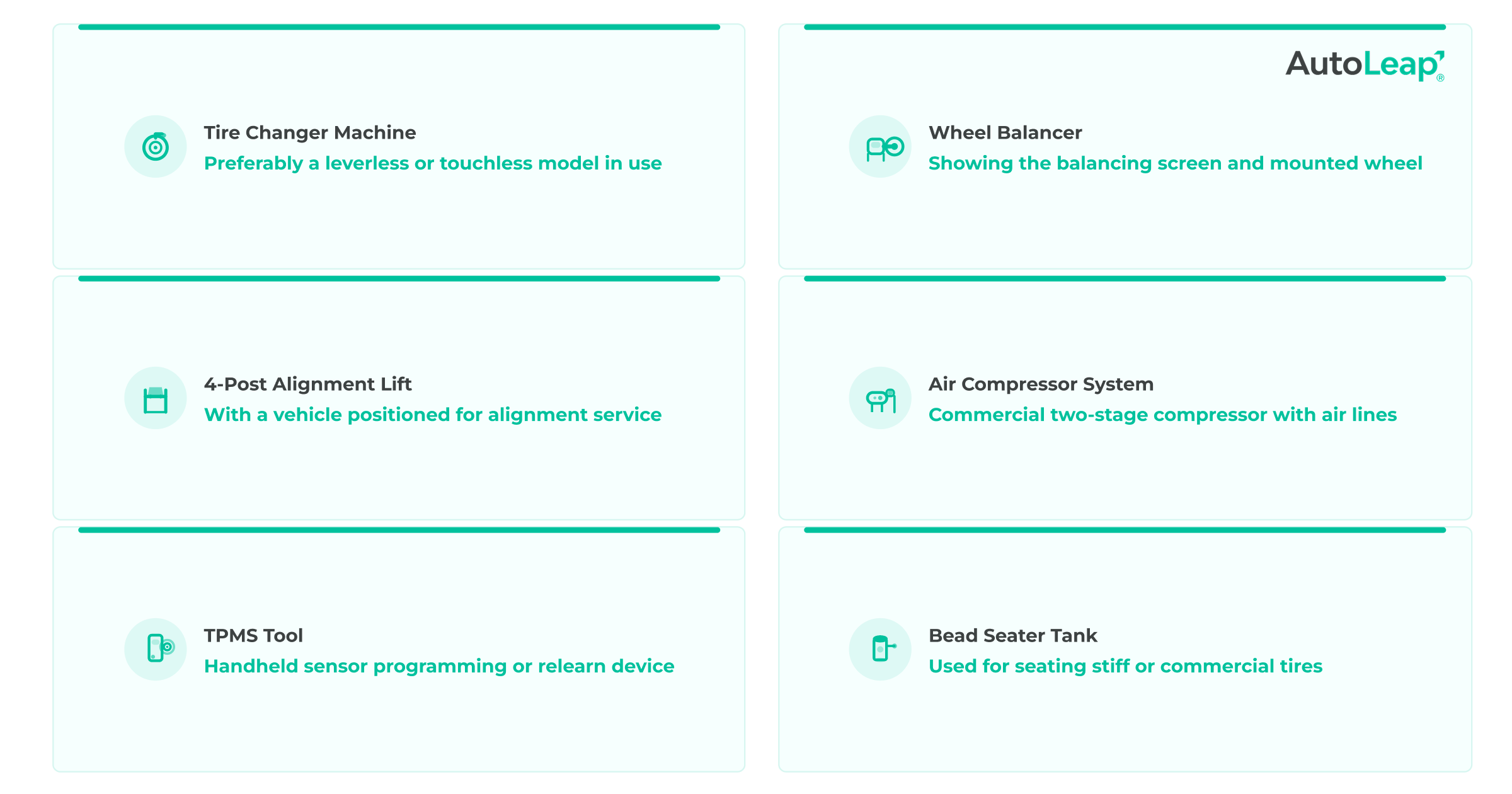
Tire Changer Types and How to Choose the Right One
This machine removes and installs tires onto wheels. When a customer comes in for a tire change. The success of tire-changing service depends on how fast your shop changes tires and returns the vehicle to the customer.
The right tire changer machine saves technicians’ time and increases productivity. Choose between manual, semi-automatic, and automatic types depending on your budget and service volume. Make sure it can handle a range of tire sizes.
A quick check on the types of vehicles your tire shop will cater to can help you decide the type of tire changer you need to get. There are many different types of tire changers that you can consider getting. Here are a few top ones:
Swing arm tire changer
A basic tire changer is all you need if your shop works on standard passenger vehicles. The manual tire changer is great for low-volume shops. This equipment is much more affordable and comes in automatic or semi-automatic models.
A semi-automatic tire changer combines manual and automated processes. They assist with bead breaking and tire demounting, but you’ll still need to install the tire back onto the rim. Overall, this option strikes a balance between affordability and efficiency, costing between $1,800 to $3,000.
Tilt-back tire changer
Then you have tilt-back tyre changers, which are great for shops that service a mix of vehicle tires. These advanced machines handle bead breaking, demounting, and mounting with minimal manual effort. They are faster and have a tower that tilts back to fit larger tires. It can move easily with the press of a button. The cost varies between $5,000 to $6,000.
Leverless/Touchless tire changer
These are fully automatic tire changers. They can lift and set heavy tires with their automatic functions, requiring no manual effort. The fully automated mounting head eliminates lever contact with the wheel and protects alloy and low-profile wheels from scratching. This machine is suitable for shops that change ultra-high-performance tires and have high-volume tire-changing requests. It costs between $8,900 to $13,900.
Heavy-duty tire changer
There are also heavy-duty tire changers for trucks, buses, and commercial vehicle tires up to 90 inches in diameter. You need to invest in a heavy-duty tire changer if you want to attract customers running commercial businesses. This machine costs between $9,000 to $15,000.
Each changer has unique benefits. It all comes down to your tire shop’s specific needs. For example, a shop planning to serve modern vehicles with low-profile tires and aluminium wheels that buys a swing-arm changer will scratch wheels and generate complaints from the first week.
When selecting a tire changer for your shop, consider factors such as the volume of tire service you provide, the types of vehicles you service, the available space, and your budget. Invest in a tire changer that aligns with your business needs and can help you provide efficient and reliable tire services to your customers.
Vehicle Lifts and Floor Jacks
Vehicle lifts are used to raise cars high enough to perform large repairs. Technicians can work on all four wheels simultaneously, essential for rotation, alignment prep, and undercarriage inspection. Floor jacks can only partially raise cars for minor repairs.
2-post vehicle lifts
These are the most common lids, best for general tire and light repair, typically 8,000–10,000 lb capacity. They are also easy to use and smaller than other models — ideal for garages with limited space and a tight budget. Vehicle lifts range from approximately $2,000 for a basic 2-post unit
4-post vehicle lifts
These lifts are used to raise heavy vehicles and can raise to 14 feet. It is good for alignment work or when more access is needed during repairs, typically 11,000 – 14,000 lb capacity. These lifts cost around $8,000 or above.
Sometimes, an auto shop uses floor jacks instead of vehicle lifts. This is to save costs, but it can lead to losses. Floor jacks slow service dramatically and increase technician injury risk on multi-wheel jobs.
Jack stands work for low-volume startups handling simple tire swaps or single-wheel jobs. They’re fine when the budget is tight and the workflow is slow, as long as proper safety practices are followed. A vehicle lift becomes essential once you’re doing frequent rotations, multi-wheel services, alignments, or a higher daily car count. It’s required for speed, technician safety, and handling heavier vehicles efficiently.
2. Wheel Balancing Equipment
Wheel balancing ensures smooth driving by evenly balancing each wheel. It makes sure the tires work fine on the road without wear and tear or wobbling. They identify wheel imbalances, so whenever one of the tires is out of balance, there are vibrations.
The machine spins the wheel, detects where it’s uneven, and shows the technician exactly where to add small weights. Once adjusted, the tire runs evenly, giving you a smoother and more stable ride.
Wheel Balancer Types: Dynamic, Static, and Bubble
Dynamic balancers are more accurate, while static or bubble balancers are more affordable. There are three types of wheel balancers: static, dynamic, and bubble. Which of these would you need? Let’s see.
Static wheel balancer
Static wheel balancers are the most basic type. They operate on the principle that the heaviest part of the tire and wheel assembly will gravitate to the bottom when suspended. They are generally more suitable for non-precision applications, such as lawn equipment and off-road vehicles. The usual cost range is between $500 – $1,000.
Dynamic wheel balancer
Dynamic wheel balancers are more sophisticated than static ones. They address static and dynamic imbalances by assessing the weight distribution around the entire wheel and tire assembly as it rotates. These balancers provide more accurate results and are suitable for passenger cars, trucks, and other vehicles where precision balancing is crucial for a smooth ride. The basic to mid-range dynamic wheel balancer costs between $1,000 to $3,000.
Bubble balancer
Bubble balancers, also known as bubble-level balancers, are the most basic type of wheel balancer. You can use them for small-scale operations or temporary balancing needs. Bubble balancers consist of a horizontal axle and a bubble level. But they lack the precision and accuracy of dynamic balancers and are often considered less reliable for achieving optimal balance. These balancers cost between $50 – $250.
A major mistake many shops make is relying on static or bubble wheel balancers for everyday passenger vehicles. While these tools can correct basic imbalance, they don’t detect dynamic (side-to-side) imbalance. One of the main causes of vibration at highway speeds.
The result? Tires may seem balanced in the shop but still cause steering shake, uneven wear, and customer callbacks. Since wheel balancing directly affects ride quality and stability, using the wrong machine ends up costing more in repeat labor and lost trust than investing in a proper dynamic balancer from the start.
Wheel weights are essential for balancing tires and ensuring a smooth, vibration-free ride. But the tools you use to install and remove them matter just as much as the weights themselves.
High-quality wheel weight pliers remove clip-on weights cleanly without damaging the rim, while cheap tools often slip, scratch wheels, and even cause hand injuries. For modern alloy wheels, plastic adhesive removal tools are critical—they safely remove stick-on weights without gouging the surface, unlike screwdrivers that can leave permanent marks.
A complete shop setup also includes both clip-on and adhesive weight kits. That’s because steel wheels typically use clip-ons, while modern alloy wheels require adhesive weights to avoid visible damage and maintain a clean finish. Using the wrong tools or weights leads to poor results, lost weights, and customer complaints.
3. Wheel Alignment Equipment
Wheel alignment improves tire life and ride quality. The equipment helps technicians align the angles of tires so they meet factory specifications.
Tire alignment is among the top three profitable services. The shops can charge a premium due to its specialized nature, and the machine cost investment is usually recovered within four to six months.
2D vs. 3D Alignment Systems
Feature | 2D Wheel Alignment | 3D Wheel Alignment |
Measurement type | Measures angles in 2 dimensions (X, Y) | Measures full geometry in 3 dimensions (X, Y, Z) |
Technology used | Basic sensors, lasers, or mirrors | Cameras, targets, and advanced imaging systems |
Accuracy | Moderate accuracy, may miss complex issues | High precision with full suspension analysis |
Speed | Slower, more manual input required | Faster, mostly automated process |
Parameters measured | Limited (mainly toe, basic angles) | Full set (toe, camber, caster, thrust, etc.) |
Ease of use | Requires more technician skill | Easier, software-guided workflow |
Cost | Lower upfront cost | Higher investment but more capability |
Best for | Basic vehicles, low-volume shops | Modern vehicles, high-volume/pro shops |
Alignment machines range from approximately $6,000 for a basic 2D system to over $40,000 for an advanced 3D system. Most independent shops start with a mid-range 3D system in the $10,000–$20,000 range, as it covers the broadest vehicle range
What Does Adding Alignment Service Require Beyond the Machine
To provide fast and accurate alignment, both the alignment machine and the vehicle lift are required. An alignment machine can tell you what the alignment is and what needs adjusting. But to measure, technicians need to rotate and unload tires for which lifts are required.
Accurate alignment depends on proper setup; otherwise, readings can be wrong and lead to poor results. A few of the requirements for adding alignment service are:
- A flat, level bay floor is required for accurate readings
- A 4-post lift or alignment rack is required since most 2-post lifts cannot be used for alignment procedures
- At least one technician must be trained specifically on the machine’s software since incorrect setup produces inaccurate measurements that damage customer vehicles.
Customers trust your shop to fix their vehicle completely and get it back on the road quickly. But if you don’t have alignment equipment, you have to send it to another shop after doing all the hard work. That means losing control over the final quality, risking delays, and giving up part of the revenue.
Bringing alignment in-house, especially with mobile systems, lets you finish the job yourself, keep things moving faster, and deliver a smoother experience for your customers.
4. Air Compression and Inflation Equipment
Air compressors are used to inflate tires, power pneumatic tools, operate lifts and clean components.
Air Compressor Sizing: CFM and Tank Capacity by Shop Volume
CFM (Cubic Feet per Minute) measures actual air delivery. It is the volume of compressed air your compressor produces. This means how much air the compressor delivers continuously. Tank capacity determines how long it can sustain peak demand before cycling. How much air is stored before the compressor needs refilling?
A higher CFM would mean can operate multiple tools such as impact wrenches or tire machines without a pressure drop. Larger tanks are helpful to meet unexpected demand. This is why auto shops must have the correct CFM and tank capacity per shop volume and demand. Undersized compressors can lead to slower tire changes, weak tool performance and a decrease in productivity.
Shop Size | Recommended CFM (at 90 PSI) | Recommended Tank Size | Key Note |
Small shop (1 tire machine, 1–2 technicians) | 10–15 CFM | 60–80 gallon | Suitable for basic tire operations and light pneumatic tool use |
Medium shop (2 tire machines) | 20+ CFM minimum | 120+ gallon | Needed to support simultaneous tire work and tools without pressure drops |
All shops (general rule) | Slightly above current demand | A larger tank improves stability | Always oversize slightly for future growth and workload spikes |
Auto shops must also know the single-stage vs the two-stage compressor. A single-stage air compressor compresses air once and is used for light, intermittent use. The cost ranges between $300 to $1,200. A two-stage air compressor compresses air twice, providing more efficient and consistent pressure for an auto shop’s daily use. The cost ranges between $800 to $3,000+.
Two-stage compressors are recommended because they maintain more consistent pressure under continuous load and last significantly longer under professional shop conditions.
Tire Inflators, Dedicated Gauges, and Nitrogen Systems
Tire inflator provides accurate tire services compared to air compressors. It has an in-built precision gauge, auto shut off at exact PSI and a secure valve connector. This helps reduce or minimise air loss, correct pressure in tires, and improve tire safety.
Nitrogen inflation systems are a premium add-on service. Nitrogen is less prone to pressure loss and moisture-related fluctuation than regular air, which can help maintain more stable tire pressure over time. This is only done on customer request because of the extra cost and other complexities.
5. TPMS Tools and Sensor Service Equipment
What TPMS Is and Why Every Tire Shop Needs a Service Tool
Tire pressure monitoring system (TPMS) is a tire safety feature that’s built in every vehicle since 2007. It includes a sensor that monitors tire pressure and sends alerts if the pressure is low. When the tire is rotated or replaced, it is important to properly service TPMS along with the sensor. If it’s not serviced, there will be warning lights or the sensor may not send tire information in real-time. This is why three TPMS functions every shop must offer:
- Relearn procedures: This resets the system so it can correctly identify sensor position
- after tire rotation or changes.
- Sensor programming: Replaced sensors are configured to match the system frequency and unique ID.
- Sensor replacement: installing a new TPMS sensor and properly torquing the clamp-in valve stem using a torque-specific tool to avoid air leaks or sensor damage.
TPMS Tool Selection: Relearn, Programming, and Sensor Kits
When selecting the right TPMS tool, you should consider these three factors:
- Vehicle coverage: The tool must support all vehicle makes and models that your shop services.
- Software update capability: TPMS protocols change with new model years, and a tool without regular updates becomes obsolete
- Aftermarket sensor capability: It allows technicians to program universal sensors instead of keeping multiple OEM sensors.
Apart from tools, there are one-time-use service parts that must be stocked. These TPMS consumables are:
- Rubber valve stem kit: It is replaced when tire dismounted to avoid air leaks.
- Valve core: To maintain sealing performance.
- TPMS service kits: Grommets, washers, caps, and cores for clamp-in sensors are required whenever sensors are removed or serviced.
Skipping valve stem replacement is one of the most common shop mistakes, and it often leads to post-service leaks that become a liability issue the shop cannot defend, since the failure is usually attributed to improper service rather than normal wear.
6. Tire Repair and Inspection Equipment
These are among the most commonly used tire repair tool names in any shop. A full kit includes patch tools, plugs, vulcanizing cement, and rasps to quickly fix punctures. Always keep extra supplies in stock.
Tire Repair Tools: Plugs, Patches, Spreaders, and Bead Seaters
- Tire plug kit: These kits contain tools for inserting tire plugs into punctured tires. They often include reaming tools to clean the hole and insertion tools to place the plug securely.
- Patch kit: Patch kits repair larger punctures or cuts in the tire. You can place the patches on the inside of the tire to ensure the repair is dependable and lasts a long time. You can even add a tire patch roller to press and smooth out patches applied to the inside of the tire for a secure bond.
- Tire spreaders: It helps in holding the tire open when the technician inspects and patches the installation. This helps identify hidden damage inside the casing.
- Vulcanising cement and patch roller: The cement is applied to bond the patch and secure the liner. The patch roller is used to remove trapped air and repair the flat for maximum adhesion.
- Bead seater: This tool is used to mount large, stiff, or commercial tires. This is because it releases a high-volume burst of compressed air that quickly seats the bead into position. Sometimes technicians use flammable spray methods as an alternative to force the bead outward. It is a dangerous method that can lead to injuries and wheel damage.
An auto shop should ensure repairing tire inside out. Plug-only repairs are temporary; proper internal inspection + patching is the professional standard.
Inspection Tools: Tread Depth Gauges and Leak Detection Equipment
Tire inspection is the first step, and so the right tools make it easier to inspect correctly. Tread depth gauge helps technicians measure remaining tread depth in 32nds of an inch across the tire surface. This identifies uneven wear and tear approaching the legal replacement threshold of 2/32 inch.
Checking tread depth is a must on every customer visit and before any repair begins. The measurement is recorded and documented as proof of tire’s condition, to avoid legal claims and give a clear idea to technicians of what kind of repairs are needed. It also increases customer trust because the reading can be shown and explain how close the tire is to becoming damaged.
Dunk tanks are another tool to check slow leaks and air loss. These are large water tanks that submerge an inflated tire and wheel assembly. When the tire goes underwater, the bubbles are released, which shows the exact source of the leak. Dunk tanks are especially effective for locating bead leaks, damaged valve cores, sidewall punctures, and tiny tread punctures that are almost impossible to find during a dry visual inspection.
Visual tire inspection is one of the common mistakes. Slow leaks cannot be diagnosed with the naked eye. Dunk tank helps diagnose correctly and avoid recurring tire issues, leading to customer frustrations.
7. Tire and Wheel Storage Equipment
Technicians searching for tires or moving stacks of tires waste time that could have otherwise been spent on completing tire services early. Poor tire and wheel storage and roughly moving these tires can lead to damage to inventory and disorganised space. This is when tire and wheel storage equipment comes in handy.
Tire Storage Rack Types and Layout Planning
Auto shop layout, inventory volume and service model are key factors that decide which storage rack to opt for.
- Single-sided wall-mounted racks: These are good for small auto shops because they leave maximum space for technicians to work. The rack keeps inventory against the wall.
- Double-sided freestanding racks: These are suitable for high-volume auto shops. It can be accessed from both sides and works well in larger drive-through storage layouts.
- Vehicle tire trees: It stores tires upright to avoid flat spotting during long-term storage. Suitable for seasonal wheel tire storage.
- Rolling tire carts: Technicians can reposition or change as the shop layout changes.
Proper tire inventory is just one part. How the tires are stored also plays an important role. Tires that are stacked flat for a long period can lead to flat spots or sidewall distortion. This is why vertical or slightly angled tire storage is safe for the long term.
Underestimating the amount of storage space is one of the most frequent pitfalls that new tire shop owners fall into. If the shop starts with 50 tires yet has only space for 30, items will inevitably end up on the floor, tripping hazards will be created, technicians will be slowed down, and there will be damage to the inventory being done improperly. As a general guideline, tire shops should allow for a storage system that holds at least 1.5 times the opening inventory, to allow the system to accommodate growth without becoming overcrowded in the first few months.
Wheel Dollies and Transport Equipment
Modern trucks, SUVs and commercial vehicles are heavy and difficult to move. When technicians repeatedly try to move for tire repairs, it can cause vehicle damage and physical strain for technicians. This equipment helps resolve this:
- Wheel dollies: These are used to roll heavy vehicles rather than manually carrying and lifting them.
- Tire transport carts: Technicians can carry multiple wheels on the cart and move them around as they work. They don’t have to constantly lift or reposition all the time.
8. Hand Tools, Safety Equipment, and Shop Operations Supplies
Technicians need hand tools to perform regular repairs. The important ones are:
- Impact wrench: It easily loosens and tightens lug nuts to speed up wheel removal.
- Torque Wrench: Prevents over- or under-tightening of lug nuts. Critical for safety and avoiding customer callbacks.
- Lug Nut Socket Set: These impact-rated sockets in common sizes are essential tools for any technician. Colour-coded options protect wheels from scratches. But it is essential to keep both common metric and SAE sizes because standard chrome sockets can crack under pneumatic force.
- Valve stem tool kit: It is used to install and remove valve cores and stems during tire service.
- Wheel weight pliers: These are for on-clips and adhesive weights. It helps avoid wheel scratches and fasten weight removal.
- Rolling service cart: These are toolbox carts for technicians to move around. Easier to have the most used tools by their side when switching between bays. Those same steps can save a tire shop with 15 to 20 cars per day significant labour efficiencies and turnaround times. Mobile service carts also keep tools organised, eliminate clutter around work areas and minimise lost time looking for missing tools during busy service times.
A complete hand toolset for a tire shop costs between $300 to $700, depending on quality and brand.
Safety Equipment and OSHA Compliance Requirements
Safety should be a top priority in your tire shop. Equip your workspace with safety gear such as goggles, gloves, fire extinguishers, and proper ventilation systems. These are essential for your work staff.
Provide them with the right equipment and a safe environment to work. Use chemical-resistant gloves when handling lubricants, solvents, and repair materials. Shops also need a tire inflation cage to safely contain potential tire or wheel explosions during inflation. Make sure it’s above 15 PSI, as well as a properly rated fire extinguisher for chemical and electrical hazards.
Make sure your equipment for tire shop operations meets permits and safety compliance requirements. Start by reviewing OSHA’s standards for automotive shops. Non-compliance can lead to legal and financial penalties. A tire explosion injury, due to missing equipment, can lead to approximately a $15,000 fine per incident.
9. Tire Shop Management Software
Using software like AutoLeap’s tire shop software helps you keep track of inventory, appointments, customer information, and financial records. This is one of the initial investments you will need to make as you start your tire shop. It will help you organize your entire business and help you streamline day-to-day tasks.
Why Tire Shop Software Belongs on the Equipment List
The modern tire shop can’t function without more than just physical tools. A good tire shop management software is crucial.
Manages appointments, customer data, work orders, tire inventory, invoicing and reporting all in one unified system. Paper Ticket or Spreadsheet-Based Shops may not keep track of Inventory, Reorder Points, or the productivity of their technicians or the average value of repairs. A customer who walks into the dealership for a tire rotation can automatically have a vehicle history search and service reminders for the TPMS, estimates, and even an item for review after checkout, all performed by the integrated software without any manual effort of the service advisor.
Also, integrated software makes inventory management more efficient. The system monitors the most popular tire sizes, alerts the operator to low tires inventory and links all parts sales to a repair order. The shop owner can know the stock movement, profits, and know that there are problems with stock when the customer calls for an unavailable tire size in real time.
Estimated Equipment Investment by Priority Category
With a tire shop, you must ensure that you have the best gear for day one of the business, while also planning on upgrading for future expansion. Equipment quality and number of bays, as well as alignment service at launch, are all contributing factors to most new shops being in the $35,000 to $100,000+ range. If you want to get a more detailed breakdown of the costs of starting a tire shop, you can check out this in-depth review of tire shop startup costs.
Priority Category | Included Equipment | Estimated Cost |
Essential / Day 1 | Tire changer, wheel balancer, air compressor, lift, TPMS tools, inflation equipment, hand tools, repair kits, safety equipment, software | $25,000–$60,000 |
High-Value Additions | Alignment machine, bead seater, nitrogen system, dunk tank, storage racks, wheel dollies | $10,000–$45,000 |
The worst thing that a new shop owner can do is to purchase the lowest-cost equipment that they can. Many entry-level tyre changers and wheel balancers are broken in the first 12-18 months of commercial use, resulting in downtime and replacement expenses that are greater than the cost of purchasing a mid-grade commercial machine from the beginning. When a shop is looking for equipment that will serve them well for years to come, a good choice is usually to go with the middle-of-the-road equipment.
Conclusion
Getting your tire shop off the ground starts with the right equipment needed to start a tire shop. From the essentials to the extras, this tire shop equipment list is your step-by-step guide to doing it right.
Additionally, having designated storage spaces for cleaning supplies, along with a routine cleaning schedule. This helps streamline operations and showcases your commitment to providing a top-notch tire shop experience. And while this does not fall under equipment, using an efficient tire shop management software is a powerful tool to help you grow your tire shop. Use the software to connect appointments, inventory, and customer records in one place.