



Most independent auto repair shops with 3-5 service bays will require a 5-10 HP two-stage air compressor with an 80-120 gallon tank that provides about 25-35 CFM at 90 PSI. This will vary depending on the number of bays, the number of air-powered tools used and how often multiple technicians run those tools at the same time.
Use the sizing matrix below to determine the right compressor size and capacity for your shop and its future growth.
Air Compressor Sizing Guide For Auto Repair Shops
Choosing the right air compressor starts with understanding your shop’s airflow demand. Use the table below as a starting point to match compressor capacity with your operation’s size, tool usage, and workload.

| SHOP SIZE / TYPE | COMMON TOOLS | MIN CFM | HP | TANK SIZE | RECOMMENDED TYPE |
|---|---|---|---|---|---|

1–2 bays |
Impact wrench, ratchet, tire inflation | 15–20 CFM | 5 HP | 60–80 gal | Reciprocating / single-stage |

3–5 bays |
Above + air lift, spray gun, blow gun | 25–35 CFM | 7.5–10 HP | 80–120 gal | Reciprocating / two-stage |

6–10 bays |
Continuous multi-tool use, paint booth | 40–60 CFM | 10–15 HP | 120–200 gal | Rotary screw |

10+ bays / |
Industrial equipment, spray painting, non-stop operation | 60+ CFM | 15–25 HP | 200+ gal | Rotary screw (VSD) |

Mobile mechanic |
Impact wrench, tire work, portable applications | 4–8 CFM | 1.5–2 HP | 6–20 gal | Portable reciprocating |

Tire shop |
Tire mounting, inflation, impact tools, lug nut service | 20–30 CFM | 5–7.5 HP | 80 gal | Reciprocating / two-stage |

SIZING TIP
Add a 25% buffer when running multiple tools at once — two tools at 8 CFM each need a compressor rated for at least 20 CFM, not 16.
Different types of air compressors
Since an auto repair shop needs to power different pneumatic tools, inflate tires and use a spray gun for spray painting, reliable air compressors quickly become a must-have in the mechanic shop equipment list.
Let’s break down the different types of air compressors and review their functionality:
- Reciprocating/piston air compressors: Reciprocating air compressors, often known as piston compressors, operate similarly to piston-driven pumps. Due to their adaptability and cost, they are among the most popular compressors used in auto repair shops.
- Rotary screw air compressors: Two interlocking helical screws are used in rotary screw compressors for compressed air. They provide a constant flow of compressed air and reviewers find them very effective. Auto repair shops frequently use this compressor due to their dependable performance and high air demand. They are perfect for larger shops where a constant air supply is essential.
- Scroll air compressors: This compressor uses two spiral elements for compressed air. They are appropriate for smaller shops offering specialized services because they are compact, quiet, and low maintenance. Scroll compressors are used with small pneumatic tools and airbrushing.
- Centrifugal air compressors: Centrifugal air compressors are used in bigger auto assembly factories and heavy-duty auto repair shops where high-volume, high-pressure air is needed. These effective compressors function by compressing air using the centrifugal force theory. Unfortunately, they are difficult to maintain and aren’t the most practical option for smaller auto repair shops.
- Oil-lubricated compressors: Compressors with oil lubrication are more dependable and appropriate for heavy-duty auto repair activities. That’s because their lubrication slows the wear on working parts. They do, however, need routine maintenance and frequent oil changes.
- Portable vs. stationary air compressors: You can select between a portable air compressor and a stationary air compressor depending on the size of your shop and its mobility requirements. Portable compressors are appropriate for smaller auto repair businesses or shops with limited space since they are compact, lightweight, and portable. On the other hand, stationary compressors are bigger, have a higher capacity, and stay fixed in one place.
Best air compressors for your auto repair business
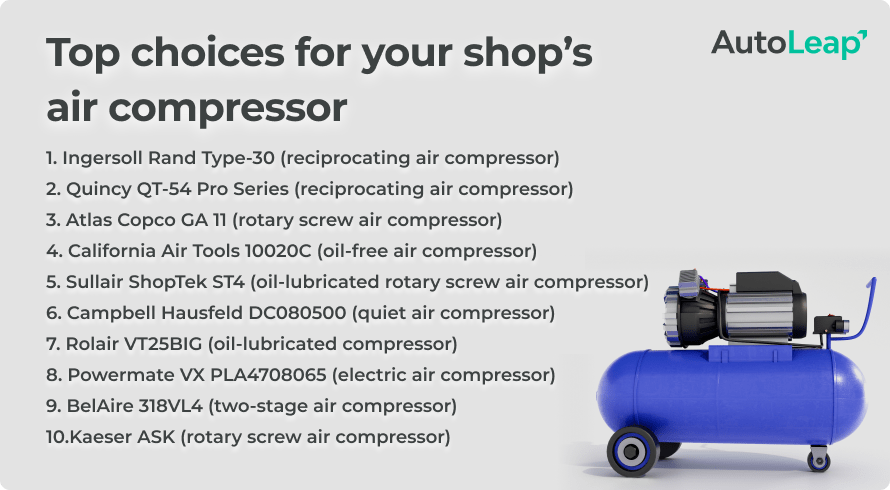
1. Ingersoll Rand Type-30 (reciprocating air compressor)
Best for: 3-10 bay general repair shops that operate air tools all day long.
Why: Ingersoll Rand products are renowned as durable, commercial-grade compressors, capable of continuous operation each day. A good match for any repair shop that doesn’t want to transition to an all-industrial system.
Typical Specs: 24–38 CFM at 90 PSI | 5–10 HP | 80–120 gallon tank
Price range: $800–$14,000+
Pros
- Heavy-duty daily use construction.
- Large network of services and parts.
Cons
- Higher upfront investment
- Increased size versus entry-level models
2. Quincy QT-54 Pro Series (reciprocating air compressor)
Best for: 3–5 bay repair shops looking for a long-term, heavy-duty reciprocating compressor.
Why: Quincy compressors are known for their durability and reliability. They’re ideal for shops that run compressors every day for years and are looking for top-of-the-line construction.
Typical Specs: 15–25 CFM at 90 PSI | 5 HP | 60 gallon tank
Price range: $2,000–$4,500 Pros
- Excellent durability
- Strong warranty reputation
Cons
- Premium pricing
- Heavier installation requirements
3. Atlas Copco GA 11 (rotary screw air compressor)
Best for: 10+ bay repair facilities, body shops, and operations with continuous air demand.
Why: Atlas Copco is a leader in the field of industrial and rotary screw compressor systems. They are meant for situations that require a continuous flow of air and where the standstill of the units could affect productivity.
Typical Specs: 50–60+ CFM at 90 PSI | 15 HP | Rotary screw system
Price range: $8,000–$20,000+ Pros
- Energy-efficient operation
- Excellent for continuous-duty environments
Cons
- High acquisition cost
- More capacity than many small shops need
4. California Air Tools 10020C (Ultra quiet oil-free air compressor)
Best for: Mobile mechanics, small garages, and low-volume repair operations that prioritize quiet operation.
Why: California Air Tools compressors are significantly quieter than many traditional reciprocating units. They work well in smaller facilities where noise levels and space constraints matter.
Typical Specs: Approximately 5.3 CFM at 90 PSI | 2 HP | 10 gallon tank
Price range: $800–$1,200 Pros
- Ultra-quiet operation
- Oil-free design reduces maintenance
Cons
- Limited airflow capacity
- Not intended for continuous commercial use
5. Sullair ShopTek ST4 (Oil-lubricated rotary screw air compressor)
Best for: Growing repair shops that need rotary screw performance without industrial-scale complexity.
Why: Sullair ShopTek ST4 provides continuous-duty airflow in a compact package designed specifically for automotive and commercial service environments. Its rotary screw design helps reduce downtime and maintain steady air pressure throughout the workday.
Typical Specs: 15–20 CFM at 90 PSI | 5 HP | 80–120 gallon tank
Price Range: $5,000–$12,000+ Pros
- Continuous-duty rotary screw design
- Stable airflow throughout the day
Cons
- Higher purchase price than piston compressors
- Professional installation often required
6. Campbell Hausfeld DC080500 (quiet air compressor)
Best for: New shop owners and light-duty repair work.
Why: Campbell Hausfeld offers easy-to-use entry-level solutions for shops requiring low-level air requirements. They’re frequently a sensible option for smaller businesses.
Typical Specs: 4–5 CFM at 90 PSI | 1–2 HP | 8 gallon tank
Price Range: $200–$400 Pros
- Affordable entry point
- Widely available
Cons
- Not designed for heavy continuous use
- Fewer industrial-grade options
7. Rolair VT25BIG (oil-lubricated compressor)
Best for: mechanic and service trucks on the road.
Why: Rolair’s attention is being paid to portable compressor solutions. These units are widely used in locations outside of the typical shop environment where compressed air is required.
Typical Specs: 4–10 CFM at 90 PSI | 1.5–2 HP | 2–20 gallon tank
Price Range: $300–$2,000 Pros
- Highly portable
- Durable construction
Cons
- Limited tank capacity
- Not suitable for multi-bay shop operations.
8. Powermate VX PLA4708065 (electric air compressor)
Best for: Independent repair shops looking for a compromise between cost and performance
Why: Powermate VX PLA4708065 offers practical shop-level performance at an accessible price point. It delivers enough airflow for common automotive tools while keeping initial equipment costs manageable for smaller operations.
Typical Specs: 14–16 CFM at 90 PSI | 4–7.5 HP | 60–80 gallon tank
Price Range: $800–$1,500 Pros
- Competitive pricing
- Good workmanship for general repair work.
Cons
- Smaller dealer network
- Fewer premium features
9. BelAire 318VL4 (Two-stage air compressor)
Best for: General repair shops that need dependable two-stage performance.
Why: BelAire 318VL4 is designed for professional automotive applications and provides the higher airflow and durability expected from a commercial-grade two-stage compressor. It’s well suited for shops that use multiple air tools throughout the day.
Typical Specs: 15–25 CFM at 90 PSI | 5–7.5 HP | 60–80 gallon tank
Price Range: $700–$2,500 Pros
- Commercial-grade two-stage performance
- Durable cast-iron construction
Cons
- Higher upfront cost than entry-level models
- Requires dedicated installation space
10. KAESER Series (Rotary screw air compressor)
Best for: High-volume repair facilities and multi-bay operations focused on efficiency.
Why: KAESER compressors are known for energy-efficient rotary screw technology and exceptional reliability. Their systems are designed for continuous operation, making them a popular choice for shops where compressed air is a mission-critical utility.
Typical Specs: 40–100+ CFM at 90 PSI | 10–25 HP | Rotary screw system
Price Range: $8,000–$25,000+ Pros
- Excellent energy efficiency
- Designed for continuous operation
Cons
- High initial investment
- May be oversized for smaller shops
Note: Price ranges above are based on representative commercial-grade models from manufacturer and distributor listings reviewed in 2026. Actual pricing varies by tank size, motor configuration, phase requirements, and dealer promotions.
How do I choose an air compressor for my auto repair shop?
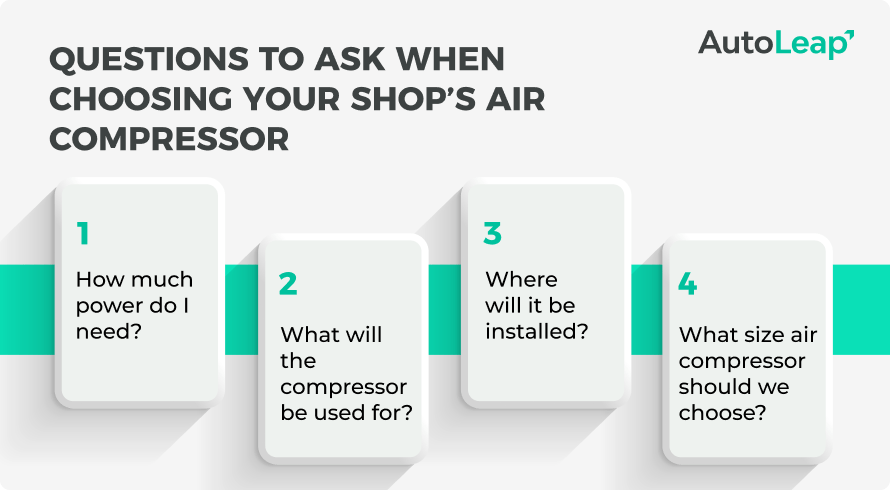
Power needs
An air compressor delivers 4 to 5 SCFM at 100 PSI for every horsepower unit, according to the Air Compressor Guide.
Use this benchmark to evaluate the exact SCFM your shop will require.
Energy usage
Professional-grade air compressors for auto repair shops are designed to withstand heavy usage for many responsibilities around the service bays, as they are durable and portable.
However, there are other considerations with this usage. One primary concern is the amount of energy they use to operate! As a growing shop focused on long-term profitability, the last thing you want is an out-of-control electric bill.
Take the time to calculate your usage needs and project how this will affect your electrical usage in the shop. Then, discuss these usage limitations with your team and stick to the plan.
These two components must factor into which air compressor you choose for your shop.
What will the air compressor be used for?
As we discussed, ensure you have a list of all your potential usage needs for the air compressor and how often you will execute these tasks.
That consideration will influence what air compressor features and specifications matter the most.
Other factors influencing your decision are how quiet you want it to run or how clean you want the air to be. The placement of your air compressor is another discussion point. It’s not just about filling a space; it’s about integrating this vital instrument into your shop.
Here are some other primary factors to consider:
- Proximity to power sources: Your compressor’s location should be conveniently near power sources. Seems obvious, right? But a thoughtful plan here makes a difference. It will help ensure seamless operation and reduce the need for extensive wiring.
- Ventilation: Good ventilation is not a luxury; it’s a necessity. An adequately ventilated space prevents overheating, ensuring your air compressor runs efficiently.
- Business flow: Keep the rhythm uninterrupted. Think about how the compressor’s location will interact with other areas of your business. The goal is to enhance workflow, not hinder it.
- Electrical compatibility: Ensure your building can support the compressor’s electrical requirements. It’s about balancing the compressor’s needs and your facility’s capabilities. And you want to remember the added costs associated here as well.
Beyond the basics, additional factors contribute to your workplace’s efficiency and safety. Some additional shop considerations for a new air compressor include:
- Noise level: Air compressors can be pretty loud, so consider the noise impact on your work environment. Placing it where noise is less disruptive to employees and customers is ideal. If noise is a significant concern, consider soundproofing options or enclosures designed for compressors.
- Safety and accessibility: Ensure the air compressor is easily accessible for maintenance and inspections but also situated in a way that doesn’t pose a hazard to staff or customers. Adequate space around the compressor for safe operation and maintenance is crucial.
- Moisture control: If your service bays are prone to humidity, it’s essential to consider how moisture in the air can affect the compressor. Placing it in a dry area or using a dehumidifier can help prevent moisture-related issues.
- Space for expansion: Consider your shop layout and how you allocate space for additional service bays or equipment. Ensure there’s room to upgrade or add more air compressors in the future, much like planning for additional workstations.
- Room temperature: Excess heat from an air compressor can raise the temperature in your shop to an uncomfortable level. You’ll need to remain mindful of this detail and the potential disruptions it may cause. The comfort of your techs matters, especially as they keep pace with a rigorous workload.
What size air compressor do I need for my mechanic shop?
Depending on your needs, air compressors come in all shapes and sizes. Options include everything from 12-volt units to large industrial systems like rotary pumps.
To choose the right size for your shop, you need to focus on:
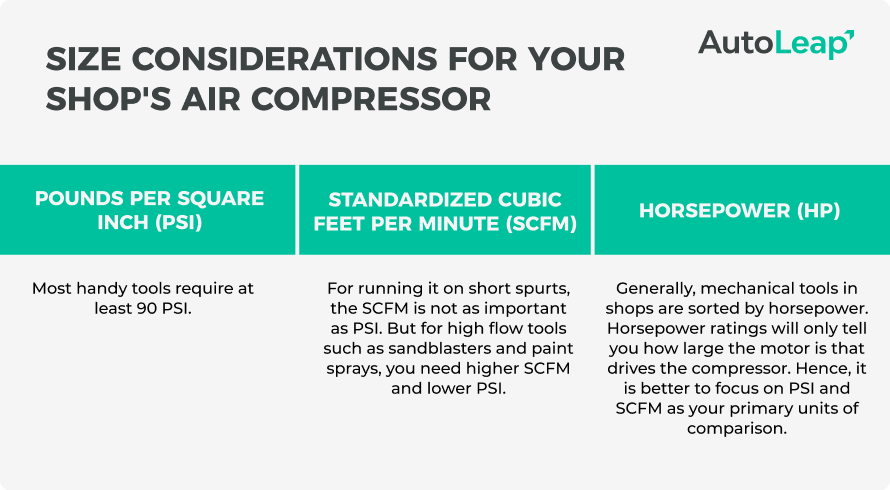
Once you consider these details, you can determine the size you need. Most tools have specifications and air compressors that match. You will need a rating of about 90 PSI and around 4 SCFM for impact wrenches or ratchets – the two most used air tools.
More air compressor considerations
- Tank size: The volume of compressed air that an air compressor can store depends on the tank size. Larger tanks offer a more consistent air supply, requiring less continuous use of the compressor. A larger tank is advantageous for auto repair shops because it ensures a constant airflow for diverse activities without excessively cycling the compressor.
- CFM (Cubic feet per minute) and PSI (Pounds per square inch): When selecting an air compressor for your auto repair shop, CFM and PSI are specifications to keep in mind. While PSI monitors the air pressure level, CFM shows how much air the compressor can produce. Depending on the tools and equipment you use in your auto repair business, different CFM and PSI requirements will apply.
Advantages of air compressors
With their steady supply of compressed air, air compressors deliver plenty of value for auto repairs and general maintenance work on vehicles.
Let’s break down some of the ways you can maximize a quality air compressor in your shop:
- High-pressure dusting & washing: Air compressors simplify cleaning dirt and dust behind an engine block or other parts of a vehicle where access is difficult. Its nozzle end has enough force to blow away settled dirt or soot without additional wiping or scrubbing. Choose compressed air systems with enough power for the work you want to perform. A quality air compressor helps in cleaning a wide range of mechanical parts. It’s often hard to clean behind the fissures inside rotors while you’re performing brake replacement jobs. But with the help of compressed air systems, you can complete vehicle cleaning jobs quickly and easily.
- Pneumatic tools: Air ratchets, airbrushes, sandblasters for sand blasting, paint sprayers for the painting process, air saws, and air sanders are examples of essential tools your mechanics may use. This equipment is powered by, you guessed it, air compressors.
- Tire inflation: Without air compressors, tire inflating facilities and garages are unable to operate. They are a piece of crucial equipment for shops that regularly inflate tires. In these situations, choosing the appropriate air compressor or digital tire inflator can increase your output.
Tips for air compressor maintenance
The tools, no matter how great they may be, mean nothing if they’re not well looked after and maintained. Air compressors are no different.
The following items on your auto repair shop inventory checklist should be inspected, cleaned, and serviced regularly to keep your compressor operating efficiently :
- Belts
- Motor bearings
- Intake vents
- Air filter
- Oil filter
- Lubricant
- Air dryer
- Amps
- Oil level
- Temperatures
- Vibration
- Voltage
Closing thoughts
Selecting the right type of air compressor involves understanding the size of air required, the tools you use and your future plans. The right size system can mean less downtime, increased technician efficiency, and preventing unnecessary future upgrades.
While having the right size compressor means increased productivity, knowing the profitability of your shop depends on measuring the performance of your labor as well. Use our labor rate calculator to check if the rates you are charging are aligned with the costs you are operating at and the profit you want.

Boost your shop sales
Simplify shop management
Empower your technicians