







Running an auto repair shop is incomplete without an online presence. An automotive reputation management strategy is the way to go. Your satisfied customers share positive reviews. Your potential customers see the trust earned online. Google improves your shop’s local ranking. All results in long-term credibility and more customers walking in.
Key takeaways:
- Learn why Google reviews have the biggest impact on local visibility and customer trust.
- Build a consistent review system using SMS follow-ups within 1–2 hours of service completion.
- Track the metrics that matter: review growth, response rates, and local search performance.
This blog tells you how to choose the right review platforms, optimize your Google Business Profile, and respond to reviews. Use feedback to improve operations, filter inspections in your shop management software, and measure reputation management success.
1. Why Online Reviews Are the Most Powerful Marketing Tool Your Shop Has
How Google uses reviews to rank local repair shops in the Local Pack
Imagine your auto repair shop appears at the top of Google search results. Every customer search results in your shop name, map and location appearing in the top three results. The chances of customers searching through and reaching your shop for services increase.
So, how does your auto shop appear in the top three results? This is called a local pack. A Google local pack would show your auto shop name, star ratings, address, opening hours, location map and website link.
Google sees local rankings based on relevance, prominence and distance. Relevance and distance are the easy part. A customer nearby needs a car serviced and is searching for an auto shop nearby. Your auto shop is within walking distance and also provides car services. So, by relevance and distance, Google can list your auto shop as one of the options.
Prominence is entirely based on customer rankings. It is how well-known your auto shop is and how many customers trust your services and post good reviews online. The higher the reviews and positive ratings, the higher the local ranking will be.
Apart from review counts and star ratings, Google also focuses on three SEO-specific factors:
- Review recency: How current the feedback and reviews are. Potential customers need to see the latest reviews to understand that the business is still doing well today.
- Review velocity: How consistently and quickly an auto shop is getting customer reviews. New reviews signal that the auto shop is actively in business and gaining customer trust.
- Keywords within review text: Specific keywords in the review phrases tell Google about the business and improve local SEO for your auto repair shop.
Google tries to surface the business and satisfy a searcher’s intent. This is why an actively reviewed shop receives stronger prominence signals than a stagnant competitor. Let’s consider the following example:
Shop A | Shop B |
45 reviews | 90 reviews |
4.2-star average | 4.7-star average |
Last review: 4 months ago | Last review: 3 days ago |
Clearly, Google will rank Shop B. Why? It has more reviews, has recently received reviews, and is more trusted and prominent in the market. Based on this, Shop B will be more likely to appear on Local Park visibility for searches on auto shop near me.
The link between review volume, recency, and customer trust
A customer searching your auto shop online would evaluate two things: quantity and freshness. Quantity for an auto shop is customer trust to get their vehicle serviced, washed, parts purchased, and even come to your shop for minor car inconveniences.
Freshness is when your customers can trust your shop today. Does your shop have advanced technology? That works well with modern ADAS systems. Customers satisfied with both quantity and freshness can result in positive reviews.
Auto shops with a high number of customer reviews show a history of customer satisfaction. More recent reviews mean your shop is still delivering quality services. Review recency shows potential customers that this business is actively providing services, and its customers are happy with the services. As per the Review Tracker guide:
“67% of consumers say reviews are influential when choosing an auto service provider.”
Fresh reviews are trusted more than old reviews. Auto shops having reviews from last month or even older lose authenticity. Someone reading old reviews might think that services, staff and pricing would have changed. For example:
Metric | Shop A | Shop B |
Reviews | 45 | 90 |
Rating | 4.2 | 4.7 |
Latest Review | 4 months ago | 3 days ago |
Google will rank Shop B higher. Due to more review volume, higher ratings and latest reviews.
Why satisfied customers don’t leave reviews and how to change that
Customers leave after their cars are serviced. They would show satisfaction and appreciate the services, and that’s it. Satisfied customers don’t necessarily mean more reviews. Customers often get too busy or forget to post reviews. That’s why shop owners shouldn’t wait for reviews.
It is a common mistake that auto shops assume good service would generate reviews. Rather, they should follow a proactive review request process. Cash in on the right timing in the service process to ask for customer reviews.
2. Which Review Platforms Actually Matter for Auto Repair Shops
Google reviews: primary ranking and trust signal
Ensure that Google is the primary platform. Review-building efforts towards Google help achieve SEO rankings and customer trust. As per BrightLocal’s Local Consumer Review Survey 2024:
“81% of consumers used Google to read reviews of local businesses in 2024, making it the most-used review platform. “
Reviews on Google directly influence local park visibility via prominence signals. When someone searches your auto shop, there is a separate reviews section. It shows quantity and ratings from all the customers. The shop name appears in Maps, and reviews are the most-consulted platform for “auto repair near me” searches.
Even for customers, posting reviews on Google is convenient. They are already logged in to their Google account, so it’s easy to follow the online link and post their reviews and ratings directly.
Yelp, Facebook, and secondary platforms: how much weight do they carry?
Yelp and Facebook should be treated as secondary review platforms. This means most auto shops’ efforts to gain reviews must go to Google first. Then use Yelp and Facebook to enhance brand presence and credibility.
Auto shops can allocate their efforts to gaining reviews:
- 80% Google
- 15% Yelp (especially iOS-heavy and West Coast markets)
- 5% Facebook (if the shop has an active local community presence)
Note: these percentages are best-practice guidance, not industry benchmarks.
Platform | Customer effort to leave a review | Local SEO value for independent repair shops |
Low: Most customers are already signed into a Google account, and a direct review link opens the review form immediately. | High: Directly supports Google Business Profile prominence and local search visibility. | |
Yelp | Medium: Customers may need to sign in or create a Yelp account before posting. | Low–Medium: Builds trust and visibility on Yelp but has limited direct impact on Google Local Pack rankings. |
Medium: Requires a Facebook account and is most effective for businesses with an active local following. | Low: Strengthens social proof but offers minimal direct influence on Google local rankings. |
Platforms to skip: why dealership review sites don’t apply to independent shops
Independent repair shops try to avoid asking customers to post a review on dealership review sites. DealerRater, Cars.com, and Edmunds are for dealership shoppers.
Repair customers adding reviews to these sites creates unnecessary friction. Also, it has zero local SEO value for an independent shop. This is why redirect all requests to Google.
How to Set Up and Optimize Your Google Business Profile
Categories, services, and attributes: what repair shops most often get wrong
Before setting up a Google profile, it is important to set the basics right. Primary and secondary business categories are one of the core pre-labels. You can choose 1 primary category and 9 secondary categories. This helps Google match your shop to relevant searches.
It is important to choose the primary category that best describes your core auto shop business. It could be an auto repair shop, a tire servicing or a mechanic shop. But selecting the Google Business Profile categories for repair shops tells Google what your business is. Also, complete the services and attributes section to improve relevance for customer searches.
Do not include service options that your shop does not perform. Choosing incorrect classifications will hurt your local search relevance.
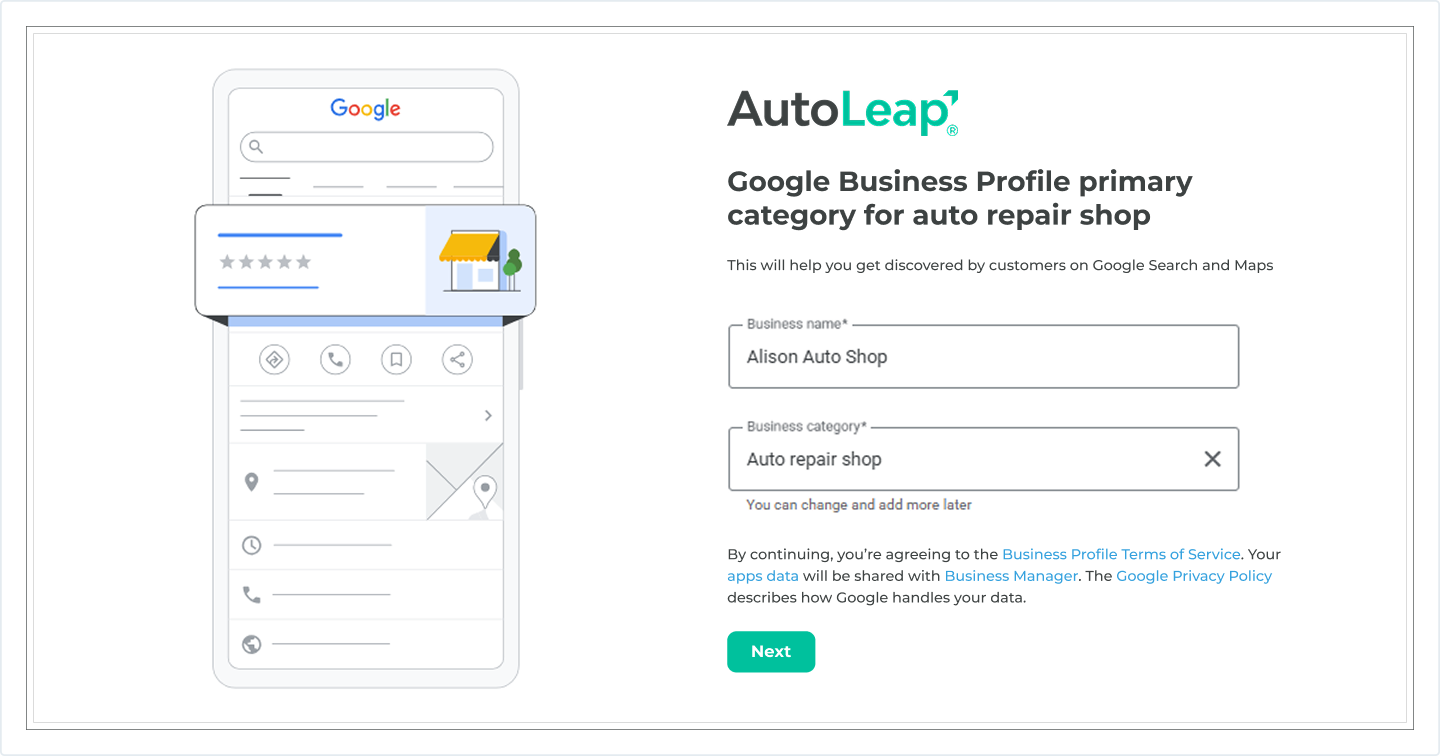
Photos, hours, and descriptions that drive profile conversions
No Google Business Profile is complete without photos. Add at least 10 high-quality photos of your auto shop. Let’s look at the example below:
If fixing vehicles is your main focus, choose “Auto Repair Shop” as your primary classification. Following that, pick three to five secondary labels that align with your specific offerings. These include:
- Tire Shop
- Transmission Shop
- Oil Change Service
- Brake Shop
- Auto Air Conditioning Service
Now add photos of your shop exterior, bays, technicians, waiting area, and completed work area. Add complete hours, including holiday exceptions, and a description written in plain language that customers actually search.
A complete business profile increases online views and visits to your auto shop. Customers are 2.7 times more likely to consider a business reputable if they find a complete business profile on Google Search and Maps.
Using GBP posts to stay visible between customer visits
A regular GBP post keeps your profile active. It is important to follow a simple 10-minute maintenance routine each month. In this routine, you add a recent photo of your auto shop. Also, share posts and talk about promotional services, seasonal services, or even shop updates.
3. How to Build a Consistent Review Collection System
Timing your review request for maximum conversion
Asking for a customer review need not look forced. But the more reviews, the better the rankings. So, when is a good time to ask for reviews?
The best time to request a review is within 1-2 hours after the service is complete and the invoice is closed. This is when the auto shop experience is still fresh in the customer’s mind.
You can send a warm and polite SMS to the customer saying:


Sharing the direct Google review link via SMS is an easier option. This way, customers can click on the link and are directed to where they have to share the review. If they are willing to share a review but can’t find the right link. Then, chances are that they will not give a review even when they wanted to. When they have the link, it reduces friction and frustration.
Send another SMS if the customer hasn’t shared a review within 48 hours. You can say:
Try to avoid sending multiple messages. Two messages per visit are enough.
SMS vs. email: which channel gets more reviews from repair customers
SMS is faster than email to reach customers. They can read the SMS sooner and provide a review immediately from their phones. This is why SMS outperforms emails, with higher open rates and faster review completion time. As per SimpleTexting SMS marketing report 2025:
“82% of consumers check text notifications within five minutes of receiving them, making SMS an effective channel for time-sensitive review requests sent shortly after service completion.”
This doesn’t mean emails are never to be used. Sometimes customers do not consent to receive texts. In which case, emails are secondary options for auto shops.
Train your service team to set up the ask without scripting it
Service advisors and the team need training on getting customer reviews.
When customers come to get the vehicle after services, the advisor explains to them what services were performed, and the vehicle is in perfect condition. During this conversation, the service advisor can depict customer is satisfied with their tone and responses.
It is at this time that the service advisor or the team can verbally request the customer to share their review. The request shouldn’t feel scripted or forced. Rather, they can say:
“You’ll receive a quick text after your visit; we’d appreciate your feedback.”
A common mistake the service team makes is asking verbally but not sending a digital follow-up. This results in a review loss. Even if the customer intends to review, they receive no follow-up text. They will forget within hours.
This is why the team should automate the SMS trigger at invoice close, so requests go out consistently regardless of how busy the service advisor is.
4. How to Respond to Reviews: Positive, Negative, and Unfair
Responding to 5-star reviews: beyond a generic thank-you
Once you receive positive reviews, it is important to reply. A generic thank you would not suffice. Rather, a personalised message shows the auto shop truly cares and reassures repeat customers.
Try using specific services performed and mention them naturally. The customer posted a review about brake repairs. The auto shop can reply with: “We’re glad we could get your brake repair completed quickly.” This shows potential customers that the auto shop is involved and improving click-through from search results. As per the local consumer survey 2025:
“89% of consumers are more likely to choose a business that responds to all reviews, while 57% say they’re unlikely to use a business that doesn’t respond at all. “
A step-by-step approach to negative review responses
Follow a step-by-step approach to diffuse negative reviews:
- Acknowledge the customer’s concern.
- Apologise for their experience (without admitting fault).
- Invite them to continue the conversation offline with a contact name and phone number.
- Keep the response under three sentences.
- Avoid technical explanations or public arguments.
A sample response to a negative Google review can be:
“We’re sorry to hear your visit didn’t meet your expectations. We’d appreciate the opportunity to make things right. Please contact Sarah at (555) 123-4567 so we can discuss your experience directly.”
What to do when a review is fake or retaliatory
It is not easy to take fake or retaliatory feedback. Some responses trigger anger or frustration. This is because the feedback is not true, the situation never happened, or that particular client never visited your shop. And so all the claims they posted online are false.
It is at this point that your team keeps their calm. Avoid accusing the reviewer or becoming defensive. Here’s what to do instead:
- Flag for Google removal if the review violates content policies
- There are content policies on the reviewer who was never a customer; the review contains false claims
- Respond calmly and briefly in the interim
- Continue earning genuine reviews to lessen the impact of isolated negative ratings.
6. Using Customer Feedback to Improve Shop Operations
Building a feedback loop between reviews and shop process
Treat customer reviews as an operational KPI, not isolated comments. Review new feedback weekly, log it against the service advisor and technician on the repair order, and discuss recurring patterns during monthly team meetings instead of reacting to individual reviews.
The complaints that appear most in auto repair reviews, and what they actually mean
Recurring comments like “the wait was longer than expected” often point to inaccurate time estimates or poor communication, not slow repairs. Identify the process behind the complaint before changing shop operations.
Turning negative patterns into staff coaching moments
Use 90-day review trends to guide coaching rather than emotionally replying to negative reviews. For example, if multiple customers mention delayed updates, then improve estimate accuracy and communication during check-in.
54%–70% of customers will do business with a company again if their complaint is resolved. That figure rises to 95% if the complaint is resolved quickly.
7. How Your Inspection Workflow Generates Your Best Reviews
Why customers who approve repairs via digital inspection leave more reviews
Digital vehicle inspection gives customers a tour of why their vehicle needs repair. Multiple photos and videos are shared with the customer to better understand and be transparent about the actual vehicle condition.
This clears up customer uncertainty or confusion about why repair is necessary. Also, when they feel confident, they are more likely to approve the repair process.
Confidence is one of the strongest predictors of unprompted 5-star reviews. Why? Customers are involved in the process from start to end and are shown through visuals. And so they are likely to include words like ‘honest’ or ‘trustworthy’ when sharing a review.
This is why it is important to provide a transparent service experience and earn customer trust.
The moment right after approval: turning transparency into a review trigger
Here’s an example of an inspection-to-review workflow:
- Technician completes digital inspection with brake pad photos
- Customer reviews and approves the repair via text
- Repair is completed, and RO is closed
- Automated Google review request is sent within 60 minutes
- Customer leaves a review highlighting the shop’s honesty and transparency.
Customers engaged in the inspection process already had a trust-building interaction. That’s why it is the strongest opportunity to request a review.
What to look for in shop software that makes this workflow frictionless
It is a common mistake to send review requests to all closed repair orders. Instead, prioritize review requests for customers engaged with inspection reports.
Choose shop software that supports digital vehicle inspections with photos and videos. Apply filters on repair orders based on customer-opened and approved inspection reports. Once filtered, set automatic repair requests after the repair order closes.
“OK Tire, using AutoLeap’s Digital Vehicle Inspection tool dramatically improves clarity, customer trust, and 30% increase in approval rates.”
8. How to Measure Whether Your Reputation Management Is Working
The five metrics every shop owner should track monthly
Track these KPIs together:
- Average star rating: Shows overall customer sentiment.
- New reviews per month: Measures review volume.
- Review response rate: How consistently you engage customers. The target is 100%
- Percentage of 1–2-star reviews in the last 90 days: Highlights recent problem patterns
- Review velocity: Auto shop reputation is growing, flat, or declining
Together they provide a more accurate picture than star rating alone and help build auto repair marketing strategies.
What a healthy review growth rate actually looks like for a repair shop
Review consistency matters more than occasional spikes. For example:
Shop | Reviews | Average rating | Monthly velocity | Local SEO position |
A | 85 | 4.3 | 12/month → 4/month | Weaker local SEO position |
B | 50 | 4.5 | 15/month | Stronger local SEO position |
Shop A has a weaker local SEO position than Shop B despite having more total reviews. This is because its review velocity has dropped sharply.
Google weighs recency and consistency more than static totals. So Shop B’s steady monthly review growth gives it the stronger local SEO edge.
How to benchmark your reputation against local competitors
Compare your shop star rating, review volume, review velocity, and response rate with the top-ranking local repair shops. Do not just go by overall rating.
A 4.8-star shop that gets one review every two months. This shop will usually be outranked in the Local Pack by a 4.5-star shop that consistently earns 10 reviews per month. This is because Google values recency, consistency, and engagement as much as the average rating.
Closing thoughts
Automotive reputation management isn’t about collecting the most reviews. It’’s about creating a consistent system that builds trust at every customer interaction.
Optimizing your Google Business Profile, requesting reviews at the right time, and tracking key reputation metrics. Treat customer feedback as an ongoing business asset. This way, you can improve local visibility and win more repair customers.