







Auto repair labor rates in the US are in the range of approximately $90 to over $180 per hour. This depends on the geographical location, the type of shop, and the skill of the technician. The average labor rate in Canada is about CAD $95 to CAD $145 per hour. These vary significantly among provinces and territories.
In both countries, labor rates vary. This is due to operating costs, technicians’ availability, and market demand. In large cities, overhead costs, such as rent, wages, and insurance, are more expensive than in rural areas. This can drive up prices for shops. Speciality repair shops, European vehicle repair experts and vehicle dealership service departments also usually charge more for labor than other repair shops. Technician certifications, continuing education and investments in diagnostic equipment can also impact pricing.
Looking for guidance on estimating repair times rather than setting labor rates? See our step-by-step labor guide for shop owners

What are auto shop labor rates?
It is the rate charged for repairing and maintaining vehicles. Labor rates impact the overall cost of services. These costs reflect the expertise and quality of service at a shop. Higher rates are valued at better and faster service.
It is important for both shop owners and customers. They need to understand the work being done and make sure the prices reflect the quality of that work.
Labor rates formula and factors
The factors include technicians’ wages, shop rent, utility costs, the expense of equipment, and other operating costs. Shops essentially look at how many hours a technician is billable. This means how many hours they can charge customers for. The billable hours and other costs are added to calculate the hourly rate.
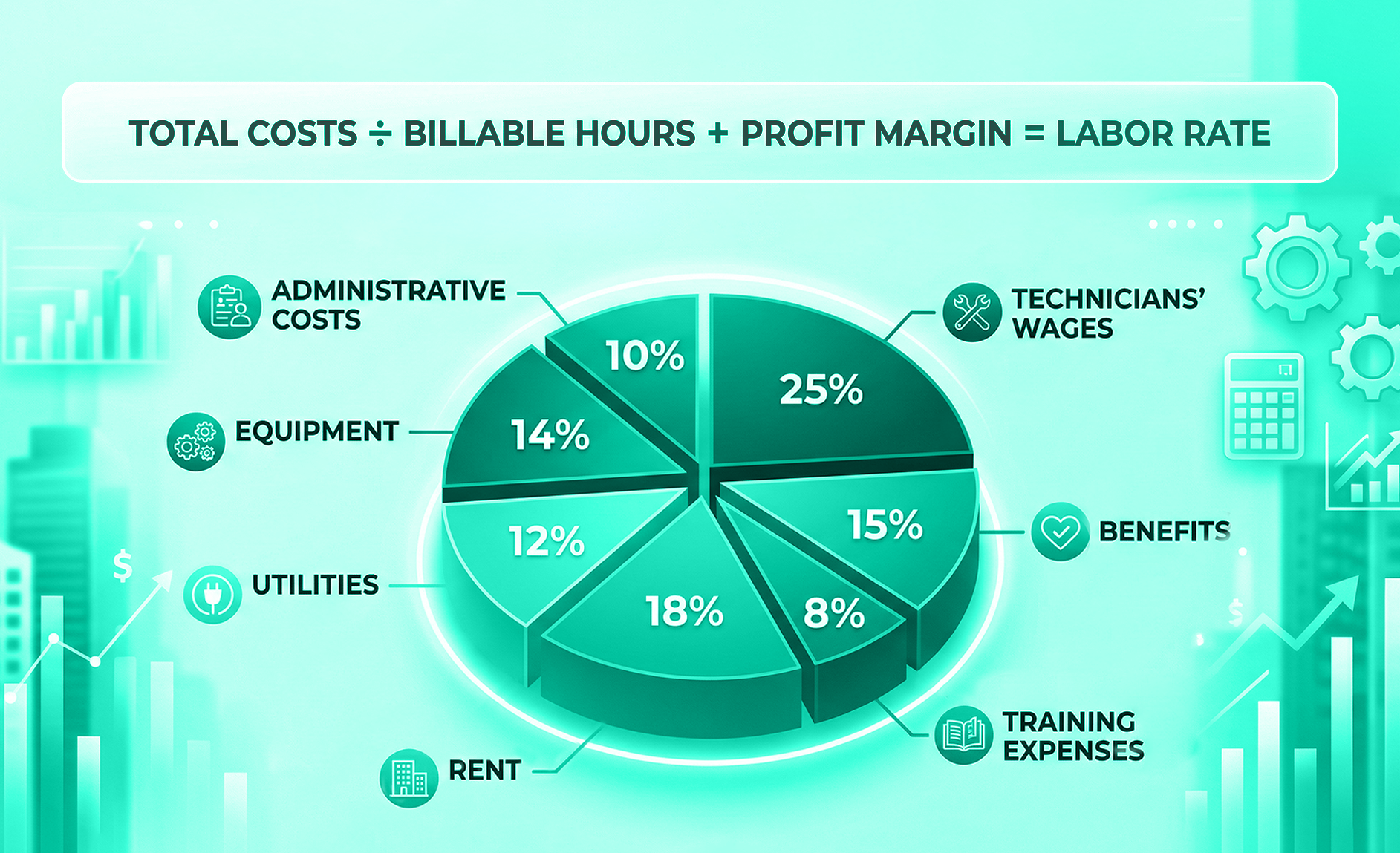
Flat Rate vs. Hourly Labor Rate
With flat rates, the shop sets a standard price for certain repairs. It is based on the estimated time repairs take, regardless of how long it actually takes. Hourly rates are for the actual time spent repairing vehicles. This offers flexibility but leads to unexpected costs.
5 Factors for Auto Repair Labor Rates
Changing state legislation, rises and lows in the economy, and living costs are some of the factors that affect labor rates.
Location and living Costs
In remote states, the cost to transport goods and resources can drive up labor rates. States like Alaska and Hawaii often have higher costs due to their isolation. Shops there might raise their prices to cover increased expenses and lack of access to resources.
Then there are states with high living costs, such as New York and California. Mechanics need to earn enough to cover their own living expenses, like housing and transportation. That’s why labor rates tend to be higher in these areas. States like Mississippi have lower living expenses and lower labor rates.
Within the sector, the rate varied between urban and rural areas. The sector had urban vs rural labor rate differences. This urban-rural divide is across Canada. Higher average operating expenses and demand lead to higher labor rates in major markets like Toronto, Vancouver and Calgary. Also, lower average labor rates in many rural communities and the Atlantic provinces. The same trends can be seen in the large US metros vs. regional markets.
Technician skills
Another factor is the expertise of the technicians. Shops that hire certified mechanics and provide specialized training may charge more. Since those technicians can diagnose and fix problems more efficiently. Customers often trust these experts and are willing to pay a premium for their skills.
Shop Type
The type of shop has an impact. Dealerships charge more because they employ factory-trained technicians. They have better access to specialized tools and resources. Independent shops, in contrast, generally have lower rates. Chain shops can be similar, as they often operate with a set menu of prices and services.
State and Local Regulations
State and local regulations can increase labor costs. For example, California has stringent labor laws. It has higher minimum wage requirements that increase the costs for automotive services. Meanwhile, states with fewer regulations, like Texas, have lower rates.
Employers have to pay higher wages. They have higher labor rates than states with lower wages, such as Arkansas and Mississippi.
Demand for Automotive Services
The general demand for automotive services can also impact labor rates. In busy regions or densely populated states, the higher demand for repairs can drive prices up. More cars on the road mean more repairs needed. So, shops charge higher labor rates to reflect that demand.
State-by-State Analysis of Auto Shop Labor Rates
Here is the state-by-state average auto mechanic labor rate. Automotive shop labor rates vary by state based on location, cost of living, and shop focus.
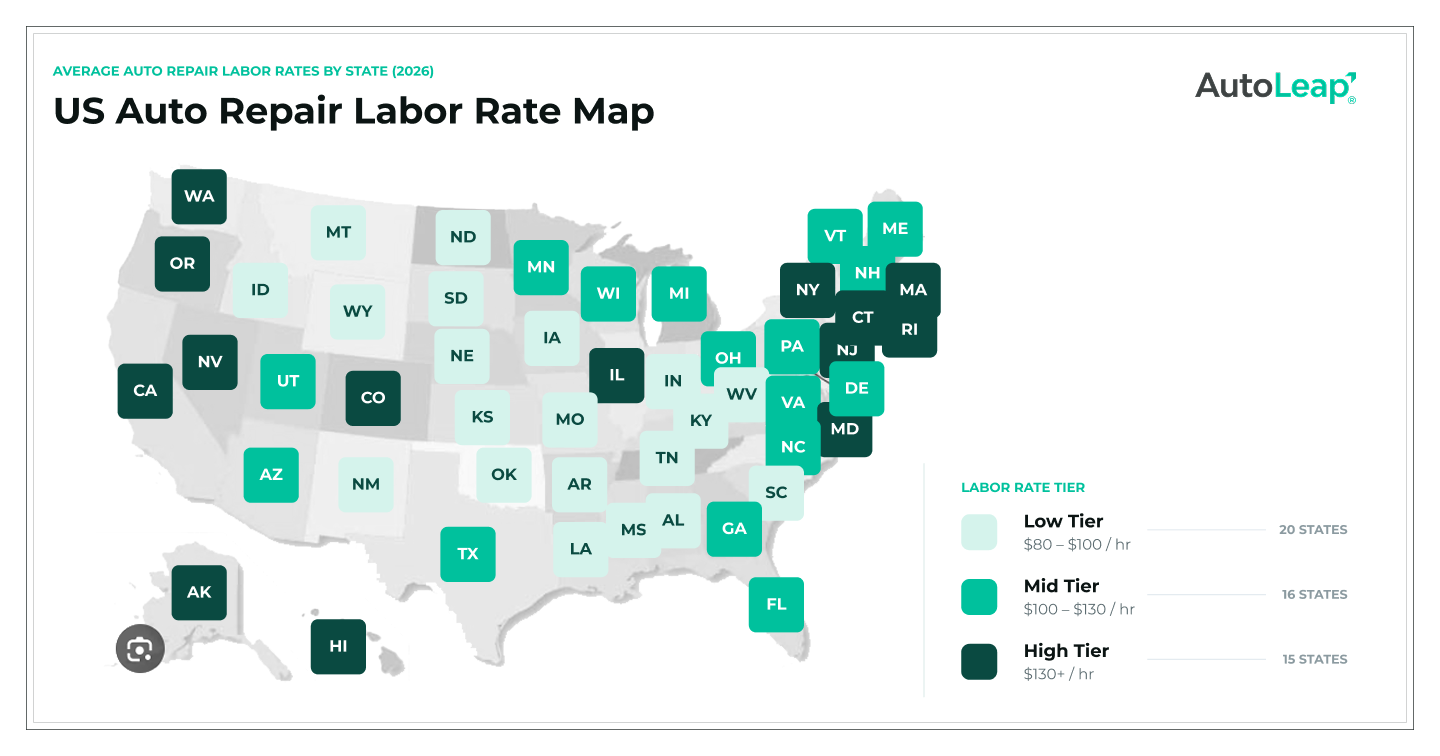
Northeast
These states have higher labor rates due to higher wages, strict regulations, and demand for advanced repairs.
Midwest
Midwest offers moderate labor rates due to affordable costs overall.
South
These states offer competitive pricing due to lower costs, an increase in population, and demand for vehicles, leading to higher services and repairs.
West
Western states, especially California, offer the highest labor rate. This is because of high living standards and high environmental standards.
National Averages and Key Takeaways
Across the U.S., the average auto repair labor rate typically falls around $120 to $159 per hour. A national benchmark is near $140 for independent shops. The location, cost of living, and mechanic experience are key factors for labor rates.
| State | Region | Average Labor Rate |
| Alabama | South | $140-$150/hr |
| Alaska | West | $135-$150/hr |
| Arizona | West | $125-$140/hr |
| Arkansas | South | $140-$150/hr |
| California | West | $155-$175/hr |
| Colorado | West | $135-$150/hr |
| Connecticut | Northeast | $125-$140/hr |
| Delaware | South | $130-$145/hr |
| District of Columbia | Mid-Atlantic | $135-$150/hr |
| Florida | South | $140-$145/hr |
| Georgia | South | $140-$150/hr |
| Hawaii | West | $120-$140/hr |
| Idaho | West | $130-$145/hr |
| Illinois | Midwest | $125-$140/hr |
| Indiana | Midwest | $135-$145/hr |
| Iowa | Midwest | $130-$145/hr |
| Kansas | Midwest | $135-$150/hr |
| Kentucky | South | $140-$150/hr |
| Louisiana | South | $140-$150/hr |
| Maine | Northeast | $130-$140/hr |
| Maryland | South | $135-$145/hr |
| Massachusetts | Northeast | $130-$135/hr |
| Michigan | Midwest | $135-$145/hr |
| Minnesota | Midwest | $135-$150/hr |
| Mississippi | South | $150-$155/hr |
| Missouri | Midwest | $135-$150/hr |
| Montana | West | $140-$150/hr |
| Nebraska | Midwest | $135-$150/hr |
| Nevada | West | $130-$140/hr |
| New Hampshire | Northeast | $120-$135/hr |
| New Jersey | Northeast | $140-$145/hr |
| New Mexico | West | $135-$145/hr |
| New York | Northeast | $135-$140/hr |
| North Carolina | South | $85-$105/hr |
| North Dakota | Midwest | $130-$145/hr |
| Ohio | Midwest | $130-$140/hr |
| Oklahoma | South | $135-$150/hr |
| Oregon | West | $130-$140/hr |
| Pennsylvania | Northeast | $135-$140/hr |
| Rhode Island | Northeast | $120-$130/hr |
| South Carolina | South | $130-$145/hr |
| South Dakota | Midwest | $130-$150/hr |
| Tennessee | South | $140-$150/hr |
| Texas | South | $140-$145/hr |
| Utah | West | $130-$145/hr |
| Vermont | Northeast | $115-$130/hr |
| Virginia | South | $130-$145/hr |
| Washington | West | $135-$145/hr |
| West Virginia | South | $140-$145/hr |
| Wisconsin | Midwest | $130-$145/hr |
| Wyoming | West | $150-$155/hr |
Data compiled from AAA, BLS, and industry surveys. Last updated June 2026.
Note: State-level auto repair labor-rate datasets vary significantly between industry surveys, and some values in the table may differ
Auto Repair Labor Rates in Canada by Province
Auto repair labor rates in Canada vary significantly by province and territory. Higher rates found in regions with high operating costs and stronger demand for skilled technicians. Most Canadian repair shops charge between CAD $95 and CAD $135 per labor hour. These rates can exceed this range in major metropolitan markets. Differences in cost of living, technician availability, and provincial tax structures (GST, PST, and HST). These all contribute to regional pricing variations.
Canadian Auto Repair Labor Rates by Province and Territory
| Province / Territory | Region | Average Labor Rate (CAD) |
| Alberta | West | $120–$140/hr |
| British Columbia | West | $125–$145/hr |
| Saskatchewan | West | $105–$125/hr |
| Manitoba | Central | $100–$120/hr |
| Ontario | Central | $120–$140/hr |
| Quebec | East | $110–$130/hr |
| New Brunswick | East | $90–$105/hr |
| Nova Scotia | East | $95–$110/hr |
| Prince Edward Island | East | $90–$105/hr |
| Newfoundland and Labrador | East | $95–$110/hr |
| Yukon | North | $115–$135/hr |
| Northwest Territories | North | $125–$145/hr |
| Nunavut | North | $135–$155/hr |
Data compiled from CAA, Statistics Canada, and provincial industry reports. Last updated June 2026.
Note: Canadian labor-rate estimates compiled from automotive repair industry surveys, regional shop pricing data, and Canadian market benchmarks. Provincial averages reflect prevailing independent auto repair shop labor rates and are intended as directional benchmarks rather than regulated pricing standards.
Source: CAA (Canadian Automobile Association) Repair Cost Guidance
Citation Footnote
Average labor rates are based on publicly available automotive repair industry benchmarks, regional shop pricing surveys, and Canadian market rate comparisons reviewed in 2025–2026.

How to Set Competitive Labor Rates for Your Auto Shop
Setting competitive labor rates is difficult for shop owners. They want to ensure they can cover their costs. Also, ensure they charge their customers a fair price. They generally do a cost analysis and market research to set the right price.
The pricing model is cost-plus, and it’s the same for the United States and Canada. Labor rates are derived by the shops. They consider factors like
- Technicians’ wages
- Occupancy costs
- Equipment investment
- Software costs
- Desired profit margin.
- Work insurance: WSIB premiums in Ontario, WorkSafeBC premiums in British Columbia. These differ from US workers’ compensation structures.
Competitor survey
Benchmarking is when you do a survey of the rates being charged by other auto shops in the market. After doing the survey, you can decide to have a competitive rate that does not undercut your rates. It shouldn’t be so low that you lose business because of low quality. But not so high that you lose business to competitors.
Trainings and skills
Skilled and certified technicians can work efficiently and quickly. Garage owners should invest in the training and certification of their employees. They can raise their rates because that is the value customers will pay for.
Complex repairs at different rates
Not all services are equal. Complex repairs are more time-consuming than basic car services. Repairs to the engine or transmission are complex and require a higher level of expertise. Repair shops can charge more for the time spent, the parts used, and the resources invested for complex services.
Use shop management software
Shop owners use shop management software to track billable hours, overheads, and profit margins in real time. They can make quick decisions based on accurate data and reports.
Business Operations and labor rates
Labor rate variance is a function of regional economic conditions, labor costs and regulatory requirements in both the United States and Canada. Canadian repair shops also adjust based on provincial tax laws like GST, PST, and HST. This can impact the price of repairs and customer expectations. Rate variations across the Canadian market are due to a combination of factors. These include differences in provincial minimum wage rates, technicians’ availability, and operating costs. Repair procedures are uniform throughout North America. But some operate in either metric or imperial measurement systems. This depends on the vehicle type and manufacturer’s requirements.
Let’s look at how they affect business:
Pricing and Profits
Labor rates affect the pricing model of auto repair shops. If you charge too little, you might not be profitable in high labor-rate markets. If you charge too much in low-labor-rate markets, you might lose customers.
A market survey of local labor rates helps owners plan better. Like what to pay technicians, what to invest in tools and technologies, and how much to spend on marketing and other expenses.
Customer Expectations
Customers’ expectations can vary depending on the size of your region’s labor market. If you are in a high-labor-rate area, you might expect quality service, modern diagnostics, and quick service. This will keep your customers satisfied.
In a low-labor-rate area, customers will expect value and reliability. In this case, the challenge for a business is to provide good quality, trustworthy relationships at a reasonable price.
Technician hiring
In regions where pay is higher, shops can hire fewer but more qualified mechanics who can work efficiently. They finish jobs more quickly, contributing to overall productivity. On the other hand, shops in lower-cost areas might hire more staff to ensure they can meet demand without sacrificing quality.
Using auto repair labor guide software like AutoLeap. The software makes sure your shop is using local information to set your labor rates. It efficiently estimates repairs, ensuring you are competitive and profitable.
Competitive Positioning in the Local Market
Observing local labor rates and trends can help a business determine its position. They can then adjust their services and prices according to market demand and target customers
Shops operating in areas with lower rates offer a broader range of services. From maintenance and basic repairs to boost their market share. Some shops offer niche high-end services to cater to high-end clients only.
Closing thoughts
By taking these factors into account and using an automotive labor guide software, you can set competitive and profitable labor rates, ensuring your auto repair shop is successful regardless of your location. This will help you set your prices. Be sure to include local labor rates to compete for business.
It’s important to be aware of local labor rate benchmarks. Running an independent repair shop in the US or Canada, stay profitable and competitive in your market. Comparing rates against the regional averages helps you determine which areas you need to work on. Use those to gain the advantages of improved margins, qualified technician wages, and better control of operating costs.

Boost your shop sales
Simplify shop management
Empower your technicians