







Your auto shop is busy. You’re scheduling appointments, servicing customers, inspecting vehicles, communicating with your customers, and doing so much more. There’s a lot going on. Without the right tools supporting you and your staff, it can quickly get very overwhelming.
Adding tools like auto repair shop management software can help you manage operations smoothly. You can order parts, schedule appointments, manage your technicians, or even payroll. There’s so much that you can manage easily. It frees you up to service your customers and build lasting relationships with them.
Let’s take you through the many ways the software can help your auto shop overcome these common challenges. But first, let’s zero in on the challenges auto shops face on a daily basis.
Schedule a free demo today!

Boost your shop sales
Simplify shop management
Empower your technicians
9 Common auto repair shop challenges
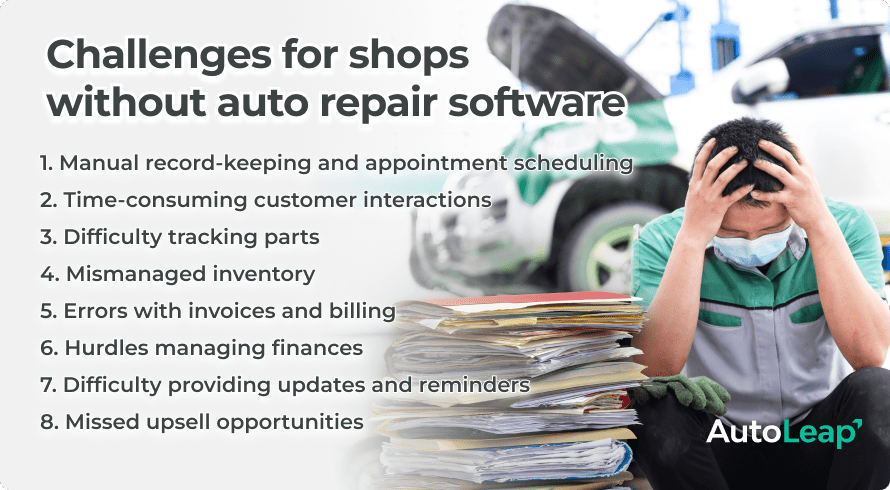
Auto shops face many challenges in their daily operations. With so much happening in parallel, it is hard to keep tabs on the different moving parts in the shop.
1. Scheduling appointments manually
Your auto shop will most likely have multiple customers looking for appointments. Scheduling appointments and managing a calendar manually means it is very easy to double-book a slot or overbook bays. Keeping an eye on technician calendars can easily get confusing. It gets difficult to manage their workload when the calendar is all over the place.
All of these issues might seem ordinary, but they can disrupt the workflow and, over time eat into the shop’s revenue.
2. Time-consuming customer communication
Your technicians often spend a lot of valuable time on the phone explaining service repairs to customers. This eats up their time and also creates an unpleasant service experience. And when your customers don’t have clarity on what’s going on with their vehicle, they lose trust in your business.
3. Outdated inventory management practices
Your shop’s inventory needs to be up to date. If technicians are spending all their valuable time searching for or ordering parts at the last minute, jobs will get delayed.
This will leave your customers frustrated and unhappy. On the other hand, when you order more parts than necessary, you have capital tied up there. Parts can get obsolete fast, so without proper tracking and management, you lose money there.
4. Stuck on paper invoices and billing
Having accurate data is crucial for auto repair shops.
If your shop is still issuing manual invoices and doing bookkeeping the old way, then your data is likely prone to errors such as mispricing or miscalculations.
This can happen often when staff forget charges or sometimes overcharge for a service. Since there is no central system where all invoices and payments are managed, it can cause payment disputes that hurt cash flow. Over time, this can damage your shop’s reputation.
5. Lack of finance management
Managing invoices manually also means your financial records are most likely a mess. Documents get lost, invoices and bills are all over the place. This is problematic during tax season and audit cycles. It can even lead to legal and financial troubles.
6. Mechanic shortage
There is a mechanic shortage in the auto industry as it is. Staff are overworked, and it is a struggle to find and retain qualified and experienced technicians.
A handful of people are not only servicing vehicles, but also ordering parts, managing customers, answering calls, and doing admin work. A burnt-out staff means higher employee turnover, which can cause workflow disruptions as well.
7. New technology in cars
The auto industry is moving fast. We already have electric and hybrid vehicles. Then there is Advanced Driver Assistance Systems (ADAS) with new complex features. New technology means your technicians need to keep up with the latest trends. They need new tools to work on modern vehicles, in addition to the latest training and education.
8. Missed opportunities for upselling services
Auto shops lose money and often disappoint customers when they don’t track past services and upcoming maintenance checks.
An easy way to service customers is by keeping a track of when they need certain services done, for example, regular oil changes or tire changes. You lose out on upsell opportunities and a significant revenue stream without a centralized system for customer records.
Without software, you would miss this important context and may never mention it to them.
8. Storing all records manually
Auto shops sometimes have manual records and written notes for repair scheduling. This can create confusion and can also lead to potential mistakes. There will be miscommunication between the technician and service advisor which will cause further delays in coordinating repairs.
Auto repair shop customers’ pain points
So when the shop is struggling with so many issues, this directly impacts the kind of experience your customers have at the shop. With delays, mismanaged calendars, undertrained mechanics and getting wrongly charged for services, your customers are bound to be frustrated.
One bad experience can cost you repeat business. The key is to understand your customers’ pain points so you can take the necessary steps.
Incomplete information
Your customers want updates on how the repair work is going. They expect transparency every step of the way. Incomplete information leads to distrust. At the end, they might also suspect unexpected charges on the final bill. They won’t trust the quality of repairs either.
Communication delays
Customers also get frustrated with the lack of communication. If they are calling you or asking for updates, they expect fast, clear responses. Unreturned phone calls and vague status updates will leave them dissatisfied. Plus, customers also want clear timelines. If your technicians are unclear on how long the repair work will take, again your customers will be unhappy.
Inconsistent service
Another major pain point for customers in the auto industry is the inconsistent service quality on every shop visit. This again impacts customer loyalty when they do not get the same level of service.
Long wait times
Customers don’t want to wait for a long time to get simple work done. The long wait times, scheduling issues, and repeat visits cause nothing but frustration for the customers. They will simply take their business to a shop that doesn’t make them wait too long.
How shop management software helps overcome these customer pain points
So your shop is drowning in inefficient daily operations, customers are unhappy, and there’s havoc all around. How will you overcome all these customer pain points?
The best way to overcome these is by using a shop management software that can help the shop owners manage operations smoothly. Here’s how it can make a difference.
Easy scheduling and communication
With shop management software, digital calendars can help with automated scheduling and reminders. Customers can schedule appointments themselves, which means more convenience and accessibility. Plus, they get an automated reminder before their appointment, which reduces the chances of no-shows.
Integrated forms of communication, such as texts or emails, keep the customers informed without someone having to manually update them. A centralized calendar aligns your team and keeps a track of all appointments.
Improved transparency
Features such as digital vehicle inspections (DVIs), let technicians record vehicle issues with photos and videos to help communicate the problems detected to the customer.
Unclear documentation leaves room for doubt. But with clear photos and videos of before and after, your technicians words will be backed by actual proof. Plus, your technician won’t have to spend hours explaining what repairs are needed, which saves time.
Digitally documenting repairs helps build trust and also reduces wait times by securing faster approvals.
Automated inventory management
Shop management software gives you control over your inventory. It allows you to track parts, manage costs, and track inventory in real-time. The software flags auto parts and supplies that are running low, and can quickly order parts across hundreds of vendors. This automated inventory management ensures accuracy and helps your technicians save time.
Technician training and retention
When your technicians are supported with a shop management software that automates invoicing, appointment scheduling, manages inventory, and can also send updates to customers, they get a lot of time back.
Efficient workflows reduce technician frustration, time spent on one job, and also leave more time for them to get additional training. This training helps them work even more efficiently. Plus, with so much ease, you have a better chance of retaining them. If they are overworked and burnt out, chances are they will end up leaving.
Issues with traditional repair shop management methods
Despite the availability of the best shop management software, there are some auto shops that still use traditional, manual, paper-based methods. A few things these shops keep doing are.
They rely on manual processes
These auto shops still have manual shop management processes. They depend on pen, paper, and memory for scheduling, sending reminders (if they send reminders), and record-keeping. This means lost information, inconsistent services, and a slow workflow. Calculations go wrong, there are more errors, and all this means your customers see your shop as unprofessional and amateur.
They don’t have proper customer feedback systems
The auto shops use traditional methods of shop management to collect customer feedback. They don’t have a structured way to understand what their customers want, and because of this, shops happen to miss out on valuable insights. They also miss out on what their customers want and where they can improve in their services. This causes service gaps and creates negative experiences for the customer.
They have inaccurate records
Again, with everything being managed, calculated, and recorded with pen/paper, there are many inaccurate records. Your technicians might underestimate jobs, miss out on charges, or there might be pricing errors. All of this affects your shop’s profitability over time. Plus, with wrong calculations and inaccurate estimates, you lose customer trust as well.
They are busy with daily tasks
Without a shop management software, your technicians are going to be bogged down with daily mundane tasks. These become a burden and take an unnecessarily long time. Shop owners, managers, and technicians are stuck managing repetitive tasks, and they don’t have time for big-picture planning. They are unable to focus on the long-term strategic growth of the auto shop.
How modern shop management methods help auto shops
Adopting technology helps auto shops get more work done, increase profits, and build customer trust and loyalty. Using modern shop management methods can help shops
Increase efficiency
By automating repetitive tasks, your team can focus on servicing customers, repairing vehicles, and increasing billable hours. Instead of spending endless hours scheduling appointments or doing paperwork, they can focus on more productive work.
Improve profitability
When technicians have more time to focus on productive work, they increase profits for the shop. Not just that, with a shop management software, they have better estimates, inventory management, and of course, when everything is automated, there are fewer mistakes. This means a healthier bottom line for your shop.
Keep loyal customer
When things are running smoothly, they are more organized, and your staff can service customers better. With transparency and clear communication with the customers, you get a chance to build an honest relationship with them. This builds trust and turns one-time customers into lifelong clients.
Better work environment
All of this reflects in your shop’s work environment as well. With less ad hoc work popping up, fewer admin tasks to take care of, your staff is less stressed. They spend more time in the service bay rather than the front desk, which helps in technician retention as well.
Wrapping up
It’s important to stay with the times and adopt technology to stay ahead of the curve. This can help improve your systems, serve your customers better, and also improve profitability. A modern shop management system does just that. With a smooth, organized workflow, it gives your technicians time to focus on the job they are hired to do instead of spending all their time doing admin work.