



Opening a tire shop sounds straightforward on the surface. You stock some tires, hire a couple of technicians, and let the customers roll in. But anyone who’s actually done it will tell you the real picture is a lot more detailed. And a lot more expensive than most people expect.
The good news? It’s also a genuinely lucrative business when you get the fundamentals right. Tire shops are one of the few automotive businesses that benefit from consistent, non-negotiable demand. Cars need tires. They always will. The question isn’t whether the market is there. It’s whether you’ve planned your capital carefully enough to survive long enough to capture it.
This guide walks you through every major cost category you need to budget for, including the ones most aspiring owners seriously underestimate.

The initial tire shop startup costs
Before a single customer drives in, you’re already spending money. Two of the biggest early commitments are your physical location and the administrative layer that makes your business legal and protected.
Get the right facility and garage space
Tire shops have specific real estate requirements that many first-time owners don’t fully consider. You’re not just renting floor space. You have to think about ceiling height, bay access, and drainage infrastructure. You need enough square footage to store hundreds of tires without creating a fire hazard or a logistical nightmare.
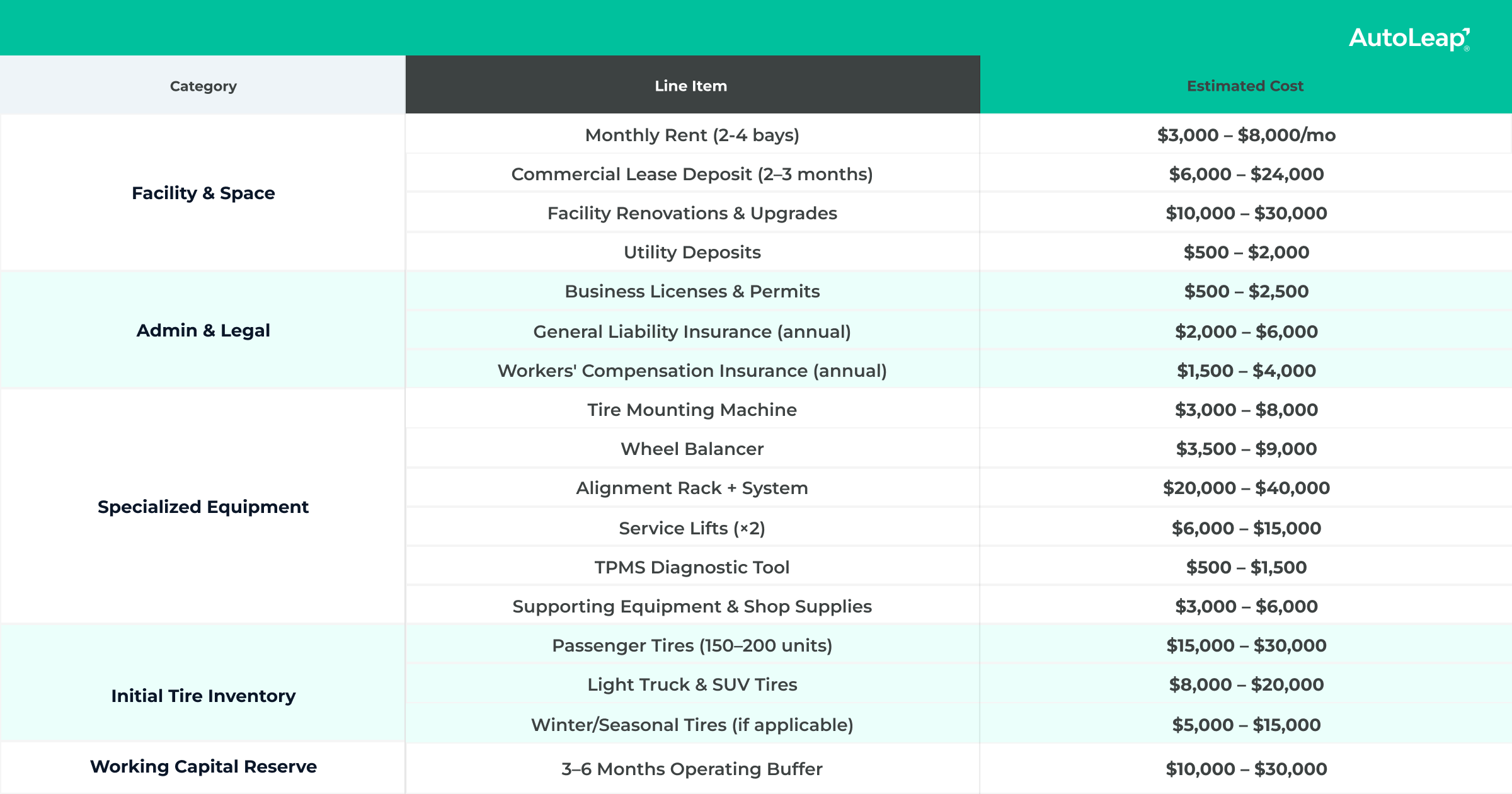
In most mid-size U.S. markets, a commercial garage space with two to four service bays will run you anywhere from $3,000 to $8,000 per month in rent, depending on city, condition, and how much of the facility is already built out. In high-traffic metro areas, that number can climb significantly higher.
Here’s where a lot of people stumble: they calculate monthly rent but forget about the commercial lease deposit, which is usually two to three months of rent paid upfront. That’s a $6,000 to $24,000 hit before you’ve even touched a lug nut. Add in utility deposits, parking lot considerations, and any required exterior signage, and your initial facility commitments can easily approach $30,000 to $40,000 before you’ve renovated a thing.
Speaking of renovations, tire shops need
- Sturdy flooring
- High-capacity shelving racks for inventory storage
- Proper drainage for fluid disposal
- Adequate lighting throughout the bays.
Budget between $10,000 and $30,000 for facility upgrades, depending on your space’s condition. If you’re lucky enough to find a location that was previously used as an automotive shop, you could save significant money here. If you’re converting a general warehouse, expect to spend on the higher end.
A smart play when evaluating locations: don’t just look at the rent figure. Factor in
- Proximity to high-traffic roads
- Local competitor density
- How easy it is for customers to pull in with a trailer or a truck hauling heavy loads
The slightly more expensive space on the corner of a busy intersection will almost always outperform the cheaper unit tucked behind a strip mall.
Account for administrative fees and business licenses
This part isn’t glamorous, but skip it, and you’re operating illegally. Which is a fast way to end your business before it starts. Here are all the permits and licenses you’ll need for your tire shop:
- Business license from your city or county
- Seller’s permit if your state taxes tire sales (most do)
- EPA registration for proper tire and fluid disposal
- Automotive repair dealer license, depending on your state.
- Additional environmental compliance certifications, particularly around waste oil and used tire disposal.
Budget roughly $500 to $2,500 for licensing and registration fees across the board, though this varies significantly by state. California, for example, has a notoriously complex licensing environment for automotive businesses.
Don’t overlook business insurance. A tire shop carries real liability. Let’s not forget you’re mounting tires that go on vehicles traveling at highway speeds. A general liability policy for an automotive shop typically runs between $2,000 and $6,000 per year, and you’ll want to make sure it specifically covers tire installation and road hazard liability. If you’re hiring employees from day one, add workers’ compensation coverage on top of that.
Invest in equipment and initial tire inventory
This is the section that separates tire shops from general auto repair businesses, and it’s where the most significant capital commitments live. If you came from a general mechanical background, this part about opening a tire shop might genuinely surprise you.
Buy essential tire mounting and balancing machines
You cannot run a tire shop without specialized equipment. Here’s all the equipment you need to start your tire shop:
Tire mounting machine (tire changer): This is the machine that removes old tires from rims and seats new ones. A solid commercial-grade unit from a reputable brand like Hunter, Coats, or Ranger will cost between $3,000 and $8,000. Try not to cut corners here. Cheap mounting machines damage wheels and create comebacks that destroy your reputation fast.
Wheel balancer: After mounting, every tire needs to be balanced before it goes back on a vehicle. A quality computerized wheel balancer runs $3,500 to $9,000. Newer models with automatic laser measurement are faster and reduce technician error, which matters a lot when you’re moving volume.
Alignment rack and alignment system: This is the big one. A four-wheel alignment system from a brand like Hunter or John Bean requires a specialty lift and software that often costs $20,000 to $40,000 combined. You don’t absolutely need alignment capability to open a tire shop, but it’s one of the highest-margin services you can offer, and customers almost always need a check after new tires. Many successful shops add this in their first year once cash flow stabilizes.
Service lifts: You’ll need at least two two-post or four-post lifts to mount tires efficiently. Quality lifts run $3,000 to $6,000 each, and installation adds another $500 to $1,500 per lift, depending on your floor and electrical situation.
TPMS tools: Tire Pressure Monitoring Systems are standard on virtually every vehicle made after 2007. You’ll need a quality TPMS diagnostic and programming tool to properly service these sensors during tire replacements. Budget $500 to $1,500 for a professional-grade TPMS tool.
Supporting equipment: Add in an air compressor, impact wrenches, torque sticks, bead sealer, valve stem tools, and basic shop supplies, and you’re looking at another $3,000 to $6,000 in supporting gear.
When you add it all up, outfitting a basic two-bay tire shop with essential specialized equipment, before alignment, costs roughly $20,000 to $40,000. With alignment capability from day one, that number jumps to $40,000 to $80,000.
The cost of outdated equipment
Beyond reputation damage, outdated or underpowered equipment creates real operational drag that adds up fast. A slow tire changer adds five to ten minutes per vehicle, manageable on a quiet Tuesday, but catastrophic on a Saturday when you’ve got eight cars backed up in the lot.
When you’re budgeting equipment, think of it less as a purchase and more as the engine your entire daily operation runs on. A shop with a $6,000 tire changer and a $7,000 balancer can comfortably turn eight to twelve tire jobs per day. A shop running outdated gear might manage four to six, and that gap in throughput directly determines whether your business is profitable in year one.
Capital needed for passenger and truck tire inventory
Here’s the cost that catches almost every first-time tire shop owner off guard: you need a lot of product on the shelf before you sell a single tire.
Think about it from a customer’s perspective. If someone comes in needing a 245/45R18 and you don’t have it in stock, they’ll drive to the next shop. Customers don’t want to wait three days for an order. That means you need to stock a meaningful range of sizes from day one, and tires aren’t cheap at the wholesale level.
A practical initial inventory for a shop targeting passenger vehicles should cover your most common tire sizes, which in most U.S. markets means stocking a range of all-season tires in the most frequently sold fitments. Here’s a quick tire cost estimate for you:
- Passenger tires typically cost $50 to $150 each at wholesale, depending on brand and size. A foundational inventory of 150 to 200 tires across popular sizes will run you $15,000 to $30,000.
- If you want to serve light trucks and SUVs, which is smart, because truck tire margins are excellent, add another $8,000 to $20,000 for those fitments. Truck tires wholesale at $100 to $250 each and often sell with better margins than passenger tires.
- Winter tires are a significant opportunity in cold-weather markets. If you’re in a region with real winters, having even a modest stock of winter tires available starting in late September can drive substantial early revenue. Budget an additional $5,000 to $15,000 for seasonal inventory if your climate warrants it.
The most common mistake new tire shop owners make is buying too wide a variety of inventory instead of buying depth in their most popular sizes. Instead of stocking two of every size, stock eight to twelve of your top fifteen to twenty sizes. You’ll fill more same-day orders, turn inventory faster, and avoid the cash flow nightmare of sitting on slow-moving specialty sizes that don’t move for months.
Build relationships with regional tire distributors early. Most offer next-day delivery on sizes you don’t have in stock, which gives you a safety net while you figure out what your market actually demands.
All in, expect your initial inventory investment to land somewhere between $25,000 and $60,000, depending on market, scope, and whether you’re targeting a broad customer base or a specialty niche.
Calculate the cost to buy an existing tire shop business
Not everyone starts from scratch. Buying an existing tire shop is an increasingly attractive option, and for good reason. But it comes with its own set of financial complexities that you need to go into with eyes wide open.
Starting from Scratch vs. Buying
Before weighing the pros and cons of each path, it helps to see them side by side, because the decision is more than just about money. It’s about risk tolerance, timeline, and what kind of problems you’d rather solve.
Starting from scratch | Buying an existing shop | |
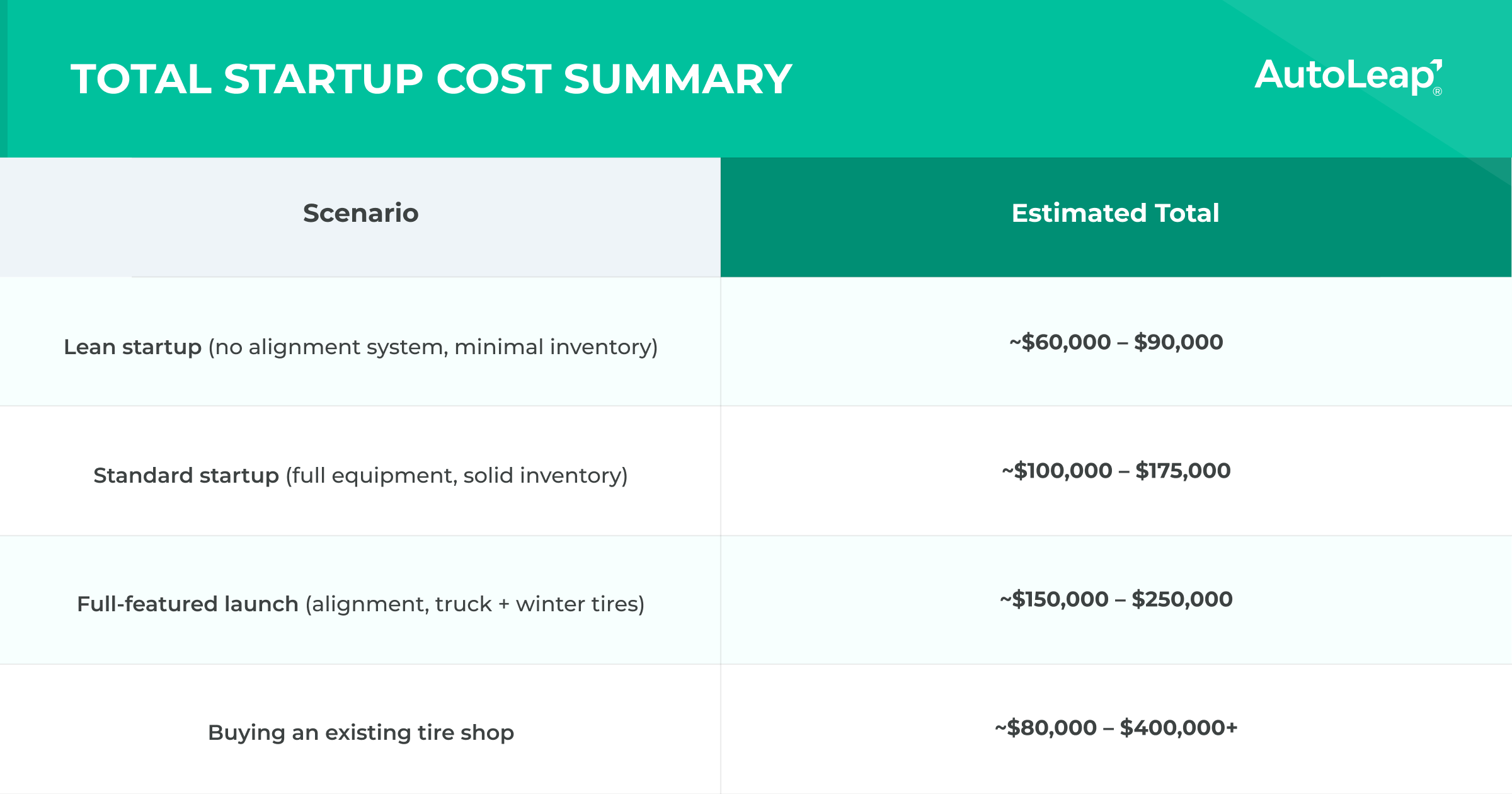
Upfront cost | $60,000 – $250,000 | $80,000 – $400,000+ |
Time to first revenue | 3 – 6 months | Day one |
Equipment | New, under warranty | Varies, inspect carefully |
Customer base | Built from zero | Inherited, but loyalty unverified |
Renovation control | Full control | Limited by existing layout |
Hidden risks | Construction delays, slow ramp-up | Deferred maintenance, reputation baggage |
Cash flow timeline | 6 – 18 months to stability | Potentially immediate |
The core tradeoff is straightforward: starting from scratch costs less upfront and gives you full control over every decision, but you’re buying yourself a longer, leaner road to profitability. Buying an existing shop costs more, but compresses the timeline dramatically. A well-chosen acquisition can have you cash-flow positive within weeks rather than months.
The right answer depends on your financial cushion and your appetite for uncertainty. If you have limited working capital reserves, a slow ramp-up period while building a customer base from zero is a genuine survival risk. If you have the budget to acquire an established shop, you’re essentially paying to skip the hardest part of the business, and for many owners, that premium is worth every dollar.
Evaluate existing equipment and customer base
When evaluating a purchase, never take the seller’s equipment valuation at face value. Hire a qualified automotive equipment appraiser to physically inspect every major piece of equipment.
Some helpful tips for your evaluation:
- Pay particular attention to the condition of any alignment rack. This is the most expensive single piece of equipment in most tire shops, and a compromised alignment system will need to be replaced at a cost that could fundamentally change whether the deal makes sense.
- Get at least three years of profit and loss statements, tax returns, and bank statements before you agree to anything. Look for consistent revenue trends, not just the most recent year. A shop that just had its best year might be hiding years of mediocre performance.
- Be especially careful about paying premium prices for “goodwill”, meaning the perceived value of the shop’s reputation and customer relationships. Goodwill is real, but it needs to be verified.
- Ask to speak with regular customers (yes, the seller should allow this for a serious buyer). Check online reviews across every platform going back several years. A shop with 200 five-star Google reviews over five years is worth paying for. A shop where reviews are absent or sketchy is a red flag.
The clearest advantage of buying an established shop? If you choose well, you walk in on day one with revenue coming through the door. That alone can take months off the stress and financial strain of building something from scratch.
How profitable are tire shops?
Let’s talk about the actual upside. Because the startup costs we’ve discussed are real, and you need to know what you’re getting in return.
Know the profit margins on tire sales
Tire sales alone carry modest margins. Most tire shops mark up tires between 20% and 40% over wholesale cost, depending on brand, competition, and market positioning. On a $120 wholesale tire, you’re making $24 to $48 in gross margin from the product itself. That’s not bad, but it’s not a business on its own.
Labor is where tire shops actually build profitability. Installation fees, balancing charges, disposal fees, and valve stem replacements on a standard four-tire job can add $60 to $120 in labor revenue on top of the tire sale. Those are high-margin dollars.
On average, well-run independent tire shops operate with net profit margins of 10% to 20% of gross revenue. A shop generating $600,000 in annual revenue should be clearing $60,000 to $120,000 in profit, though this varies significantly with rent, labor costs, and how efficiently the shop is managed.
Maximize revenue with service upsells
The difference between a struggling tire shop and a thriving one often comes down to how consistently the team offers complementary services.
A customer coming in for four new tires is a perfect candidate for a four-wheel alignment check. Alignment services typically carry very strong margins and take 45 to 90 minutes. Offer it every time. You’ll convert a meaningful percentage, and each alignment job can add $80 to $150 to the ticket.
Beyond alignment, brake inspections, TPMS sensor replacements, nitrogen fills, and road hazard warranties all represent legitimate upsell opportunities that customers genuinely benefit from. The key is training your staff to present these as recommendations, not pressure tactics. Customers who feel informed rather than sold to come back, and they refer people.
Tracking which upsells are working, which technicians are converting them, and which customers are due for a return visit is nearly impossible to do manually at any real volume. That’s where the right tire shop software becomes one of the highest-ROI investments you’ll make.
Wrapping up
Opening a tire shop is a genuine business opportunity with sustainable, recurring demand. But it requires serious upfront capital, typically $80,000 to $175,000 for a from-scratch startup when you factor in facility setup, equipment, initial inventory, licensing, and working capital reserves.
Go in with a realistic budget, a clear understanding of what makes your specific market tick, and a commitment to building your business around service rather than price alone. The tire shop owners who make it work aren’t the ones who spent the least to get started; they’re the ones who planned the most carefully.