


When you have invested years and years in establishing your auto repair shop, you must have, at one time or another, asked yourself: What is all this really worth anyway? It is not just figures on a page, but hours of hard work, satisfied customers, and the reputation you have gained, all built from the ground up. The trick lies in determining how that translates into a realistic selling price without leaving money on the table.
In this guide, we will use a step-by-step approach to show you how auto repair businesses are valued, what factors are affected by the number, and how profitable auto repair shops typically are, to be able to achieve the best possible result when the time to sell comes.
But is owning an auto repair shop profitable? Well, the rewards of owning an auto repair shop can be significant. It was reported by Made In Canada, that the automotive industry revenue hit $140 billion in 2026.
Schedule a free demo today!

Boost your shop sales
Simplify shop management
Empower your technicians
Buying an existing auto repair shop vs. starting from scratch?
Buying an auto repair shop business allows you to build on the foundations of an existing business that’s already generating a profit. However, it’s important to understand why someone is selling their shop. Is it incurring losses, or have the owners decided to end their business on a high note? Either way, you should always look for potential red flags.
On the flip side, starting an auto repair shop from scratch allows you to design every aspect of it. Here’s a full breakdown of the pros and cons to both sides:
Buying existing auto repair shop | Owning auto repair shop |
An existing auto repair shop will have a loyal customer base to help you make money immediately and potentially yield higher returns. | A new shop will take years to establish itself, break even on the initial investment, and then start earning revenues. |
You have professional technicians and trained staff to perform auto services. Easier to continue operations without employing. | You have to go through the entire hiring process to onboard professional staff before you start operations. |
A tire shop and a diagnostics center have very different needs in terms of equipment. If the existing shop doesn’t have the space or ceiling requirements, then it would be difficult to offer these services. | You have complete control over what decisions to implement and which services to offer. If tire servicing is in huge demand, then you can offer tire services. |
Existing vendor relationships help you quickly replenish stock and avoid service delays. | Building a strong vendor relationship takes time, especially when you are new in the market and the vendor needs to trust your professionalism and way of doing business. |
When you acquire an existing repair shop, you get its reputation too, which may be good or bad | A new shop will take time to build a name for itself. Either way, building a reputation is a daunting task. |
If the existing shop has ongoing debts, they can be transferred to your accounts. | As a new business owner, you can plan finances, invest savings, and even decide to expand slowly rather than taking huge business loans. |
How to value an auto repair business
The reason you are buying instead of starting from scratch is that an existing shop is immediately profitable. But how do you confirm the numbers are true? Look at a few mechanic shop valuations. Each measure tells whether the auto repair business is worth buying based on its size, profits, or location.
EBITDA & SDE
EBITDA is earnings before interest, tax, depreciation, and amortization. EBITDA is used for mid-sized to large auto shops with revenues exceeding $2 million. An EBITDA multiple of 3.5x to 6.5x for mid-sized and 6x to 8x for large shops is considered ideal. There are several factors that impact EBITDA multiple, such as a diverse customer base, hired professional technicians, multiple location operations, niche auto services, and the use of auto repair software and other systems.
Seller discretionary earnings (SDE), a good measure for auto shops earning revenue around $1.5 million. SDE multiples from 2x to 4.5x are ideal. Factors impacting this multiple are repeat customers, owner working hours, location and equipment condition, and debt and revenue breakup.
The add-backs, when it comes to calculating Sellers Discretionary Earnings (SDE), are the ones that transform your net profit. This is an easier-to-understand version of what the business actually earns.
The compensation to the owner is not subtracted back since a new owner can opt to pay themselves in different ways, or get a manager. So your current salary is not an absolute expense.
The depreciation and amortization are also reversed because they are not cash going out of your business, but accounting costs.
The following are discretionary costs-things such as a personal car, phone charges or travel expenditures. These pass through the business but are not directly related to the business. The buyer is not likely to bear such costs, so they are recalculated back in order to reflect the actual earning potential.
You can consider SDE in terms of a simple question: how much money could this business bring in the hands of a new owner?
Revenue multiples
Some buyers also look at revenue multiples. This means how good the net profit margins of the auto shops are. Usually, 0.35x to 0.7x annual gross revenue is a good bracket to buy the auto shop. The higher the multiple, the more premium the shop is. In order to gain a higher multiple, factors like labor gross profit, parts markup, or monthly car count per bay are considered.
It is worth knowing that valuation multiples are not constant. They change depending on the market, demand by buyers, and the appearance of your shop in comparison to others.
In the current market, smaller owner-operated stores are usually in the 2x-3x SDE category, particularly when the owner is more engaged in day-to-day operations. Stores that have better systems, repeat customer traffic and do not depend so much on the owner can go to 3.5x-4.5x.
The type of buyer is also a factor. A single buyer can be conservative, or a regional chain or a private equity group can pay a premium to have a well-managed shop that meets their expansion plans.
Asset valuation
Take the time to gather the list of your shop’s total assets. Those may include tangible property, equipment, and tools, and intangible assets such as shop reputation and loyal customers. Their value is taken at fair market value.
Then, all liabilities of the auto shop are calculated at current value. These can include debts and other short-term loans. At the end, total assets are subtracted from total liabilities to know asset valuation. The higher the value, the more likely to buy.
Key financials that final buyers’ check
The past and current financial history to ensure continuing cash flows. You can ask for the previous five to ten years of profit and loss accounts, monthly revenues, balance sheets, part and labor margin, and tax returns.
Take a look and ask, do they have enough cash to pay fees or labor costs? Are they paying their suppliers on time? What is the current labor rate, and how is it calculated? How many loans are still outstanding?
Key financial KPIs to track in your shop will help you see if the shop is running operations with enough cash. There is enough revenue to make future payments, and there are valuable assets for providing services.
How much does it cost to buy a mechanic shop?
Some buyers intend to start small and then expand as the shop business grows. While others want to start with a large garage and offer maximum services or go premium with only niche services. The cost of buying can vary based on the size of the shop, where it is located, and which equipment you buy.
Here are the major costs incurred:
Purchase price
A small auto shop would cost between $50,000 and $200,000. A franchise or large shop can cost between $500,000 and $2 million.
Working capital
When you start your business, you should have enough cash to run day-to-day operations. You need to cover the shop’s rent, bills, wages, and daily inventory. The rent of a small shop would cost you over $100,000 per year. The labor wages can cost around $80,000 per year. Ongoing expenses such as bills and inventory can cost a few hundred dollars every month.
Closing costs
When you are finalizing the purchase, there are some additional closing costs to pay. Legal fees range from $1,500 to $5,000. This fee is for drafting and reviewing purchase agreements and other legal documents.
Then, you have to pay government fees and transfer taxes. The cost varies by jurisdiction but is usually between $100 and $500. It is a government fee to record the purchase, update the business owner, and update permits and licenses if needed.
Modernization costs
The old auto shop may need equipment upgrades, technology systems, or better marketing efforts. These modernization costs are incurred to improve services and gain performance efficiencies.
Many old auto shops follow old processes. They use pen or paper for noting down customer appointments and inventory details, resulting in errors, delays, and inefficiencies. As part of modernization, it is important to adopt modern shop management software.
AutoLeap is an easy-to-use, all-in-one shop management solution that lets you schedule job bookings, manage your inventory, and improve customer service all in one place. From sending appointment reminders, creating estimates and invoices, to maintaining labor cost records, AutoLeap helps your auto shop gain efficiencies and build customer relationships.
Step-by-Step Valuation Walkthrough
If you are attempting to compute what your shop is worth, a simple way of doing it step by step is as follows:
1. Gather your financials
Start with the last three years of tax returns and profit & loss statements. Consumers desire predictability, not speculations.
2. Find SDE every year
Subtract the owner’s salary, non-cash and discretionary costs from your net profit. This provides you with a more accurate amount of earnings.
3. Use a weighted average.
Every year is not the same. Customers tend to attach more importance to your last performance. For example:
Year 1: $120K SDE (20% weight)
Year 2: $150K SDE (30% weight)
Year 3: $180K SDE (50% weight)
Weighted average SDE = $162K approximately
This will even things out; a good year will not make you inflated, and a bad year will not make you sink to the bottom.
4. Choose the right multiple
Depending on the size of your shop, systems, personnel and the role of the owners, you may be between 2x and 4x SDE.
5. Determine your range of valuation.
With the above example:
$162K × 2.5 = $405K
$162K × 3.5 = $567K
Your shop would be reasonably priced at $400K-570K.
6. Modify according to the real-life factors.
It can be an increase or a decrease caused by things such as location, reputation, the condition of equipment, and the strength of the team.
Things to do before buying a mechanic shop
Why is it important? Reviewing crucial documents and conducting a thorough investigation can help verify information, reduce risks, and make better buying decisions. Here’s what to check:
Financial audit
You can collect federal and local tax information from the past three years. Check if taxes are paid on time, if any taxes are unpaid, or if any audit or penalties are owed by the auto shop.
Also, review revenue trends. If it’s declining over the years, then it can signal problems in auto services. Unpaid taxes and declining revenues may indicate higher risks and help you negotiate better terms when buying the mechanic shop.
Look out for:
Customer lists: Outdated lists with dormant customers won’t be of much help. Before buying a shop, check that it has an accurate database of its current customers.
Proof of profit: Look at tax returns for up to five years.
Useless assets: Excess equipment that isn’t generating revenue inflates the selling price without adding profit.
Operational review
Take a closer look at how the auto shop is operating. Get information and understand their day-to-day operations, how they manage inventory, and how auto services are performed. Review and verify shop processes, customer dealings, labor performance, equipment condition, and increase the average repair order.
Auto equipment and tools deteriorate with time. That’s why you check equipment condition, the asset life remaining, current market value, and depreciation costs incurred. Also, look at how well it’s performing and the number of repairs undergone over the years. A detailed equipment check will help you understand if the equipment is well maintained or not. Starting an auto shop with high-performing equipment is essential for auto services to be completed on time.
Reputation check
When buying a business, make sure that it has an established reputation as a trustworthy and reliable company.
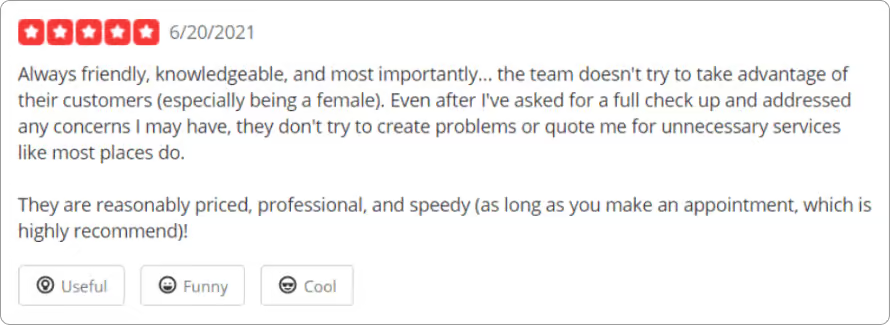
Stories of dishonest mechanics overcharging or making unnecessary repairs aren’t uncommon, so customers typically research auto repair shops online before they choose a place. That’s why reviews on sites like Yelp and Google can affect a shop’s margins.
This Yelp review, for example, encourages other potential customers to try this auto repair shop. That’s the kind of reputation you should look for in a shop you want to buy from.
Be sure to ask around the neighborhood as well since people sometimes buy positive online reviews. If you’ve acquired a shop and want to build a name for it, consider the following:
Be inclusive: Make everyone feel welcome at your shop. For example, look for ways to attract more women customers to your auto repair business.
Specialize: You could set yourself apart from the competition by entering a new market. For instance, you could work on electric vehicles and charge a premium since it’s a specialized field. By working on modern technologies, you can future-proof your business.
Staff evaluation
Automotive repair shops are customer service-oriented. Many shop owners work the front counter and service customers’ cars themselves to deliver stellar service.
You’ll likely lose customers after the purchase if the shop owner you buy from is heavily invested in the service side of the business. People want to get services from a person they trust—not a company. A shop that has a service writer who’s the “face of the company” is a big plus. When buying an auto shop, consider keeping staff members who have been with the business for a while and are popular among customers.
Also, make sure you have qualified technicians besides the business owner working on customers’ vehicles.
Shop location
An auto repair shop’s location is one of its biggest potential advantages. Here are some points to consider when assessing a shop’s location:
Convenience: How easy will it be for customers to commute to and from your shop without their car? Is there a comfortable waiting area or restaurant for customers who want to wait?
Accessibility: If you’ll be servicing trucks as well, consider how accessible your route is to larger vehicles.
Resident demographics: Look for areas where household incomes are high. This can potentially increase your average repair order size.
Competition: Your new auto repair shop should be in an area where there’s little to no competition within a two-mile radius. However, shops that you can work with are important. For instance, you might want to collaborate with a diagnostics shop if you work on engine and transmission blocks. Doing so allows both shops to benefit.
Rent expense: Operating in an area where many cars come by may help increase your car count, but make sure that the rent isn’t unreasonably steep and you can remain profitable throughout the year.
Public transport: Once people drop off their cars for longer jobs, they need access to transportation. You could provide loaner cars, a pick-and-drop service, or guide people to the nearest bus stop depending on each customer’s needs. Operating in a high-traffic area opens doors for customer transportation.
Suppliers: Ensure that plenty of suppliers exist wherever you plan to do business. This allows you to get the best rates since there’s higher competition among suppliers and gives you backup options if you want to switch to a new one. Your supplier should have all the parts you’d need to run your shop smoothly, such as specialized equipment if you work on electric vehicles.
Legal & lease
Legal due diligence examines the legal position of the business and any legal problems it is going through or has gone through.
Conduct all contract and license reviews, such as supply, customer, operational, and employee contracts, leases, and other contract agreements.
Verify intellectual property rights, such as patents, trademarks, copyrights, and trade secrets. Check business name registration, domain registration, and trademarks or brands. Check on previous or impending legal proceedings, lawsuits, or other legal matters.
Your goals, interests, and expectations
Before you commit to buying a mechanic shop or an auto repair shop, consider your lifestyle goals and personal interests, as well as your financial expectations. This will determine if buying is the right decision for you, which shop to buy in terms of size and income potential, or if you should own an auto repair business at all.
Ask yourself these questions:
- Would I rather be hands-on or hands-off at my shop?
- How interesting do fixing brakes, changing oil and batteries, and managing customers sound to me? Would I rather have it all outsourced, and can I afford to?
- Would I be okay with making less money if I want to work less myself?
- How much am I able and willing to invest in an auto shop?
- What is the minimum amount of income the business must generate?
If you’re committed to the business, you’ll be more involved in its daily operations and can help it grow.
Building Ownership vs. Leasing Note
The ownership of the building is one of the factors that are usually ignored. When you are the owner of the property, the sale is normally divided in 2 segments: the business itself and the real estate, which can greatly add to the total amount of the deal.
When you lease, buyers will scrutinize the remaining time on the lease and the transferability. A short lease that is not renewable may cause buyers to be reluctant and decrease your valuation. It is a little thing on paper, but it can make a big difference in what one is willing to pay.
Tips for buying a mechanic shop
Ready to buy an auto repair shop? Here are three common things to consider first.
1. Don’t buy a job
Buyers are to scrutinize the degree to which the current owner is engaged in the day-to-day activities. As long as the shop exists because the owner works 60 or more hours per week, you are purchasing a hard-working job, not a business that can be scaled.
2. Look for “Turnaround” potential
Shops that have good technicians and bad systems (no software, no marketing, bad processes) can be the most promising ones. The introduction of the use of modern shop management software, such as AutoLeap, can be used to fast-track the improvements in the workflow, customer communication, and profitability.
3. Transition period
Negotiate a transition period with the seller in order to have a seamless handover. Retaining the previous owner as a trainer will help retain employees, keep the clientele, and pass over operational knowledge.
What the Selling Process Looks Like
Selling your auto repair shop is not a one-time event, but a process that takes place over several months. It is much easier when one is aware of what to expect.
Step 1: Get a valuation
It all begins with knowing the worth of your shop. This is what establishes expectations and how you make future decisions.
Step 2: Make a decision on how to sell.
You can collaborate with a business broker or sell directly. Brokers assist in marketing and negotiations, but they are charged a fee. Direct will save you money but it will take more effort on your part.
Step 3: Get ready to document.
Before addressing buyers, you will have to have a clean package of information, which will include:
3 years of financial statements (profit and loss).
Tax returns
Lease agreement
List of equipment and assets.
Key performance indicators (quantity of cars, average repair order, margins)
Step 4: Screen buyers and sign NDAs.
Before you give serious buyers sensitive financial information, you will be required to sign a non-disclosure agreement (NDA).
Step 5: Due diligence
This is where customers delve into your figures, business, and resources. They’ll check out all you have brought up- this may take weeks.
Step 6: Negotiate the deal structure.
You will negotiate such terms as price, payment (cash or financing), and transition support.
Step 7: Conclude the deal.
When everything is settled on, legal documents are signed, money is exchanged, and ownership is transferred.
The average time spent between making a decision and the final sale in the shops is 6 to 12 months. It may seem like a lot, but it can be divided into steps, so it can be handled, and it all depends on preparation.
Closing thoughts
The valuation of your auto repair shop goes beyond a formula; it is about seeing the big picture. Good financials are great, but so is your systems, your staff, your customer base, and the way the business operates without you. Buyers aren’t just purchasing numbers; they’re investing in stability and future potential.
The bad news is that those who prepare early, clean up their financials, streamline their operations and minimize owner dependency always have better valuations compared to those who want to hurry the process.
When you are contemplating selling, or simply curious to know more about your numbers, the next thing to do is get informed. Get a free Profit and Valuation eBook with AutoLeap to get even deeper and begin to position your shop to achieve the best possible result.
FAQs
Q1: How long does it take to sell an auto repair shop?
Most sales take 6–12 months from the decision to close. The timeline covers getting a valuation, preparing documentation, finding and vetting buyers, going through due diligence (typically 4–8 weeks), and negotiating final terms. Shops that are well-prepared before listing consistently move faster and attract stronger offers.
Q2: Does owning the building affect my shop's valuation?
Yes, significantly. If you own the property, the sale typically splits into two separate transactions — the business itself and the real estate. If you lease, the remaining term on your lease and whether it’s assignable to a new owner directly affects what buyers will offer. Leases with fewer than five years remaining and no renewal option are a red flag for most buyers.
Q3: Should I use a broker to sell my auto repair shop?
For most owners, yes. A broker with auto repair experience can help you get a certified valuation, prepare marketing materials, reach a wider pool of vetted buyers, and keep the process confidential. The trade-off is a commission, typically 8–12% of the sale price for smaller shops. Going direct is possible but requires significantly more time and expertise to do well.
Q4: What documents do I need to prepare before selling my shop?
Buyers will want at least three years of profit and loss statements, tax returns, and balance sheets. Beyond financials, expect requests for your lease agreement, equipment list, any fleet or maintenance contracts, and a breakdown of key KPIs like average repair order, car count, and technician productivity. Having these ready before conversations begin speeds up the process and builds buyer confidence.
Q5: Can I sell my auto repair shop if it's not profitable?
It’s harder but not impossible. If the shop has valuable assets — strong equipment, a good location, or an established customer base — an asset-based valuation can still give you a reasonable number. However, most buyers expect earnings-based pricing, so low or inconsistent profitability will either significantly reduce the sale price or limit the pool of interested buyers.
Q6: What is the difference between SDE and EBITDA for auto repair shops?
SDE (Seller’s Discretionary Earnings) is used for smaller, owner-operated shops typically valued under $5 million. It includes the owner’s salary and personal benefits as part of the earnings picture. EBITDA is used for larger shops or those with professional management in place — it treats the owner as just another expense. If you’re running a single-location shop and working in it daily, SDE is the more relevant metric for your valuation.
Q7: How do I find buyers for my auto repair shop?
The main routes are: working with a business broker who has an existing buyer network, listing on business-for-sale marketplaces, reaching out directly to regional auto service chains that acquire independent shops, or approaching a current employee about a buyout. Each has different trade-offs in price, timeline, and complexity. A broker is the most common path for first-time sellers.