



The North American auto repair market is in a genuinely good place right now, and the conditions driving that growth aren’t going away anytime soon. The market is projected to grow by USD 81 billion by 2029, fueled by a few converging trends:
- The average vehicle on the road is now around 13 years old. Older vehicles need more work, plain and simple.
- Modern vehicles, EVs, hybrids, anything loaded with ADAS, sensors, and cameras, are far more complex than what shops were seeing a decade ago. That complexity demands specialized service.
- More vehicle owners are skipping the dealership and going to independent shops for faster turnaround and better value.
The growth opportunity is real and it’s here right now. The more important question is whether your shop is positioned to capture it.
This piece covers the most profitable services shop owners, managers, and operators should be thinking about in 2026, along with some practical guidance on how to act on it.

How Repair Costs Actually Affect Your Margins
Every job that comes through your shop has three cost components: labor, parts, and overhead. Understanding where the money actually goes and where it stays is what separates a shop that’s busy from a profitable shop.
Labor
This is where the real margin lives. Labor typically runs around 65% profit margin in a well-run shop, largely because your direct costs are lower than on the parts side. Services like diagnostics, electrical work, and European vehicle repairs push that margin even higher.
Labor costs cover wages, benefits, and payroll taxes for your techs and staff. Tracking how efficiently your team moves through jobs, billable hours versus hours clocked, gives you a clear read on where your profitability actually stands.
Parts
Parts cover everything needed to complete a repair: components, materials and consumables. A healthy shop targets around 50% margin on parts overall.
Parts can be a solid second revenue stream, but it’s a competitive space. Aftermarket parts generally carry better margins than OEM, so your sourcing strategy matters here more than most shop owners realize.
Overhead
Rent, utilities, equipment, marketing and the costs that keep the lights on regardless of how many cars come through the door. These aren’t tied to any specific job, but they’re always running. The goal isn’t to eliminate overhead; it’s to grow revenue faster than overhead grows.
What Makes a Service “High-Margin”?
Simply put, a high-margin service is one where the gap between what you charge and what it costs you to deliver it is wide. Low direct costs, high perceived value.
Why do these services matter so much?
- They can carry a shop through slow periods when volume drops, because each job still generates meaningful profit.
- They typically require less time and fewer parts than heavy mechanical work, which keeps your cost per job down.
- In most shops, roughly 20% of services are responsible for about 80% of total profit. Identifying and leaning into those services changes the math on your whole operation.
The 6 Most Profitable Auto Repair Services
After looking at how a range of auto shops actually perform financially, six services consistently stand out for their margin potential.
1. Diagnostics
Diagnostics is arguably the highest-margin service a shop can offer and the case for it keeps getting stronger. Twenty years ago, a mechanically inclined owner could pop the hood and get a reasonable sense of what was wrong. Today’s vehicles, with their layered sensors, ADAS systems, and complex electronics, have made that nearly impossible for most drivers.
There are no parts involved. You’re billing for expertise, and that expertise is increasingly hard to find. A shop that can quickly and accurately diagnose a problem builds something valuable: trust. Customers who trust your diagnosis are far more likely to let you repair. And customers who feel well-served by both become regulars and send referrals. It will also help drive new customers to your shop. The diagnostic service isn’t just a revenue line; it’s a pipeline for everything that follows.
2. Brake Repairs
Brakes wear out on every vehicle, every time, without exception. That’s not a niche market, that’s the entire market. Overheated pads, fluid leaks, worn rotors, grinding noise, these issues are urgent and most drivers don’t sit on them.
If your shop invests in a brake lathe, you can handle noise and vibration problems in-house that other shops are outsourcing. Keeping that work inside your four walls means keeping that revenue, too. Brake jobs also create natural upsell opportunities: a customer in for brake service is already paying attention to their vehicle’s safety, which makes them more receptive to hearing about related maintenance.
3. Suspension and Alignment
Most drivers don’t think about their suspension until something feels noticeably wrong and by then, there’s usually real work to be done. Potholes, railroad tracks, speed bumps, winter roads, and suspension components take a beating in everyday driving conditions.
This is a high-value, not-remotely-DIY-friendly service. Customers need a qualified tech, and the parts involved are generally accessible and reasonably priced. With the right setup, suspension and alignment work can run around 40% margin.
On the alignment side specifically, most manufacturers recommend getting wheels aligned every 6,000 miles. That’s a natural touchpoint to offer every time a customer is already in your bay for something else. The conversation practically writes itself.
4. Air Conditioning and Heating Repairs
A broken AC in August or a dead heater in January isn’t something most drivers put off. The demand is seasonal, but in a North American climate, that means you’re looking at real volume spikes on both ends of the calendar.
The key investment here is a quality AC machine that can handle diagnostics and service efficiently. Doing it manually is slow, and slow kills customer satisfaction. Get the equipment right, and this becomes a reliable seasonal revenue driver with solid margins.
5. Electrical Repairs
EVs and hybrids are no longer a niche; they’re a growing share of the vehicles coming through shop doors across the continent. High-voltage systems, complex sensor networks, and advanced electronics require a level of specialized knowledge that most general repair shops haven’t built out yet.
That gap is an opportunity. Shops that invest in training their techs for electrical and EV work are positioning themselves ahead of a demand curve that’s only going in one direction. The margin on this work is strong precisely because qualified techs are still relatively scarce.
6. Engine Repairs and Maintenance
Timing belt replacements average around $800. Head gasket repairs can reach $6,000. These aren’t frequent tickets, but when they come in, they move the needle significantly on your average repair order.
You can increase the value of these visits further by bundling engine work with preventative maintenance, coolant flushes, for instance, which pair naturally and add revenue without much additional labor. Customers who trust you with a major engine repair are also prime candidates for ongoing maintenance relationships. This will further help you increase the average repair order easily.
Common Auto Repair Services: Don’t Ignore Them Either
High-margin services get the spotlight, but the routine work is what keeps your bays full and your staff productive day-to-day. These services aren’t where the big margins live, but ignoring them is leaving consistent, steady revenue on the table.
Oil Changes
Every vehicle needs one every six months or so, and that includes brand-new cars. Fast, quality oil changes build the kind of routine relationship that turns first-time visitors into regulars. The customer who comes in for an oil change is also standing right there while your tech does a walkaround; that’s a natural opening for other services.
No specialized equipment is required to get started, which makes this a realistic offering even for newer shops building out their bay capacity.
Tire Rotations and Replacements
The U.S. tire replacement market was valued at roughly $58 billion in 2024, with passenger car tires leading the segment. That number grows as more vehicles hit the road. Seeing this growth, tire repair and maintenance is a great opportunity to tap into. Bundling tire services with wheel alignment and rotation is a straightforward way to increase the value of each visit. It does take some upfront investment in the right equipment, but the volume potential is there.
Battery Replacement
Battery failures are one of the most common reasons people end up at a shop unexpectedly. It’s routine work for an experienced tech and creates a reliable, repeating service ticket. Worth having in your mix.
Headlight and Taillight Replacements
Simple, fast, and necessary for every vehicle on the road. No advanced equipment is needed, which makes it accessible for shops at any stage. Customers appreciate not having to go somewhere else for something this straightforward.
Exhaust System Inspections and Replacements
Most vehicles should have their exhaust system checked at least twice a year. When customers come in for scheduled maintenance, this is a logical add-on recommendation, easy to introduce and hard for a safety-conscious driver to dismiss.
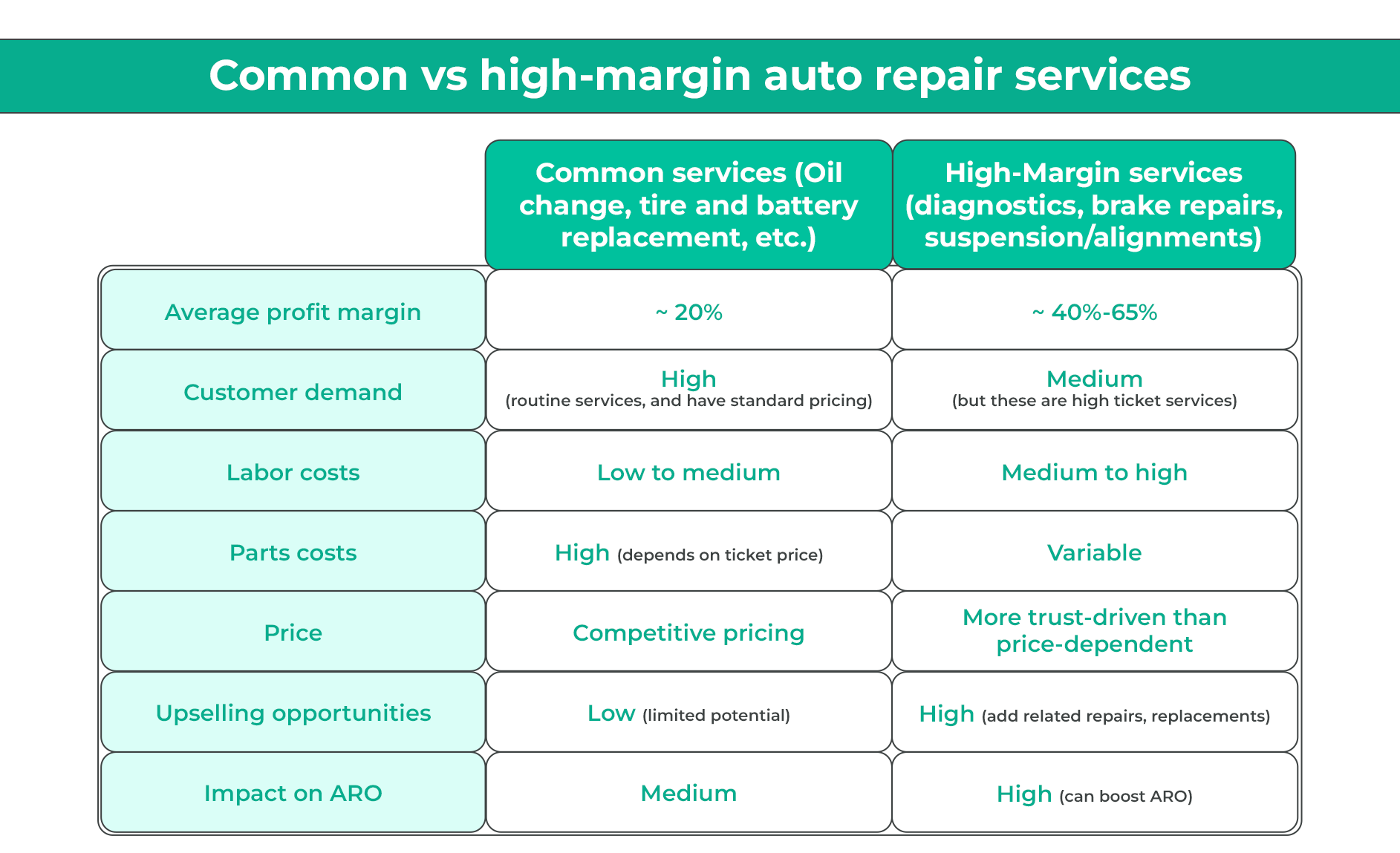
A note on margins: Common services typically run around 20% profit margin. That’s not bad, it’s just the reality of high competition and standardized pricing in these categories. High-margin services, by comparison, run 40–65%. The difference isn’t a small rounding error; it’s the difference between a busy shop and a profitable one.
What Should Shop Owners Actually Do With This?
Knowing which services are most profitable is only half of it. Here’s how to act on it.
Start with an honest audit. Before you invest in new equipment or training, pull your numbers. Use your shop management software to look at which services are actually making you money and which ones are keeping your techs busy without much to show for it on the bottom line. That data should drive every decision that follows.
Invest strategically in equipment and training. Once you know where the gaps are, the investments become clearer. Diagnostic tools, EV-capable training, a brake lathe, these aren’t impulse buys, they’re informed ones. Your team also needs the skills to deliver these services properly. Buying equipment without trained techs to run it doesn’t move the needle.
Market the services that most shops aren’t marketing. Most shops advertise oil changes. Few advertise their diagnostic capabilities or their EV specialization. If your shop has built out high-margin expertise, make sure the right customers know it, through targeted ads, seasonal campaigns, educational content, or even just clear messaging on your website.
Bundle and upsell deliberately. High-margin services naturally pair with common ones. A customer in for brake work is a natural conversation for tire condition. A wheel alignment recommendation during an oil change costs nothing to make and regularly converts. Build these touchpoints into your service workflow rather than leaving them to chance.
The Bottom Line
Being busy and being profitable aren’t the same thing. Most shops have no shortage of work; the question is whether the mix of that work is generating the margins that actually sustain and grow the business.
The answer isn’t to drop your routine services. It’s to make sure you’re not only running on them. A healthy shop has a balanced mix, steady common services keeping traffic consistent, and a solid lineup of high-margin work that drives real revenue per repair order.
Take a hard look at your current service mix. Figure out where the gaps are. Then decide whether the path forward is training, equipment, or both. The shops that grow in 2026 won’t just be the busiest ones; they’ll be the ones that know which work is actually worth doing.