


The right tire changer comes down to how many tires you’re turning monthly and the largest wheel that rolls through your door.
Three things to know before you read further:
- Volume dictates machine class:
- Under 50 tires a month, entry-level works.
- Between 50 and 200, you want mid-tier professional.
- Over 200, the math starts pointing at automated.
- Rim clamp vs. center post matters more than most specs: If more than roughly 10% of your work involves painted or polished wheels, center post mounting eliminates rim contact and the damage claims that come with it. None of the machines below are centre post, so if that’s your shop, ask your dealer about a centre post option before you buy.
- Canadian shops: dealer coverage is a hard filter, not a preference: A machine with no Canadian service network isn’t a real option, regardless of what the spec sheet says.
Best tire changers at a glance
Before anything else, the comparison. Use this table to narrow your shortlist by use case and price band, then read the full write-up for the machine that fits.
Machine | Best For | Type | Rim Capacity | Price (USD) | Price (CAD approx.) | Warranty | Canada Availability |
Ranger R80EX | Best overall | Tilt-back | Up to 28″ | ~ $11,095 | $15,300 | 24mo structural / 12mo parts | Yes, Babco |
Coats APS 3000 | High-volume tire shops | Leverless | Up to 30″ | ~ $18,000 | $24,800 | Varies by dealer | Yes, Hennessy Canada |
Triumph NTC-950 | First powered machine | Swingarm | Up to 28″ | ~$1,965 | $2,710 | 1 year | Limited |
Coats RC-55E | Best value mid-tier | Rim clamp electric | Up to 28″ | ~$8,000 | $11,000 | Varies by dealer | Yes, Hennessy Canada |
Atlas TTC301 | Heavy-duty / truck | Heavy-duty hydraulic | Up to 54″ | ~$9,700 | $13,100 | 1 year | Confirm before ordering |
Changer + Balancer Combo | Shops buying both | Varies | Varies | ~2,000–$15,000 | $2,760-$15,000 | Varies | Varies by brand |
CAD figures are approximate conversions at an exchange rate of 1 USD = 1.38 CAD, as of August 28th 2026.
There’s a lot more tire shop equipment you need to stock up on. Make sure to do the full cost analysis before moving further.
Price bands to know:
According to the Best Buy Automotive Equipment buying guide, pricing depends on the machine’s configuration, capacity, and how much load it can take.
- Swing-arm machines generally fall between 1,874-6,320 USD
- The tilt-back tire changers range between $2,474 – $7,930
- Automated and leverless machines have premium pricing
- Heavy-duty truck machines range from $9,499 to $23,999 USD (CAD 13,100- 33,100)
Best overall tire changer: Ranger R80EX

Picture from BendPak.
What the machine is
The Ranger R80EX is a tilt-back tire changer with pneumatic controls, the design most shops picture when they think “professional machine.” The column tilts back away from the operator to give you clear access when mounting and demounting, and the pneumatic control system handles the bead breaker, turntable, and helper arm pressure through a straightforward foot-pedal and hand lever layout. At roughly $11,095, the R80EX sits well above the typical tilt-back band ($2,474–$7,930). The premium reflects its pneumatic build and Canadian dealer support through Babco, not a pricing outlier.
It’s consistently cited as a leading mid-range pick for Canadian shops specifically, which matters because a lot of capable machines at this price point have thin or nonexistent Canadian parts coverage. Ranger is distributed through Babco, so warranty service and consumables are reachable.
Performance in a working shop
On a standard passenger tire changeover, the R80EX moves quickly. You break the bead, clamp the rim, mount the tire, and you’re done. The tilt-back column earns its price premium over a swing-arm on larger assemblies and anything low-profile, where the extra clearance on dismount reduces the risk of catching the sidewall.
The one real dependency is shop air. This machine needs a healthy compressor, 4 to 5 CFM at 90 PSI minimum, and if your current setup is undersized, factor that in before ordering.
Pros:
- Tilt-back column handles larger assemblies and low-profile tires more cleanly than a swing-arm at this price
- Pneumatic controls are straightforward to learn and have fewer failure points than electronic systems
- 24-month structural warranty, 12 months on operating components, 12 months labor, plus free ground shipping on warranty repairs
Cons:
- Still a physical machine: technique matters, and it won’t match the throughput of a leverless unit on a high-volume day
- Pneumatic operation requires adequate shop air supply; confirm your compressor output before ordering
- Larger footprint than a swing-arm; verify your bay has the room
Best for high-volume tire shops: Coats APS 3000
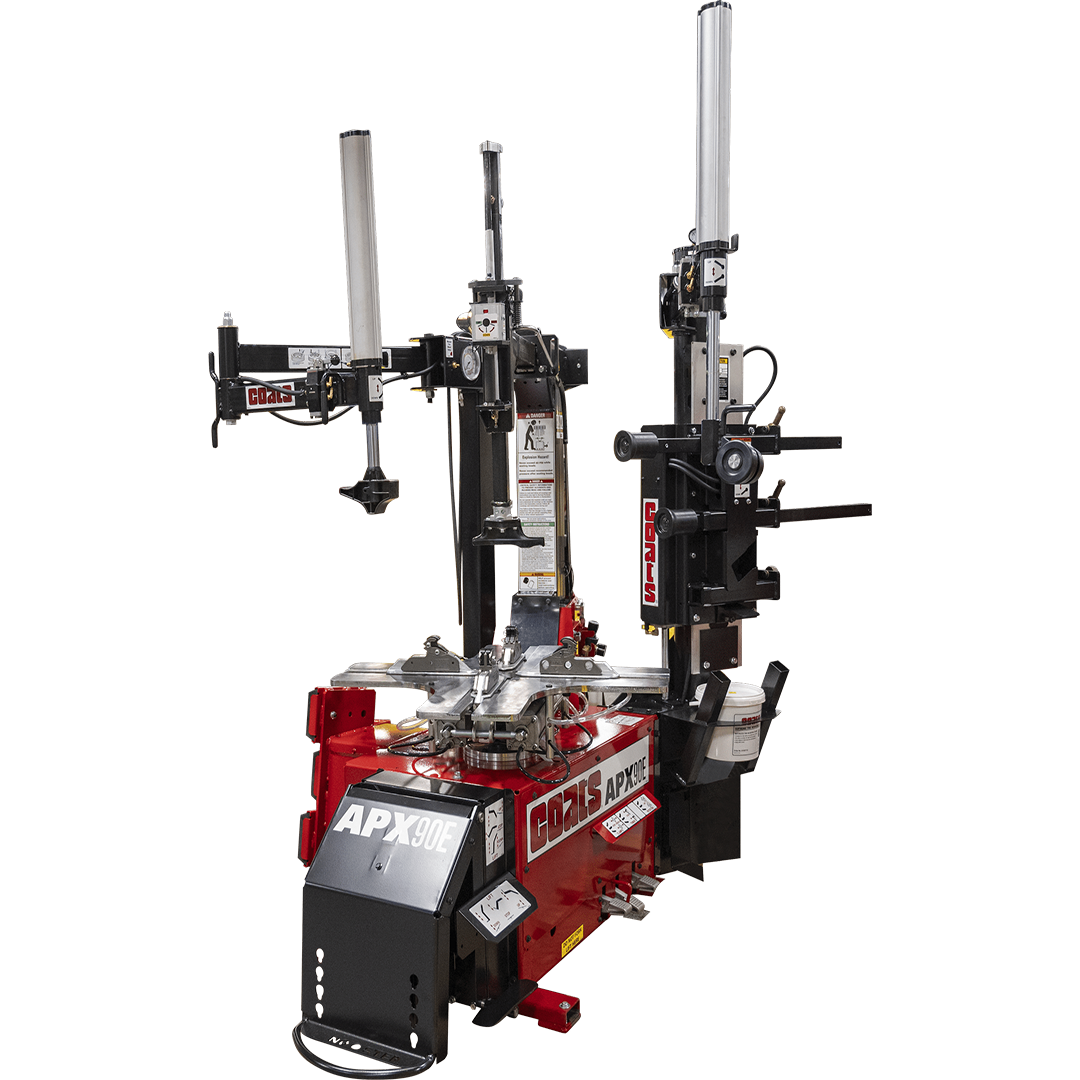
Picture from Coats Company.
What leverless machines change about your operation
On a standard mid-tier machine, throughput depends heavily on the technician running it. A skilled operator is fast, and a less experienced one is slower. And bead damage risk tracks directly with technique. A leverless machine removes that variable. The pry bar never touches the rim, so the chance of scratching an alloy or cracking a bead drops significantly, and cycle time becomes consistent across your whole team, not just your best tech.
What the machine is
The Coats APS 3000 is a leverless tire changer that demounts and mounts without pry bar contact. If the APS 3000 is outside your budget or your dealer’s stock, the Hunter Auto34, Hunter Revolution, Hofmann monty FA 1000, and Corghi Master Force are credible alternatives in the same class, each with different manufacturer pricing and service coverage.
At 200-plus tires a month, even a two-minute-per-tire throughput improvement is roughly 6 hours of recovered capacity monthly. The reduction in wheel damage claims adds on top of that. Below 150 tires a month, the math gets harder to make work. Coats distributes through Hennessy Canada in Mississauga, Ontario, which means warranty service and parts are reachable for Canadian shops.
Pros:
- Removes pry bar contact entirely; bead and rim damage risk drops significantly
- Throughput becomes consistent across technicians, not just your most experienced operator
- Coats has Canadian distribution through Hennessy Canada; warranty and parts support are accessible
Cons:
- Highest purchase price in this roundup; the throughput gains need volume behind them to recover it
- Requires real operator training before you see the speed benefit; out of the box it’s not intuitive
- More hydraulic and electronic components than a pneumatic machine; local dealer coverage matters more here, not less
Best entry-level tire changer for a first powered machine: Triumph NTC-950
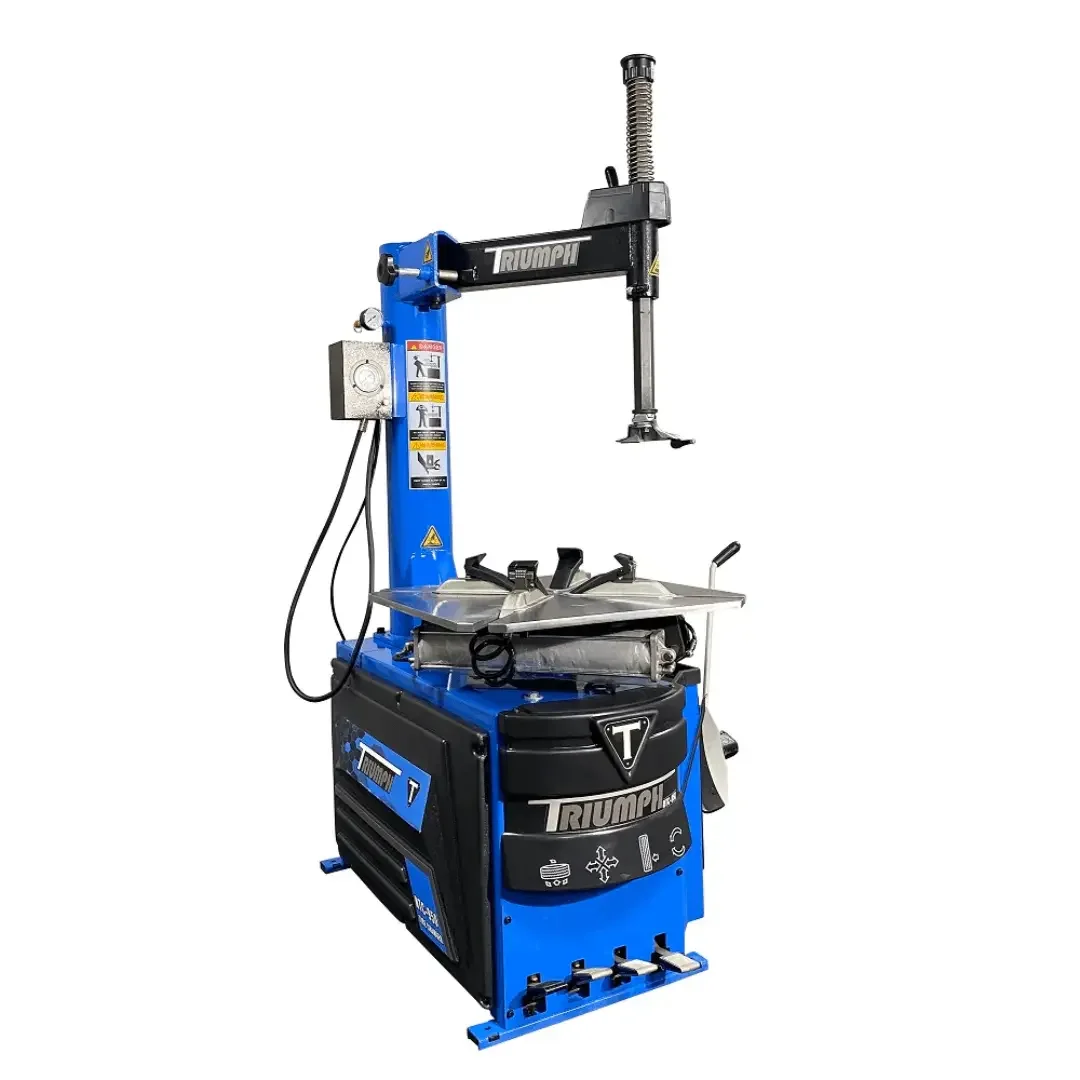
Picture from Mechanic Superstore.
What a first-powered machine needs to do
The job of your first powered changer is simple: replace manual bead breaking and leveraging for standard passenger and light truck work without forcing you to upgrade your electrical service. Most general repair shops run 110V single-phase power. The Triumph NTC-950 runs on it. That’s one of the first things to check: a machine that needs 220V in a shop that doesn’t have it adds an electrical upgrade cost that can dwarf the price difference between machine tiers.
What the machine is
The NTC-950 has a 28-inch external clamping range, a 5,500 lb bead breaker, and a 1.5 HP motor. It ships without helper arms but is designed to accept one or two assist arms added later, which is the specification that matters at the entry level. A machine that can’t accept assistive tooling caps you at basic tire work. The Katool KT-T800 (around $1,200 USD / $1,650 CAD) is a lower-cost alternative if budget is the binding constraint, though it has thinner parts coverage.
The common mistake at this price point is buying the cheapest machine that handles today’s workload. Before ordering, check whether the machine accepts assist arms later.
Pros:
- Runs on 110V single-phase, no electrical upgrade required in most shops
- Accepts assist arm additions later, so capability can grow with the shop
- Lower price of entry for a shop getting into powered tire work for the first time
Cons:
- Ships without assist arms; low-profile and run-flat work is slow or impractical until you add one
- 28-inch capacity rules out some oversized wheels
- Canadian dealer and parts coverage is thin compared with Coats, Hofmann, and Hunter; confirm availability before ordering
Best tire changer for the money: Coats RC-55E

Picture from All Tire Supply.
What value means when buying shop equipment
Value in shop equipment means the most capability per dollar you spend. A machine that handles your shop’s hardest routine job without a second purchase 18 months later is better value than a cheaper machine that forces that second purchase. The relevant comparison isn’t the RC-55E against a cheaper entry unit; it’s the price gap between them measured against the jobs the entry unit can’t do.
What the machine is
The RC-55E is an electric rim clamp machine from Coats’ RC series. The key feature is the RC Robo-Arm, which holds the top bead in the drop center during mounting; that’s what makes it capable on stiff sidewalls and low-profile tires at a price well below the automated tier. It handles standard passenger and light-truck work without requiring the technician skill level a swing-arm demands on difficult assemblies.
Pros:
- Robo-Arm handles the top bead automatically on stiff and low-profile tires, a capability the entry tier doesn’t have
- Priced below the leverless tier while handling most of what a professional shop encounters
- Coats’ Canadian distribution through Hennessy Canada means parts and service are accessible
Cons:
- Electric operation: confirm your shop’s power supply matches the machine’s specification before ordering
- Doesn’t automate the full cycle the way a leverless machine does; technician technique still matters on the most difficult assemblies
- Fewer automation features than the machines above it in this roundup; if you’re approaching 200 tires per month, the gap with leverless starts to matter
Best heavy-duty tire changer for truck and commercial work: Atlas TTC301
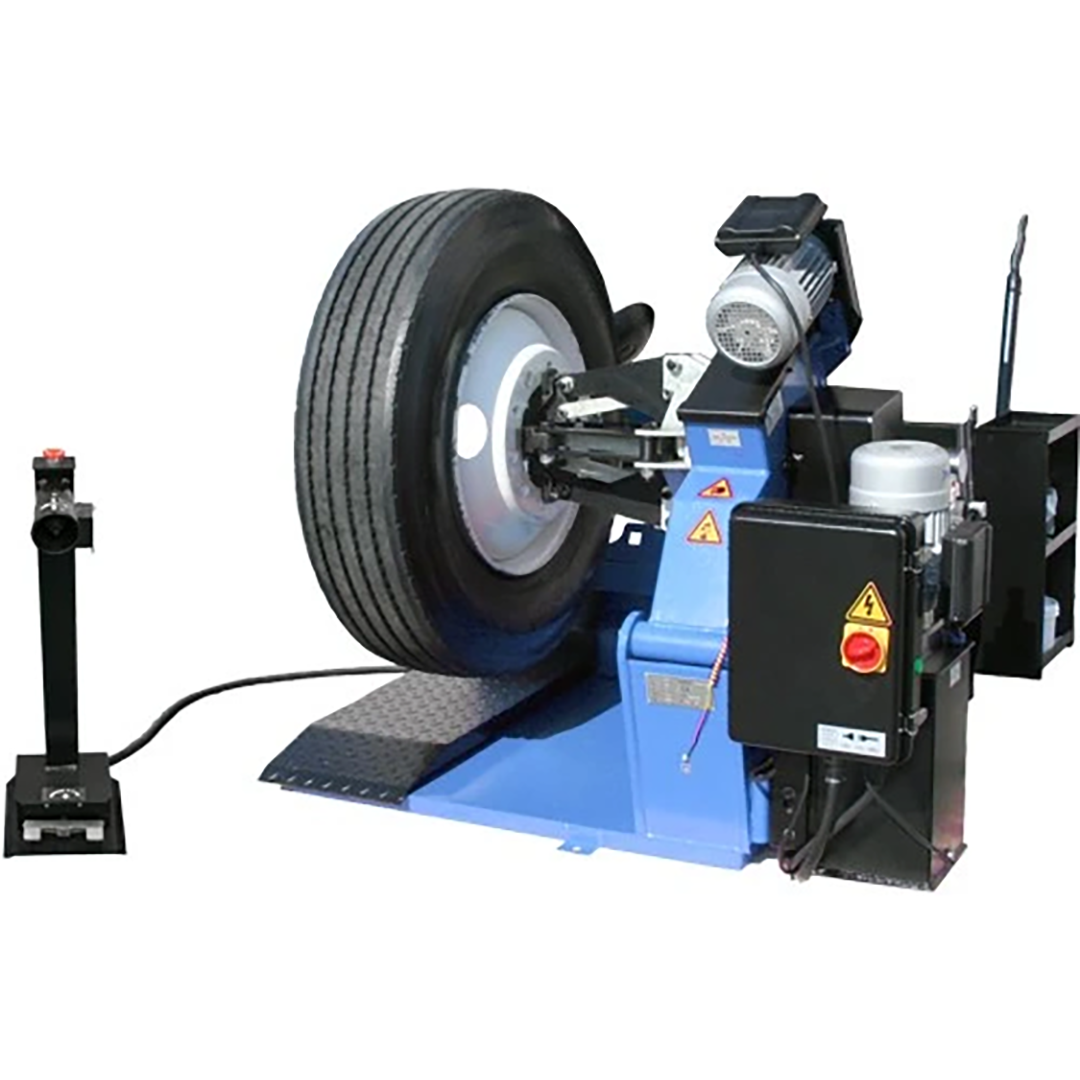
Picture from Atlas Auto Equipment.
When a shop needs a heavy-duty machine
A passenger-car turntable physically cannot clamp a commercial wheel; the diameter and weight are outside what the machine was built for. A heavy-duty tire changer uses a hydraulic self-centring four-jaw chuck that handles commercial wheel sizes and supports the weight without the technician wrestling it into position. If your shop is regularly servicing trucks, vans, or agricultural equipment, this is the class of machine you need.
At approximately $9,700 USD (roughly CAD $13,100), the Atlas TTC301 is the entry point for serious commercial truck work, per JMC Automotive Equipment’s pricing. The Coats CHD 6330 handles off-road and agricultural applications; the Coats HIT6000 steps up to approximately $23,999 USD (roughly CAD $33,100) for high-volume commercial operations.
Before buying at this level, run the numbers on commercial tire jobs per month. A shop seeing occasional truck tires is usually better served subletting that work until the volume is there. At this price, the machine needs to be earning.
Pros:
- Hydraulic four-jaw chuck handles commercial diameters and weights a passenger machine cannot
- Purpose-built for the work, not a passenger machine pushed beyond its design limits
- Atlas TTC301 is the most accessible price point in the heavy-duty class at roughly $9,700 USD
Cons:
- Purchase price is several times a mid-tier passenger machine; volume must support it
- Footprint and floor loading requirements exceed a standard bay; confirm your facility before ordering
- In a general repair shop without a commercial customer base, this machine is likely to sit idle most of the time
Best tire changer and balancer combo
When a combo makes sense
A tire mounted and not balanced is a complaint waiting to happen. For a shop buying both machines at once, a bundled changer-and-balancer package is worth pricing out, because dealers discount the pair against the two bought separately.
At the budget end, Mayflower and MechMaxx both sell paired changer-and-balancer packages. For a mid-tier option with Canadian distribution, Coats bundles its RC series changers with compatible balancers through Hennessy Canada; the pairing lets you confirm both machines are supported under the same service network.
Before accepting any combo price, price both machines individually at the same dealer first. The discount is sometimes applied to a lower-specification balancer than the shop would have chosen alone. A $500 saving on the bundle isn’t a saving if the balancer can’t handle the wheel weights or diameter range you need.
As a practical example: if the changer costs $3,800 USD and the balancer you’d choose separately costs $2,200 USD, a total of $6,000 USD, and the combo is listed at $5,400 USD, that’s a genuine $600 saving. But if the bundled balancer is a step-down model you’d price at $1,600 USD on its own, the “saving” disappears. Do the math both ways.
Pros:
- Dealer discount on the pair is real when the balancer specification matches what you’d buy separately
- Logical pairing: every tire replacement needs a balance, so the machines will always be used together
- Simplifies service: one dealer contact, one service relationship for both machines
Cons:
- The bundled balancer is often specified below what the shop would choose independently; check it against your rim size and weight range before committing
- A low-volume shop that sublets balancing may be better served putting the full budget into the changer
- Combo packages restrict mixing manufacturers; you lose the flexibility to choose the best changer from one brand and the best balancer from another
What to look for in a tire changer: a shop owner’s buying criteria
Your monthly tire volume
A 3-minute-per-tire difference is 90 minutes at 30 tires/month, and 10 hours at 200. That’s when it becomes a staffing problem, not a machine preference. Use tire shop management software to pull actual tire job counts from your repair orders before deciding; don’t guess.
Payback math, not just throughput
Time saved tells you about capacity; it doesn’t tell you whether the machine pays for itself. Run the actual arithmetic before buying: at $25 per tire and roughly $18 gross profit after tech time, 120 tires a month is $2,160 a month in margin. A $4,500 machine pays back in about two months. Use your own per-tire margin and volume to run the same math, and if the payback period stretches past 18 months, treat that as a signal to reconsider the purchase, not just proceed on capability alone.
Rim Capacity and the Wheels You Service
- Pull rim sizes from your last 100 repair orders and check the largest and smallest against the machine’s spec sheet; capacity limits are hard stops, not guidelines
- Check external clamping range, internal clamping range, and maximum tire diameter and width separately.
- Low-profile (45-series and below) and run-flat tires need a bead-assist arm; specify it at purchase, not after
- Some entry-level machines can’t accept an assist arm at all; confirm the upgrade path before committing
Rim Clamp or Center Post
- Rim clamp is the industry standard, four jaws on the rim edge, widest size range. Center post mounts through the hub bore and never touches the rim face, which is the right call above roughly 10% painted or polished work. None of the machines in this roundup are centre post models. If painted/polished wheels are a significant share of your work, raise centre post specifically with a Coats, Hofmann, or Hunter dealer rather than defaulting to one of the rim-clamp picks above.
Space, Power, and Air Supply
Space:
Allow at least three feet of working perimeter beyond the machine’s footprint and check ceiling height where the column tilts; it’s easy to miss until the machine is bolted down. See AutoLeap’s tire shop layout ideas before finalizing placement.
Power:
Most professional machines run on 220V single-phase; larger machines may need three-phase, which many light-industrial buildings don’t carry. An electrical upgrade can cost more than the difference between two machine tiers; confirm your supply before ordering.
Air:
Pneumatic machines typically need 4–5 CFM at 90–150 PSI. Check the machine’s requirement against your compressor’s output at operating pressure, not the peak rating on the label
What you can buy and service in Canada
For Canadian shops, manufacturer distribution and parts availability are a filter that rules out otherwise capable machines. Here’s where each major brand stands:
- Coats distributes through Hennessy Canada in Mississauga, Ontario: coatscompany.com/contact-tire-changer
- Hofmann operates a dedicated Canadian site at hofmann-equipment.com/ca/tire-changers
- Hunter provides installation, training, and service through a North American field network
- Ranger, Coats, Hofmann, Hunter, and John Bean consumables and wear parts are available through Equipment Parts Canada at equipmentpartscanada.com
- The Canadian Tire Recommended Equipment guide at ctequipmentguide.ca lists changers vetted for the Canadian market
Warranty terms for professional use
Warranty terms are worth comparing as a decision column, not a footnote.
- Ranger: 24 months structural, 12 months operating components, 12 months labour, free ground shipping on warranty repairs.
- Coats:
- No labour warranty, technician time and any removal/reinstallation costs are the buyer’s responsibility.
- Standard components (air cylinders, valves, seal kits, rotary couplings, hoses, air lines) are covered for 1 year; transmissions carry a 5-year pro-rated warranty (full replacement years 1–3, then the customer pays 60% of list price in year 3–4 and 80% in year 4–5).
- Shipping is split: the buyer pays freight to send equipment to a Coats Authorized Service Center, and Coats pays return freight only if the issue is confirmed a manufacturing defect, and only within 1 year of the machine’s original placement date.
The gap that matters most: Ranger covers labour for a full year and ships warranty repairs back for free, while Coats covers zero labour and only refunds return shipping on confirmed defects within that first year. On a machine you’re paying $8,000–$18,000 for, that’s a real cost difference if something goes wrong early.