






As a tire shop owner, your goal is to meet the diverse needs of your customers. You need to ensure your inventory remains well-stocked with quality all-season tire brands. Keeping that range organized across brands, sizes, and season is far easier with tire shop software built to track stock, storage, and reorders in one place. Finding the right balance between safety, comfort, and durability is vital in the tire industry, just like for car owners.
As weather conditions fluctuate and road surfaces change, your customers will rely on you to offer reliable tire options. They want long-lasting tires that also provide a high level of safety. And you need to stock them when you start your tire shop.
Let’s review the most reputable tire brands with advanced technology, skilled manufacturing, and helpful customer feedback!
Schedule a free demo today!

Boost your shop sales
Simplify shop management
Empower your technicians
Top all-season tire brands for shops
Crowning the best tire brand is easier said than done. Evaluating tires is subjective, with outside factors like customer budgets and driving preferences factoring in.
Several tire brands have earned high praise for their quality and performance. We will detail these brands and review their best-performing tire models. Let’s get started!
Michelin
Michelin tires feature innovative tire technology. They have many tire options that excel in longevity, fuel efficiency, and performance.
Let’s get into specific models for more context.
Michelin Defender T+H
Michelin Defender T+H is one of the best-selling all-season tires. It has the ultimate tread life and comes with the Michelin Promise Plan.
When you buy these tires, you get a guarantee for 60 days, roadside assistance, and an 80,000-mile warranty. Trail Tire claims these tires have ‘good hydroplaning resistance’ and ‘effective dry handling and braking on dry tarmac.’ Some users reported first-hand that there was an improvement in their ride experience. They were more comfortable.
One unexpected benefit is the improvement in your customers’ gas mileage. On the opposing end, one customer commented that the tires became shaky after two months of installation. However, most reviewers love the smooth and safe ride. Your tire shop can benefit from this quality expectation and the added assurance of the Michelin Promise Plan.
Michelin Pilot
The Michelin Pilot Tires feature Helio+ technology, which is a huge plus if you want to use them in freezing conditions. This technology provides added traction in wet and snow conditions. These tires also have an asymmetric tread pattern and come with a 30,000-45,000 mile warranty.
Many customer reviews comment on how well these tires withstand inclement weather, including rain, snow, and slush. Most feedback establishes that these tires can thrive in less-than-ideal winter conditions.
Michelin Cross Climate
Michelin Climate Change is one of the best ultimate year-round performers. These tires have excellent stopping powers on both dry and wet pavements. They also come with a 60,000-mile manufacturer’s treadwear limited warranty. Many customer reviews marvel at the driving comfort these tires deliver and their exceptional traction.
Bridgestone
Bridgestone produces tires with excellent traction, handling, and responsiveness. They have a wide variety of tires for different vehicles and driving styles. This makes them a great addition to your tire shop’s inventory.
Let’s cover some highlight options.
Bridgestone Turanza QuietTrack
Designed with exclusive QuietTrack technology, these tires deliver a quiet ride for your customers. They are well known for their impressive dry and wet road grip and traction.
The Bridgestone Turanza QuietTrack tires have a long lifespan and are one of the top choices in the market. Most customer reviews praise the long tire life and quiet ride performance. These drivers think the tires provide excellent value for money, especially when you factor in the 80,000-mile warranty.
Consider stocking and the cost of this tire as a staple of your tire shop’s inventory. AutoLeap’s automotive inventory management software covers everything from quick tire look-up to tire ordering and storage.
Bridgestone Drive Guard
The run flat technology used to make Bridgestone Drive Guard tires allows you to go for 50 miles after a puncture! But that’s only part of what these tires can do.
With responsive handling, these tires provide optimal traction on wet roads and snow. Sporting a 60,000-mile warranty, they are an excellent option for crossovers, minivans, sedans, and wagons. Those are likely popular daily commuters among your tire shop’s customer base.
Goodyear
Goodyear has a renowned history of producing innovative tires. Their tires are highly regarded for their comfort, ease of handling, and long-lasting design. That’s why many people choose them for their vehicles. And that’s why your tire shop needs to consider different Goodyear tires for your inventory.
Let’s review some stand-out options.
Goodyear Assurance Fuel Max
The Goodyear Assurance Fuel Max is a tire that saves fuel and performs well in all seasons. This tire has unique treads for dry and wet roads, which improves how it handles and prevents hydroplaning. It also comes with a warranty for 65,000 miles of tread life.
Many customer reviews comment on the exceptional qualities of these tires. However, some reviews do complain about the tire rubber cracking.
Goodyear Assurance ComforTred
The Goodyear Assurance ComforTred Touring tire is comfortable to drive on all year. It features ComfortEdge sidewalls for a mix of comfort and handling. ComforTred technology increases cushioning by 20% for improved ride quality.
This tire is suitable for vehicles like sedans, crossovers, and SUVs. Goodyear even includes an 80,000-mile warranty.
If you have customers who want a quality tire that functions well in snow, this model will meet their expectations. Several reviews label them as perfect for ‘slick weather.’ But conflicting reviews do exist. Some users complained they aren’t the most reliable option in wet conditions.
Goodyear Assurance Weather Ready
The Assurance WeatherReady by Goodyear is a Grand Touring all-season tire. It carries the Severe Snow Service certification symbol.
The tires offer better snow performance than regular all-season tires. The reason for this is Weather Reactive Technology. It also has 3D Tredlock Technology Blades and a silica-infused tread compound.
This tire offers better cornering, wet traction, and resistance to hydroplaning. Although a few driver reviews noted faster wear than other premium options, this tire comes with a six-year, 60,000-mile warranty.
Continental
Continental offers tires known for their impressive grip, especially in wet conditions. They focus on delivering high-performance tires that benefit all kinds of vehicles. Drivers who choose Continental tires in your shop will enjoy optimal handling and traction.
Let’s dig one layer deeper and review some top-lineup options.
Continental ExtremeContact DWSO6 Plus
The Continental ExtremeContact DWS 06 Plus is an excellent tire for all seasons. It performs well in braking, cornering, and steering on different roads. Features like Macro-Blocks, beveled edges, and a 3D groove design enhance its traction and braking. At the same time, the tire’s stylish sidewall design adds to its appeal. Continental backs the DWS 06 with a 50,000-mile tread warranty.
Customers who have used this tire love the smooth ride and enhanced traction. Many reviews praise the excellent performance, saying the road grip was firm even if they pushed the tires harder and faster. But you can find negative feedback online. There have been some complaints about the tires lasting less than 25,000 miles.
Continental True Contact Tour
Continental’s TrueContact Tour delivers exceptional performance in the standard touring all-season category. These tires have impressive mileage warranties. They often last longer than their mileage claims, delivering good value.
The tire’s rubber compound enhances tread life, fuel efficiency, and traction in various conditions. But they might generate more road noise compared to summer tires. Dedicated snow tires or the Goodyear Assurance WeatherReady might be better for your customers if they deal with heavy snow. Overall, this tire’s grooves and Silane additives are great for wet conditions.
Pirelli
Many drivers choose Pirelli tires because they offer high performance and luxury. These tires are known for sporty handling and styling. If you stock Pirelli in your shop, you can attract customers who want high-performance tires that look good. They are appealing tires if you plan to store some high-end options.
Pirelli Scorpion
The Pirelli Scorpion Strada tire has strong shoulder blocks and unique tread for stability, water removal, and long life. This gives you fuel efficiency and reduces ride noise. And it even comes with a 65,000-mile warranty. Overall, it’s Pirelli’s top choice for all-season performance in this category.
Pirelli Cinturato
The Pirelli Cinturato P7 all-season tire is quieter and performs better on different roads. The tire’s tread is designed well, with organized blocks in the center and firm edges.
This tire ensures minimized tread block distortion for better handling on twisty roads. Additionally, it comes with run-flat technology for puncture protection while driving.
Firestone
Firestone delivers solid all-season tires with reliable performance and longevity for daily driving.
Firestone Weather Grip
Firestone Weather Grip uses hydro-grip tread technology and deep grooves to prevent hydroplaning. So your customers will still have a smooth ride in a heavy downpour.
Some reviews indicate that Firestone Weather Grip tires can be noisy. But their high-density Zig-Zag sipes and interlocking grooves give them top-notch traction, so your customers stay safe even on slippery roads.
Hankook
Hankook offers different tires known for their excellent quality and affordable prices. This makes them a popular option for drivers on a tighter budget.
Hankook Kinergy PT
Hankook Kinergy PT has excellent traction in dry and wet conditions. This tire delivers a comfortable ride and long-lasting performance.
Some customer reviews have commented on how their braking and handling are improved with these tires. However, other reviewers have reported that these tires are noisy on highways at high speeds. Overall, most reviews say they support a soft and quiet ride.
Brand | Tier | Typical price position | Known for | Best fit for which customer |
Michelin | Premium | Higher | Longevity, comfort | Long-mileage buyers |
Bridgestone | Premium | Higher | Quiet ride, traction | Comfort-focused drivers |
Goodyear | Premium | Higher | Durability, versatility | Year-round drivers |
Continental | Premium | Higher | Wet grip, handling | Performance-focused drivers |
Pirelli | Premium | Higher | Sporty handling, luxury | Premium vehicle owners |
Firestone | Mid-tier | Moderate | Daily durability | Everyday commuters |
Hankook | Value | Lower | Quality, affordability | Budget-conscious drivers |
Factors to consider when evaluating the best all-season tire brands
When stocking your shop with the best tire brands for all seasons, there are some key factors you need to consider.
Let’s dive into each factor.
Tire size
Ensuring the correct tire size is crucial for optimal performance. You can refer to the owner’s manual or the sidewall of the current tires to find the appropriate dimensions. You can also use an online tire size calculator to see which will fit your customer’s vehicle.
Tread pattern
The tread pattern will affect the tire performance in different conditions. These can be symmetrical, asymmetrical, or unidirectional tread patterns.
Symmetrical tread pattern
Symmetrical tread patterns feature uniform grooves and blocks across the entire tire. You can rotate these tires in any direction, simplifying the maintenance process.
Tires with this pattern deliver balanced performance in dry and wet conditions. That design versatility makes them an ideal choice for many drivers. Additionally, they are long-lasting.
Asymmetrical tread pattern
Asymmetrical tread patterns showcase different designs on the inner and outer sides of the tire. This configuration optimizes traction on both dry and wet surfaces. Moreover, it also enhances cornering stability.
Asymmetrical tires are often marked with “inside” and “outside” to ensure correct installation. They are versatile and adaptable, and at higher speeds, they provide a durable grip.
Unidirectional tread pattern
Unidirectional tread patterns have a distinct one-way design. It usually comes with V-shaped grooves that evacuate water.
These tires have superior wet traction and are less effective when mounted in the wrong direction. These can be rotated only from front to back to maintain optimal performance. Because of the unidirectional pattern, they are not as adaptable as other tire shop equipment.
Load range
Load range tells you how much weight the tire can support. It’s essential to match the tire’s capacity to the vehicle’s needs for safety. Check their vehicle’s recommended load range and choose tires that accommodate the weight. The load range needs to be greater than the vehicle weight.
Considering these factors empowers your shop to make informed choices. You can stock up on various all-season tires with these considerations in check. Additionally, these criteria will help you guide your customers to options that meet their needs.
Tread Life and Mileage: How Long Do All-Season Tires Last?
Understanding UTQG Treadwear Ratings
The UTQG (Uniform Tire Quality Grading) system gives customers a useful starting point for comparing tread life.
UTQG provides insights into a tire’s performance characteristics. These include treadwear, traction, and temperature resistance. Look for higher ratings in these categories for better performance.
The ratings consist of three digits and two-letter grades. The three digits are the tread wear rating. These tell you about the tire’s durability. If the number is high, it means it will last long. The two letter grades are traction and temperature ratings. Temperatures are grades from A to C, where A is the highest. Traction is from AA to C, where AA is the highest and C is the lowest.
The three-digit treadwear rating indicates relative wear performance, with a higher number meaning a long-lasting tire. For example, a tire rated 600 should wear more slowly than one rated 400 under standardized conditions.
However, UTQG is a comparison tool, not a mileage guarantee. Driving habits, road conditions, alignment, inflation, and maintenance all affect actual tire life.
Expected Mileage by Tire Tier
- Premium tires often fall around 60,000–80,000 miles. This is particularly touring models designed for long life.
- Mid-range tires commonly offer approximately 50,000–65,000 miles. Suitable for balancing durability, comfort, and price.
- Value tires may provide roughly 40,000–55,000 miles. This is not a one-size-fits-all because individual models can vary significantly.
Customers looking for high mileage should compare the specific model’s treadwear rating and mileage warranty rather than choosing based on brand or parts markup or price alone.
Which Brands Lead on Tread Life?
The treadwear rating indicates the tire’s longevity. A higher rating signifies a longer-lasting tire. But bear in mind that this might come at the cost of reduced traction.
- Michelin: A leader for long lasting tires, with the Defender T+H carrying an 80,000-mile warranty.
- Bridgestone: Strong durability credentials; the Turanza QuietTrack also carries an 80,000-mile warranty.
- Goodyear: Several models offer high mileage, including Assurance ComforTred at 80,000 miles.
- Continental: TrueContact Tour is known for exceeding its mileage claims, while DWS 06 Plus carries a 50,000-mile warranty.
- Pirelli: Scorpion Strada stands out with a 65,000-mile warranty and a tread designed for long life.
- Firestone: Offers reliable longevity for everyday driving. Mileage varies by model.
- Hankook: Kinergy PT combines long-lasting performance with an affordable price point.
What Should You Tell a Customer?
When someone asks, “How long will these last?” then avoid promising an exact number. Give the model’s mileage warranty as a benchmark.
Explain that actual tread life depends on driving style, road conditions, tire pressure, alignment, rotation, and maintenance. A most durable tire can still wear prematurely if it is underinflated or poorly aligned.
Mileage Warranty Coverage
Mileage Warranty Terms
Use warranty coverage as a selling point when discussing tire options with customers, and incorporate it into your broader tire shop marketing strategy.
Brand | Example all-season tire | Mileage warranty |
Michelin | Defender2 | Up to 80,000 miles |
Bridgestone | Turanza QuietTrack | Up to 80,000 miles |
Goodyear | Assurance MaxLife | Up to 85,000 miles |
Continental | TrueContact Tour | Up to 80,000 miles |
Pirelli | Scorpion AS 4 | Up to 70,000 miles |
Firestone | WeatherGrip | Up to 65,000 miles |
Hankook | Kinergy PT | Up to 90,000 miles (H/T) |
Note: Example mileage warranties are taken from the relevant tire-brand websites. Coverage can vary by tire model, size, vehicle application, and warranty terms, while actual tread life depends on driving and maintenance.
Road Hazard Coverage
Road hazard protection covers damage from hazards such as potholes, nails, or debris, but it is not automatically included with every tire purchase. Some manufacturers or retailers provide limited protection on qualifying tires, while separate road hazard plans may be sold at the point of purchase. Shops should confirm the specific policy before promising coverage.
What the Shop Administers vs. the Manufacturer
The shop typically handles the initial inspection, documents tread depth, mileage, tire condition, and damage, and determines whether the issue appears warranty-related. If the claim meets the manufacturer’s requirements, the shop submits the necessary documentation or claim. Final warranty eligibility and reimbursement are determined by the tire manufacturer’s warranty terms.
Pro-Rata vs. Full Replacement
A full replacement provides a replacement tire when the claim qualifies under the applicable terms. Pro-rata coverage means the manufacturer covers only part of the replacement cost based on the remaining usable tread, with the customer paying the balance. Warranty terms determine which applies.
The difference between all-season, summer, and all-weather tires
Did you know there is also a difference between all-season, summer, or all-weather tires (also called snow tires)? Let’s consider what distinguishes these options.
All-season tires
All-season tires provide a balance of performance in a variety of conditions, including dry, wet, and light snow. They feature a tread pattern that works well in different weather conditions. This makes them suitable for regions with moderate climate changes.
Summer tires
Summer tires deliver exceptional performance in warm and dry conditions. They feature a tread pattern optimized for grip on hot pavement, enabling sharp cornering and responsive braking.
Their performance can deteriorate in colder temperatures and wet conditions. This is due to insufficient specialized tread features for water evacuation and snow traction.
All-weather tires
All-weather tires perform well in a wide range of conditions, including both winter and summer. They have a more aggressive tread pattern with sipes and biting edges that enhance traction on snow and ice.
These tires carry the mountain snowflake symbol. This indicates their capability to handle severe winter conditions. All-weather tires are a good compromise between winter tires and all-season tires.
How to sell all-season tires: what your customers actually care about
All-season tires offer versatile benefits, making them popular among many drivers.
Let’s consider why they may appeal to customers who visit your tire shop.
All-purpose design
One of the primary advantages of all-season tires is their versatility. They perform in diverse weather conditions, including dry, wet, and light snowy conditions.
, Drivers in areas with consistent weather prefer these tires. They don’t require seasonal adjustments. The shop can say you’ll get dependable year-round performance, as you get year-round convenience, as you don’t need to switch between summer and winter tires.
This saves time, effort, and money associated with tire swapping, tire shop layout and storage.
Cost-effective
All-season tires can be a budget-friendly option for your customer base. After all, you only purchase and maintain a single set of tires. Your customers wouldn’t have to own two sets of specialized tires.
The customer wants a set of tires that reduces the cost and hassle of buying, maintaining, and storing two seasonal sets. The shops can say that if you drive in moderate conditions, one good all-season set can save you the cost of maintaining two sets.
Strong winter performance
Modern all-season tires come with improved cold-weather capabilities. This makes them suitable for light snow and slushy conditions.
The customer comes in and asks for these tires. The shop can offer strong winter-performance tires as a good fit if you see cold weather and occasional light snow, but don’t need dedicated winter tires.
Comfortable ride
All-season tires provide a comfortable and smooth ride on various road surfaces. Their tread patterns often focus on noise reduction and a comfortable driving experience.
The shop can offer these tires to customers who want to ride comfortably without road noise.
Consistent handling
All-season tires maintain consistent handling and traction in a variety of conditions. This reduces the need for adjustments in driving style as the weather changes. When choosing all-season tires for your shop, consider your:
- Local climate
- Driving habits
- Benefits that align with your needs
Your customers value a comfortable and well-rounded driving experience throughout the year. So your shop offers consistent handling in changing conditions, so the car feels predictable throughout the year.
Examples of all-season tire service
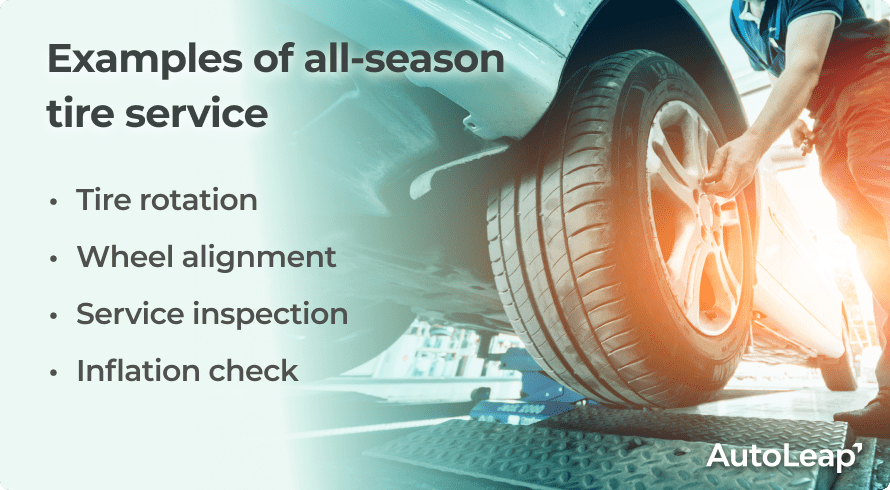
Now you can order the best tires from the abovementioned brands. But your shop needs to also offer essential maintenance to maximize your profits.
Here are examples of tire maintenance and service you can provide your customers.
Proper inflation
Check and adjust tire pressure to the vehicle manufacturer’s recommendation at every service visit.
Inflated tires will improve their fuel efficiency, handling, and tire life. And your customers will appreciate your shop for providing this service.
Tire rotation
Rotate tires according to the manufacturer’s recommended interval, typically every 5,000–8,000 miles, to promote even tread wear. This will provide a strong revenue stream for your business. For your customers, it will ensure even wear across all tires and extend their lifespan.
Visual inspections
Inspect your customers’ tires for signs of damage, bulges, cracks, or punctures. Check for damage, bulges, cracks, punctures, and tread depth during routine visits. Also, check the tread depth using a gauge to ensure safe levels of traction.
Wheel alignment
Align your customers’ wheels as needed or when they bring up uneven tread wear, steering issues, or their vehicle pulling to one side. Proper alignment will ensure optimal handling and tire longevity.
Safe driving habits
Encourage safe driving habits with your customers. Bring up how sudden stops, starts, and sharp turns can affect the lifespan of their tires. Gentle braking and acceleration will reduce tire wear and tear. Also, warn against driving over potholes and other road hazards that could damage their tires.
Wrapping up
There you have it! We hope these brand recommendations for all-season tires help your shop optimize its inventory.
FAQs
What is the best tire brand for all seasons?
Determining the best all-season tire brand is challenging due to varying preferences and needs. Well-known tire brands such as Michelin, Bridgestone, and Goodyear have good seasonal options.
Which tires are best, all-season or all-weather?
All-weather tires perform well in both summer and winter, making them versatile options. All-season tires work well in different conditions but may serve you better in extreme winter or summer conditions.
How do all-season tires differ from other types of tires?
All-season tires perform well in different weather conditions, including light snow and rain. In contrast, summer tires offer optimal grip in warm conditions, while winter tires are perfect for icy and snowy environments.
Can you use all-season tires all year?
Yes, all-season tires handle a variety of conditions throughout the year. However, their performance may be better than specialized tires in cold or hot weather. So, thinking about your local weather and how you drive is essential.