



When new auto repair shop owners purchase the wrong tools at an early stage. They don’t realise what they will actually need to repair. So the cost of starting an auto repair business quickly adds up. The list of auto repair shop equipment should be practical and useful. It should be based on the type of services the shop will provide from the beginning.
The mechanic shop equipment list below has been broken down into different categories. Starting with the mechanic shop equipment, cost range, priority of purchase and what can be held until revenue starts to flow.
1. Equipment Every Mechanic Shop Needs Regardless of Type
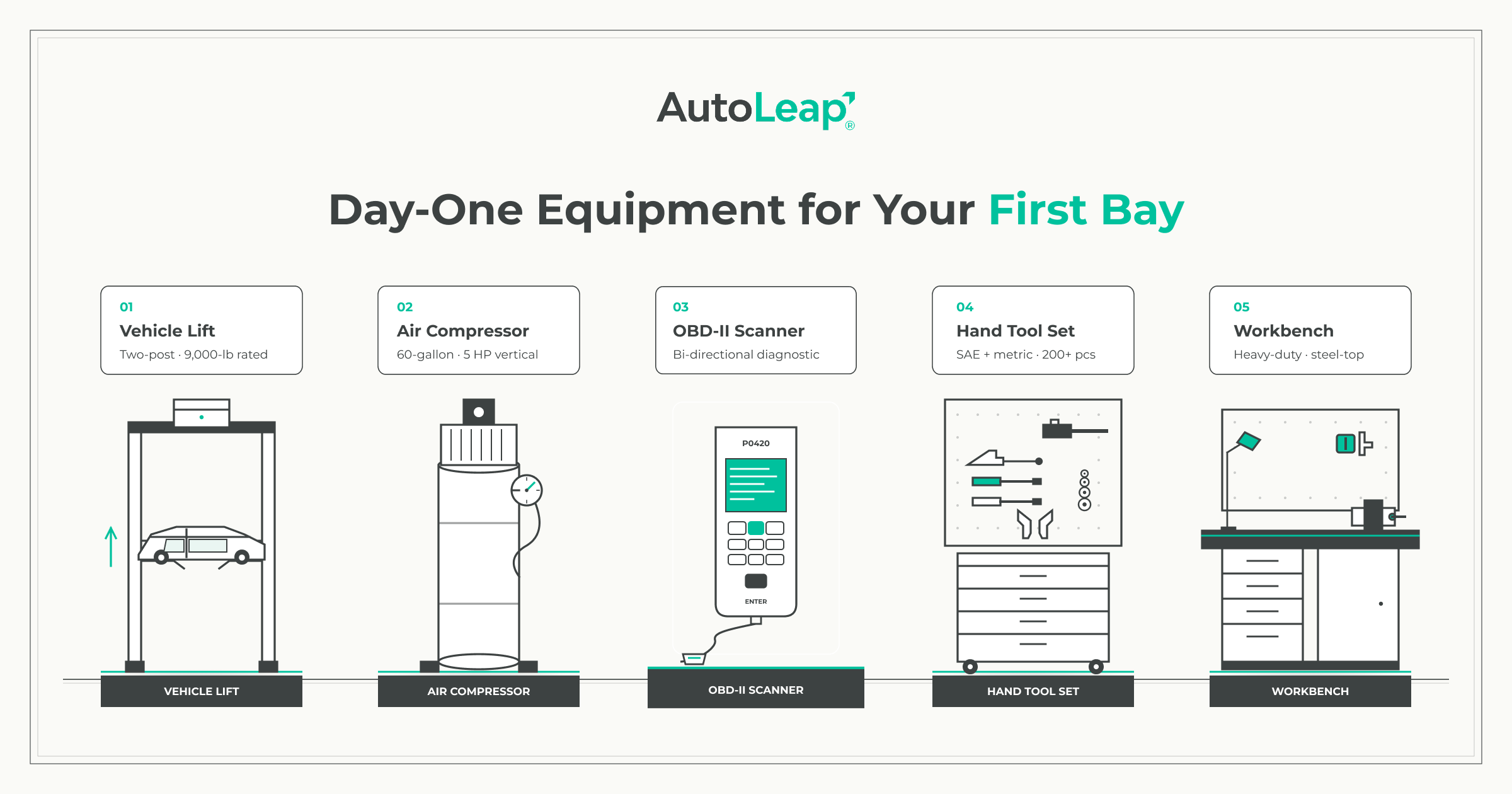
Non-Negotiable Day-One Equipment for Any Shop
There are certain essential tools that every repair shop should have. Even before it can get to work on its first repair job. Repairs, tires, diesel or performance are the basic tools that allow basic vehicle servicing to take place. What’s required for every shop:
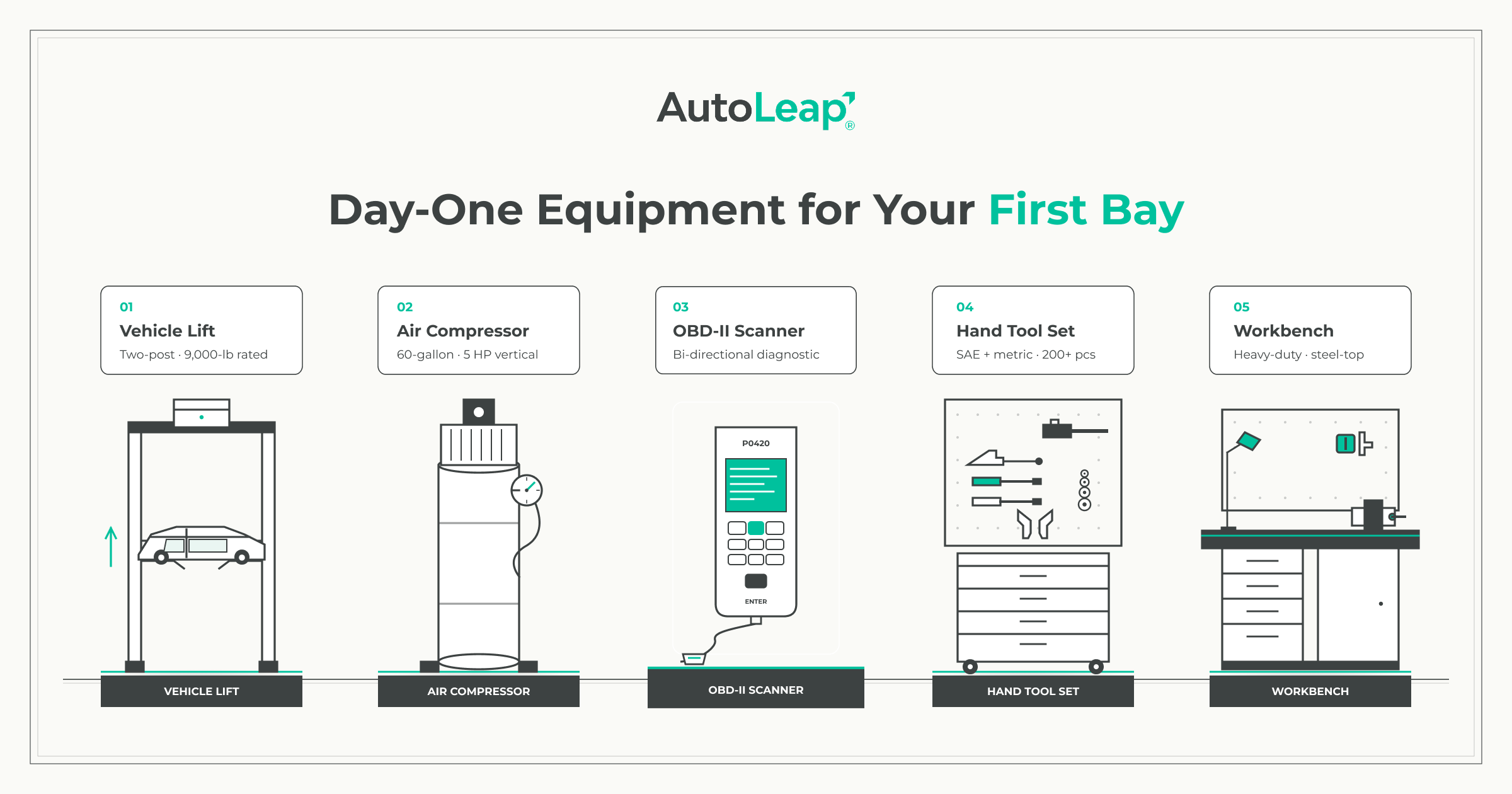
- Professional vehicle lift,
- 60+ gallon air compressor
- Pneumatic impact tools,
- Professional OBD-II diagnostic scanner
- A complete hand tool set and a workbench with a mounted vice
The shop can not complete a normal repair safely without these tools.
The vehicle lift should be the first major purchase. This improves labor efficiency because the number of jobs worked per day increases. A two-post lift offers full access under the car to perform brake maintenance, suspension repairs, and exhaust service. They can do inspection tasks and require less floor area than four-post lifts.
Shops that do not have a lift spend more time on each repair. They may be unable to complete jobs that demand access to the underbody.
The second purchase priority is the air compressor. Pneumatic tools are used daily working on tires, suspension assembly, wheel removal and teardown. A compressor with a minimum capacity of 15–20 CFM and with a 60-gallon or more tank size is a good choice.
Today’s repair work requires a professional-level OBD-II vehicle scanner. Shops can accurately diagnose vehicles using professional scanners. This is because it has bi-directional controls and manufacturer-level access.
Scanners designed for entry-level use are only able to retrieve basic fault codes. They don’t provide the manufacturer-specific diagnostics required for drivability, ABS, transmission or electrical problems.
The full collection of hand tools is next on the purchase list. All techs must have professional-quality ratchets, sockets, and combination wrenches. Also, pliers, pry bars, screwdrivers, torque wrenches and speciality fasteners too. Consumer tools often crash when used at work, leading to downtime.
The Auto Care Association (ACA) estimates start-up equipment costs for independent repair shops range from $50,000 to $75,000. This figure should be considered as a capital allocation policy and not as a shopping list.
Shops investing in equipment with higher productivity gains first will make a profit sooner. Compared to those investing in speciality equipment before they have enough customers.
The specifications are as important as the equipment itself. Vehicle lifts must be ALI certified for safety compliance. Compressors need to run at pressure at all times without being overcycled. Active support and manufacturer-specific coverage of diagnostic scanners are important.
Inadequate professional equipment results in liability problems, early equipment failure and replacement costs. This can get expensive in the first year.

Mechanic Shop Equipment Comparison by Shop Type
| Equipment | General Repair | Tire Shop | Mobile Mechanic | Specialty Shop |
|---|---|---|---|---|

Vehicle lifts |
Two-post lift for most repairs; add scissor lift for inspections | Two-post lift for tire and brake service | Not required. Portable jacks and jack stands for field work | Heavy-duty lift or alignment rack based on specialty work |

Tire equipment |
Tire changer and balancer are optional as service demand grows | Essential for day one: Tire changer and wheel balancer are core tools | Portable inflator, plug kit, and basic light tire tools | Depends on niche; performance shops often need balancing equipment |

Diagnostic scanner |
Professional OBD-II scanner with live data | Scanner for TPMS resets and basic diagnostics | Compact scanner that travels easily between jobs | OEM-level or manufacturer-specific diagnostic tools |

Air compressor |
60-gallon compressor supports daily shop operations | High-CFM compressor for continuous tire service | Portable compressor paired with cordless tools | 60-gallon or larger compressor for specialty equipment |

Specialty equipment |
Brake lathe and fluid service machines add revenue | Road force balancer improves ride quality | Portable battery tester and compact service equipment | EV tools, welders, strut compressors, or niche-specific equipment |

EV/ADAS readiness |
EV-safe tools and scan capabilities are increasingly valuable | TPMS and basic EV safety equipment are useful | Insulated hand tools and EV-safe procedures help expand services | Essential for EV, hybrid, and advanced vehicle specialists |

Mobile setup |
— | — | Service van with power supply, storage, and inventory | — |
General Repair Shops
General repair facilities need the broadest mix of equipment. This is because they handle everything from diagnostics, brakes, suspension and maintenance work. The focus is on versatility and scalability. This makes it important to invest in general repair shop tools that support a wide range of vehicle services.
Tire Shops
Tire shops rely on specialized tire service equipment. From day one, they need tire changers, wheel balancers, and high-capacity air systems. Their equipment investment is concentrated around speed, throughput, and tire-related services.
Mobile Mechanics
Mobile mechanics prioritise portability over fixed-shop infrastructure. They depend on service vehicles, compact diagnostic tools, cordless equipment, and mobile mechanic software that allow them to perform repairs wherever the customer is located.
Specialty Shops
Speciality shops require equipment tailored to their niche. It can be performance upgrades, diesel repair, collision work, European vehicles, or EV service. Their equipment profile typically includes manufacturer-specific tools and advanced speciality equipment.
PPE and Safety Equipment: Essentials for any Auto Repair Shop
Personal protective equipment (PPE) is one of the shop investments that protects both your technicians and your bottom line.
Many shop equipment lists treat PPE as a small line item. But the right safety gear helps reduce workplace injuries, lost productivity, and workers’ compensation claims. Every repair shop should equip technicians with appropriate tools. All appropriate for hand, eye, hearing, foot, and respiratory protection from day one.
Hand Protection Gloves
No single glove works for every automotive task. Most shops keep several types available depending on the job:
- Nitrile-coated gloves: Best for oil changes, fluid handling, parts cleaning, and general maintenance. All tasks where grip and chemical resistance matter.
- Leather gloves: Protect against heat, abrasion, and rough surfaces during fabrication or exhaust work.
- Impact-resistant gloves: These have reinforced knuckle protection for suspension work, seized fasteners, and heavy-duty repairs involving impact tools.
- Cut-resistant gloves: Protect against sheet metal edges, broken components, blades, and other sharp materials.
For brand selection: Mechanix Wear is a popular entry-to-mid-range option. These gloves are priced between $15–$35 per pair.
Ironclad sits in the mid-to-professional range and costs $25–$50. For heavy-duty industrial use, Youngstown Glove Company products often range from $40–$80+. These are known for durability and advanced cut-resistant designs.
Eye Protection
Standard safety glasses are sufficient for most repair and maintenance work. These work well where the primary hazard is flying debris. If shop tasks include grinding, wire brushing, chemical handling, brake cleaning, or working around airborne dust. Then, technicians need sealed safety glasses or goggles for additional protection.
When buying eye protection, look for the ANSI Z87.1 marking on the lens or frame. This designation indicates the eyewear meets impact protection requirements established for occupational use. Some products may also carry a Z87+ marking, indicating enhanced impact protection.
Hearing Protection
Technicians underestimate long-term hearing damage because noise exposure builds gradually over the years. Common shop equipment can regularly exceed safe exposure levels. These include impact guns around 100–103 dB, angle grinders near 95 dB, and air compressors around 85 dB.
Hearing protection is rated using a noise reduction rating (NRR). Disposable foam earplugs provide an NRR between 29 and 33. This makes them a practical choice for all-day wear.
Earmuffs provide NRR ratings between 22 and 30. These are used during grinding, fabrication, or other high-noise tasks. This is because they can be removed and reinstalled quickly.
Footwear Protection
Safety footwear is essential in a repair shop. Reason? Dropped parts, heavy tools, slippery surfaces, and sharp debris.
Steel-toe boots provide maximum durability but conduct heat or cold more readily. Composite-toe boots are lighter and do not conduct heat easily. These are preferred in auto shops where metal detectors are used.
Look for footwear meeting ASTM F2413. The industry standard covering protective toe-cap performance and workplace hazard protection. Popular choices among technicians include Red Wing, Timberland PRO, and Wolverine. All of which offer models designed specifically for automotive work.
Slip-resistant soles are strongly recommended because oil, coolant, and water are common shop-floor hazards.
Respiratory Protection
Respiratory protection becomes important when technicians are exposed to airborne particles, chemicals, or fumes. Common examples include spray painting, solvent-based parts cleaning, and exhaust gases from vehicles running indoors.
For dust and particulate hazards, an N95 respirator is sufficient. Half-face respirator with organic vapour cartridges works best for solvent vapours, paint fumes, and chemical exposure.
It’s important to understand that an N95 respirator filters particles but does not protect against chemical vapours or solvent fumes. Matching the respirator to the hazard is critical for effective protection.
Equipment That Can Wait Until Revenue Is Established
One of the biggest mistakes is overbuying a wide variety of tools before opening the doors. Several pieces of equipment can be useful, but are not necessary to start servicing. As customer demand grows, brake lathes, welders, wheel alignment systems, strut compressors, and A/C recovery machines can be purchased.
In fact, one area where equipment does not need to be adjusted to the actual car count is a wheel alignment machine. A system to align the trucks has a price of $5,000 to $15,000 and will need a special bay.
Your shop has fewer than 8-10 alignment jobs performed per month. It is advised to hire a local specialist for the alignments until the volume grows and requires one.
Brake lathes and A/C machines are similar. In the first year, many new shops leave the job of rotor resurfacing and refrigerant recovery. This is done to retain startup capital. This is the same for welding equipment. Welding equipment can be held for when there is some demand, and it is not already part of the workflow.
The objective for the startup period: earn revenue with the highest value equipment first. Those who wait for revenue to even out tend to have better cash flow. They don’t incur the expense of financing equipment that sits idle for months.
2. General Repair Shop Equipment Checklist
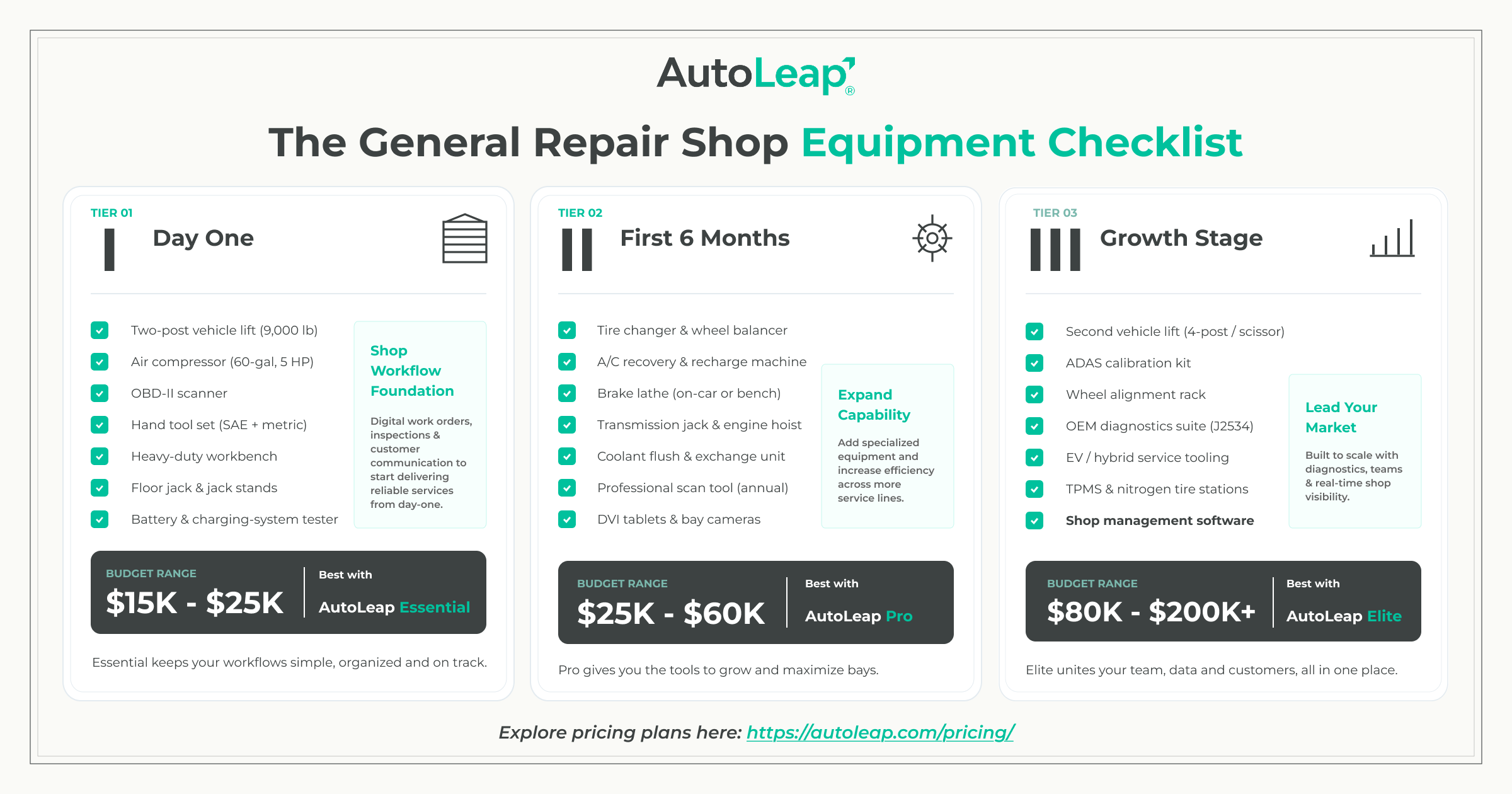
Complete Equipment List for a General Repair Shop
A general repair shop will need the most versatile mechanic shop equipment. From diagnostics and brakes to suspension, fluid services and routine maintenance. The list of equipment is based on its operational priority, not on the ease of purchasing.
Tier 1 equipment consists of tools to undertake the normal repairs in an instant. Typical general repair shops will spend about $25,000 to $40,000 during this phase. The core setup consists of
- One two-post lift for $3,500 – $7,500
- Professional OBD-II scanner for $1,500 – $3,500
- 60+ gallon air compressor
- Pneumatic tools for $1,500 – $3,000
- Complete professional hand tool set priced $2,000 – $4,000
- Workbench with a vice priced around $500 – $1,200
- PPE and safety equipment priced $300 – $600.
The two-post lift is the most versatile first lift purchased by the general repair shop. This is because it covers the widest variety of repair tasks with a small floor space.
A single lift system is used to service the brakes, repair the suspension, inspect the steering system and service the exhaust system. There is no better return in use than a few other items.
One other area where the shops tend to underinvest is in the size of the air compressor. Let’s say the repair shop is using several pneumatic tools. Then, 15-20 CFM at 90 PSI is required. Inconsistent airflow from compressors decreases technician efficiency and wears down air-powered tools.
Tier 2 equipment is installed in the first six months after opening and is, on average, an additional $15,000 – $25,000.
Shops install a second lift, wheel balancer, tire changer, fluid management tool and A/C recovery machine. A second lift greatly improves throughput and permits multiple techs to work concurrently.
Tier 3 equipment is purchased for growth and increases service capabilities. Shops typically invest a further $10,000–$20,000 once they have the justification of vehicle count. These include wheel alignment systems, brake lathes, welders, and strut compressors.
Many shop owners are beginning to buy alignment systems too soon. This is because, on paper, they look like a great deal of money. Machine expense, calibration needs and exclusive bay space are not cost-efficient. This is until the volume of use justifies the investment. It is still a better economic choice to subcontract the alignments for lower-volume stores.
3. Tire Shop Equipment Checklist
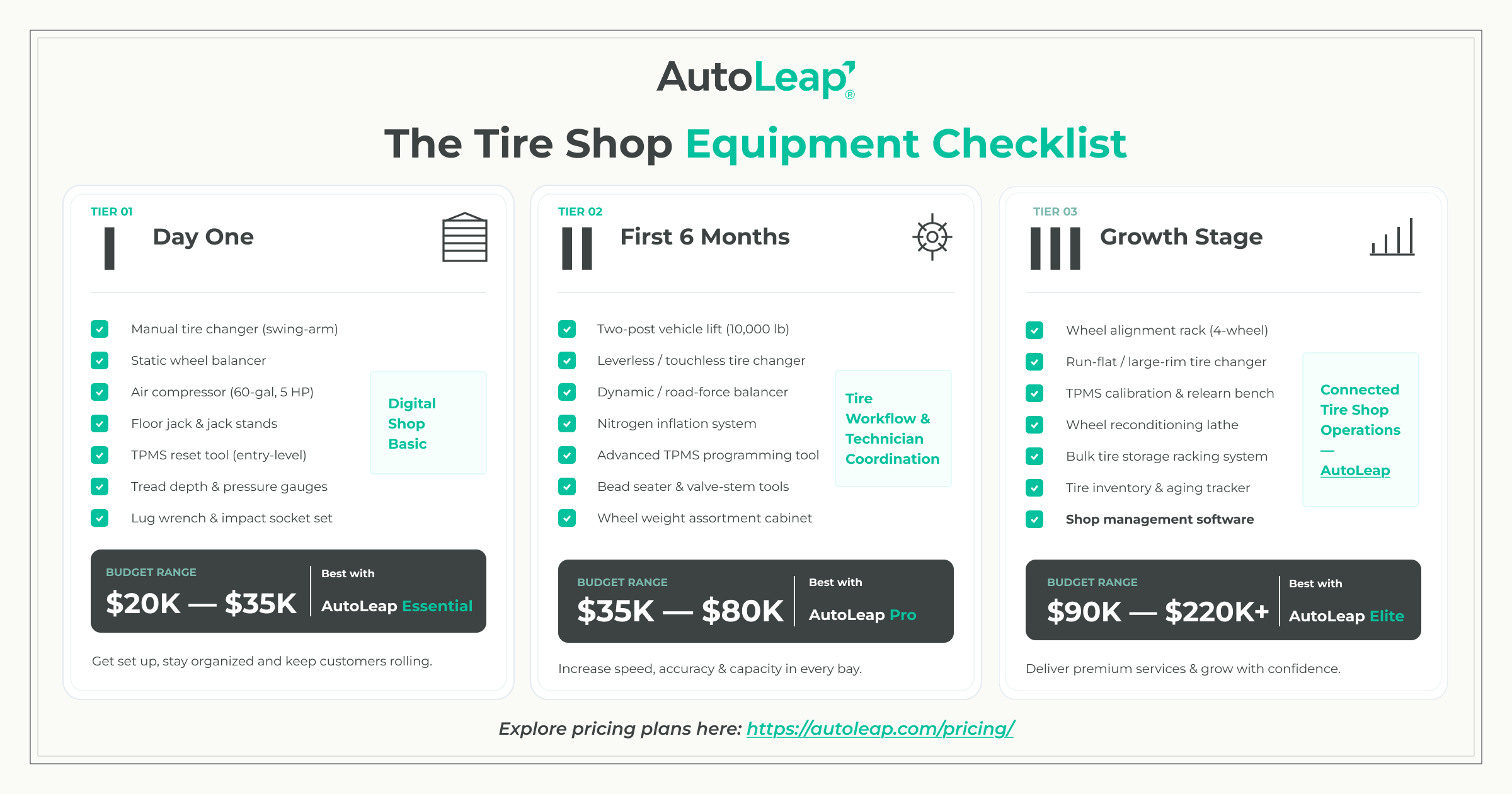
Complete Equipment List for a Tire Shop
A tire shop is unique and relies heavily on speed, wheel protection and TPMS functionality. A complete tire equipment list should focus on efficiency and damage-avoiding tire handling.
Tier 1 tire shop equipment typically ranges from $18,000 to $30,000. It consists of a tire changer, wheel balancer, TPMS diagnostic tool, 60+ gallon air compressor. Along with hand tools, torque wrenches and safety equipment.
The price of tire changer machines varies from $2,000 to $6,000. This depends on the style and the type of wheel it is designed to accommodate.
The most critical first-day purchase for a tire shop is a TPMS diagnostic/relearn tool. The procedures for tire pressure monitoring systems vary among manufacturers. Many manufacturers will not install them without performing a proper relearn procedure. Then the customer will see a warning light immediately after service.
Tire shops that are unable to do TPMS relearns often lose customer trust. Customers will take vehicles to other shops to complete the job properly.
Tier 2 equipment is installed in the first six months. It consists of a vehicle lift, nitrogen inflation system, and tire storage system. Lift is valuable when a shop adds in brake inspections, rotations and suspension evaluations.
Tier 3 purchases are high-end service features. It consists of wheel alignment systems and road force balancer improvements. This is for luxury wheels and low-profile tires.
The type of tires to be replaced is proportional to the range of customer vehicles. For lower volume jobs and standard passenger cars, swing arm tire changers are adequate. Tilt-back changers are ideal for busier stores.
Low-profile tires, run-flat tires, and luxury wheels will require leverless and semi-leverless changers. This is because they minimise the risk of damage to the wheel during the change process.
A tire shop regularly services SUVs, luxury vehicles and performance wheels. But without a leverless or semi-leverless changer. This increases the risk of costly wheel damage claims. Premium tire equipment can cost more, but it saves on repair liability.
What a Tire Shop Needs That a General Repair Shop Does Not
Some tire shops use equipment specifically for precision and speed of mounting tires.
- Road force balancers
- Bead blasters
- Tire inflation cages
- TPMS programming tools
- Speciality mounting systems
Tire shops also require much higher demands of the air systems. Why? Tires are inflated, bead seated, and pneumatic changers run continuously during the day. The reliability of compressors directly affects the speed of service and technician productivity.
4. Speciality and Mobile Mechanic Shop Equipment
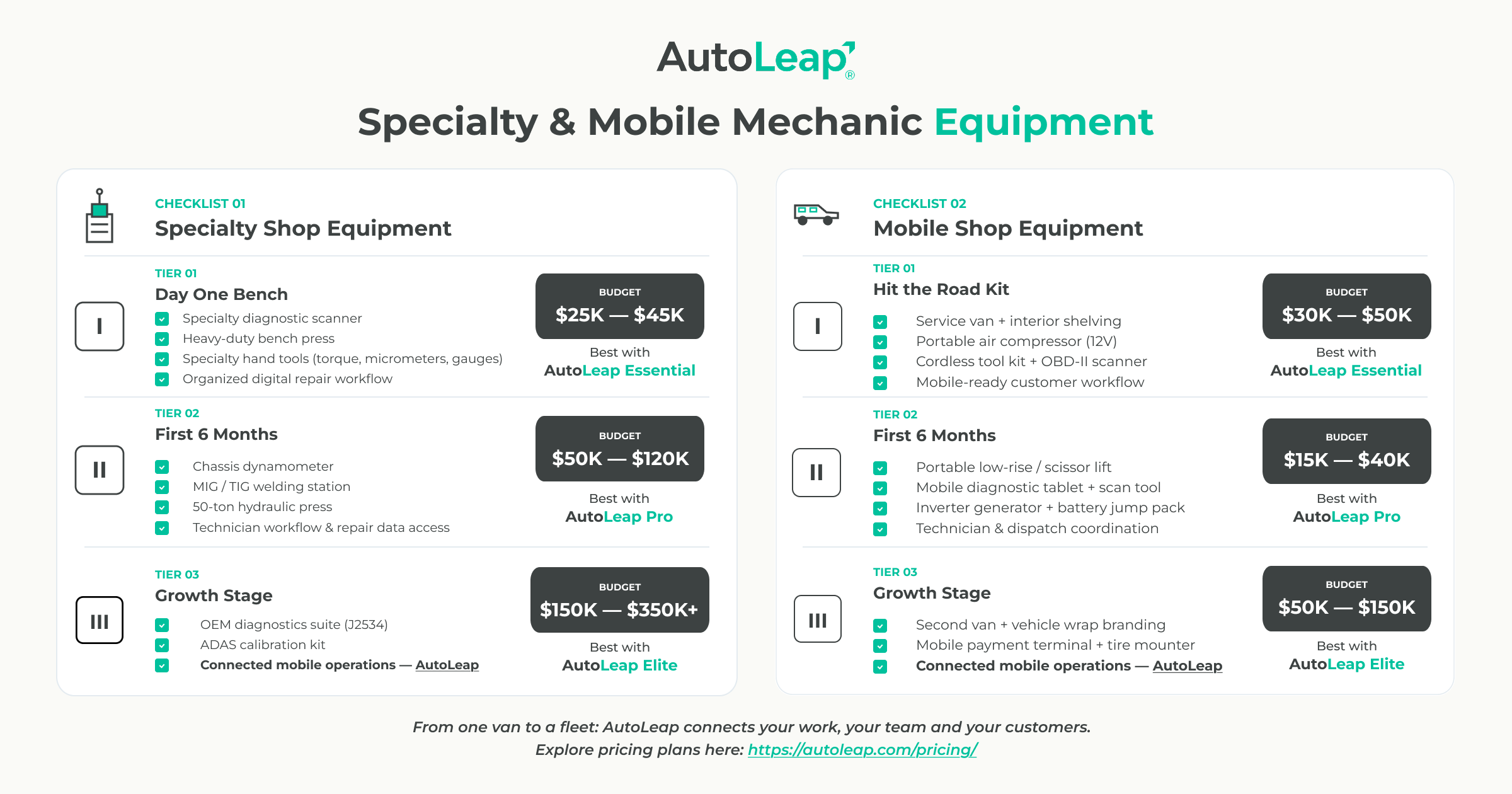
Speciality Shop Equipment: EV, Diesel, and Performance
Speciality repair shops need specialised equipment. It is matched to the distinct systems used in vehicles. There are essential repair tools for any EV, diesel or performance shop. But the number of tool categories required is different for each of these services. A performance shop may never need some of the essential tools for an EV shop.
High-voltage safety equipment is required in EV shops before the work begins. Additional equipment includes a 1,000V-rated insulated tool set in accordance with IEC 60900. The set comes with high-voltage safety gloves (Class 0), a CAT III/IV-rated digital multimeter and a high-voltage safety work zone with floor markings and barriers. Shops should also have 1 or more Level 2 charging circuits in an EV service bay.
There is increasing EV adoption in the U.S. market. EV readiness has become an imperative of the near future, not the distant future. However, battery replacement is becoming more common for EV shops. Even non-battery shops see EVs in their brake service, suspension, and tire replacement.
Diesel shops require diesel-specific scan tools that provide manufacturer-level software access. They also need injector testing equipment and diesel compression testing systems. These tools are designed for heavy-duty applications. Common automotive diagnostic equipment doesn’t offer the broad coverage necessary for today’s diesel systems.
Fabrication and precision measurement equipment are important for performance shops. Tuning and custom fabrication projects require:
- TIG or MIG welders
- Precision micrometres
- Dial indicators
- Engine dynamometer
Dynamometers are expensive to install and calibrate. These are large pieces of equipment, so shops rent instead of buying them.
Mobile Mechanic Equipment: What Fits in a Van and What Gets Left Behind
Mobile mechanics are not limited to equipment. All of the equipment must be mobile, meaning battery-operated or small enough to fit in a service van.
The basic mobile mechanics kit contains a professional scanner, cordless impact wrench with multiple battery packs, a rolling hand tool system, hydraulic floor jack, jack stands, portable work lights and a compact portable air compressor. Cordless tools are also important to mobile mechanics because they don’t require large compressors and external power sources to operate.
The services a mobile mechanic can provide are limited by the portable equipment they have. The mobile model is ideal for oil changes, brake jobs, diagnostics, battery replacement, starter replacement, and light suspension work.
But a few types of equipment are not practical for van operations. Vehicle lifts, tire changers, alignment systems, and large stationary compressors are all examples of items that need to be mounted permanently in a concrete block or require 220V power or stand-up space. Mechanics working in mobile shops that buy in tools without owning a shop have tools that they cannot use on the road.
6. Equipment Budget by Shop Type: What to Expect to Spend
Total Equipment Budget Ranges for Each Shop Type
The price of equipment can differ greatly, depending on the services the shop intends to provide. The most expensive initial investment for general repair facilities includes diagnostics, lifting equipment, tire services, and speciality repair tools.
The total equipment cost for a fully-equipped general repair shop is typically $45,000 to $85,000. Typically, that budget is for two lifts, professional scanners, compressors, tire equipment, alignment systems, speciality hand tools, and shop infrastructure.
When considering startup capital, tire shops generally have lower costs, and a full shop can be as low as $25,000 to as high as $50,000. This depends on the amount of wheel service provided. Higher quality tire businesses selling luxury and performance vehicles tend to spend more on their tire changers and road force balancing equipment.
Speciality EV repair shops typically range between $35,000 and $70,000. They provide typical repair equipment and facilities with insulated tooling, safety equipment, and charging systems.
Mobile mechanical services will still be the cheapest way to get into the business. Most mobile configurations start at $8,000 and go up to $20,000, depending on the vehicle size, cordless tool investment, and the level of diagnostic capabilities.
In addition to the lift, other expenses for shops that have to budget for lifts are shipping, electrical and installation fees. Many people do not know the true installed cost of lifting equipment. The cost of a lift of $5,000 might just become $7,000 – $9,000 when freight, concrete testing, electrical work and professional installation are added.
For a broader financial picture, this guide to total startup costs for opening an auto repair shop outlines additional expenses beyond equipment, including facility costs, licensing, and operational setup.
New vs. Used Equipment: When Buying Used Makes Financial Sense
When a used equipment buyer understands what type of equipment can be bought second-hand and what type of equipment cannot, the startup cost could be drastically reduced.
The most valuable piece of equipment can be a vehicle lift. If the lift is ALI certified and passes professional inspection, a well-maintained two-post lift removed from an existing shop can sell for 40-70% of the price of a new lift, with the lift lasting for years with proper maintenance.
A tire changer and wheel balancer can also be a good buy. If the accuracy with which the tires can be calibrated can be guaranteed and replacement parts are still available from the manufacturer.
A scanner that doesn’t have any software to support it is quickly outdated. Diagnostic scanners tend to be second-hand items, and software subscription and manufacturer access licenses are typically only valid for the original purchase.
Whether it is a new purchase or a used piece of equipment, there are three separate cost elements to be considered in every budget: equipment purchase price, shipping and delivery cost, and installation or site preparation cost.
When installation costs come in, it can cause cash flow issues for shops that take only the sticker price. The proper equipment configuration is ultimately dependent on the business being established, the customer base served and the business’s bottom line. Having time to make strategic purchases rather than all-at-once purchases results in a more solid profit stream for most stores.
Conclusion
While having the right equipment for the right shop type provides the foundation for operation, equipment functionality is equally important. Systems must be in place that connect technicians, service advisors and shop owners in real time, to schedule repairs, track parts, build estimates, and invoice customers. Auto repair shop management software is an option for shops seeking to make their daily operations more efficient.